
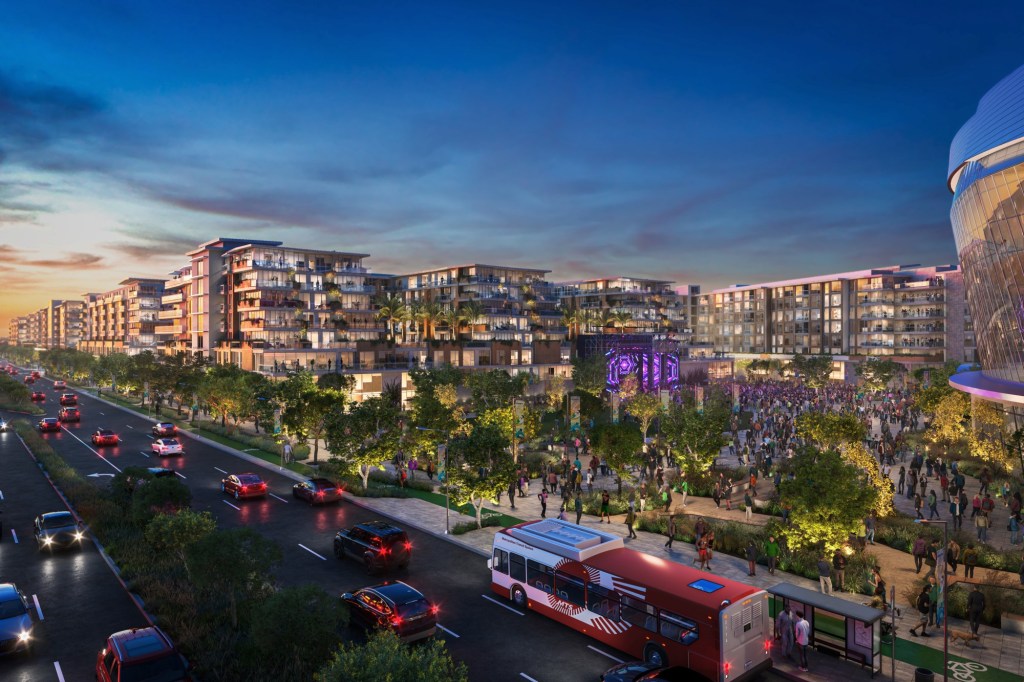
The progress of Midway Rising, the massive Sports Arena redevelopment project with a potential price tag of $3.9 billion, has been a history of bait-and-switch tactics.
On July 15, 2022, the San Diego City Council cleared the way for Proposition C to allow voters to remove the 30-foot height limit in the Midway/Pacific Highway Community Plan. Members approved the Supplemental Environmental Impact Report analyzing the effects of a 65-foot-high development. A judge had required the additional analysis to address deficiencies in the original environmental documents. At the hearing, a council member stated that the 65-foot height limit in the zoning code/community plan would be the cap if Proposition C passed.
Two months later, on Sept. 13, at Mayor Todd Gloria’s behest, the council selected Midway Rising with a proposed 86-foot height limit (not 65 feet) for the mixed-use portion of the Sports Arena project. Prior to the Proposition C vote, Midway Rising was asked at the Point Loma Association if it would go above 86 feet if offered several million dollars for an ocean-view unit on the 20th floor. A representative responded that its proposal was for 86 feet in height.
At least, that was the bait to help get Proposition C passed. In November 2022, Proposition C was approved to remove the height limit with no height cap. In April 2025, Midway Rising switched to asking for a 250-foot height for luxury units. Bait and switch.
Were voters for Proposition C misled with a theoretical 65-foot height cap? It passed by only 9,000 votes or 2%. Would some voters have changed their support if they knew it would allow a 250-foot-tall structure?
In September 2022, Gloria and City Council members said they selected Midway Rising because it proposed the most dwelling units and affordable units — 4,254 residences, with 2,000 “affordable” units and 250 “moderate-income” units as the bait. The proposal was 60% more dense than the current zoning/community plan allowed.
Yet, on Oct. 2, 2023, came the switch. Midway Rising said that it could not afford to build the 250 moderate-income housing units. Did the mayor and council know that Midway Rising was going to propose 250 high-end luxury units when they removed the moderate-income requirement? If Midway Rising can afford to build 250 luxury units, then it should be able to build the 250 moderate-income housing originally proposed. Bait and switch.
Instead of using a zoning that would allow the proposed dwelling units with a height limit of 100 feet, which accommodates Midway Rising’s original proposal, Midway Rising is now asking for mixed-use zoning to allow 240 feet in height and a specific plan to get an extra 10 feet for a total of 250 feet. Bait and switch.
In yet another switch, Midway Rising is requesting the removal of the “overlay zone” on the property, which would require public and environmental review for future changes to the project. Midway Rising could then use the Complete Community Housing Solution policy — adopted in December 2020 — to ignore the general plan, community plan, zoning, height limitations and density without public or environmental review because it is building housing considered affordable in a transit area. According to the city’s 2024 housing report, incentives (loopholes?) like this have allowed developers to build 280% to 1,000% greater density on sites than allowed by community plans without any environmental or public review. What future changes does Midway Rising have in mind? Bait and switch.
Midway Rising has indicated that it plans to move forward using state law loopholes as is being done with Kalonymus’ proposed 23-story development in north Pacific Beach to circumvent a recent court decision voiding Measure C.
Was selection of Midway Rising actually a tacit future approval by the mayor and City Council of a rezoning/community plan amendment without even knowing the new environmental impacts? Interestingly, the council approved the Complete Community Housing Solution eliminating public/environmental review about a month after the original, later-invalidated 2020 Measure E removed the height limit in the Midway/Pacific Highway Community Plan.
Thus, no environmental impacts, such as infrastructure, traffic, air quality, noise, height, etc., would affect the council’s approval of a housing/affordable project in a transit area. Prior to the Measure C vote in 2022, did San Diegans have any idea what its passage would lead to? Of course not.
Ziebarth is a retired architect who volunteered for 27 years as a member of the Citizen Advisory Committee for the Zoning Code Update and the recipient of a Lifetime Achievement Award from the American Institute of Architects San Diego. He lives in Point Loma.