
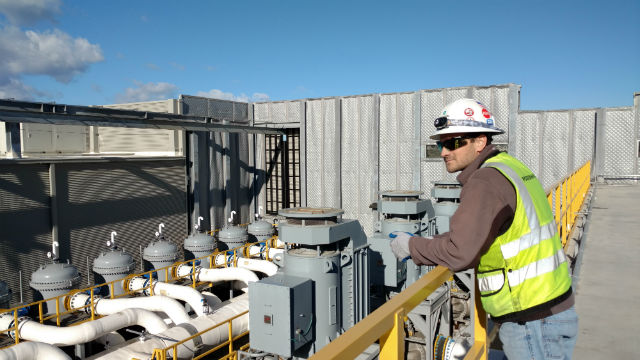
 Chris Stiedemann of Poseidon Water looks over the giant filers that remove microscopic impurities from the seawater. Photo by Chris Jennewein
Elon Musk: lend me your ear.

Now that you’ve tackled free speech, the national debt and are on your way to Mars, how about taking on two pressing problems on planet earth: rising sea levels and chronic droughts.
I’m not a scientist or engineer, but I’ve run an idea on solving these problems by a few experts — with interesting reactions. The plan is straightforward: vast expansion of ocean desalination plants globally to offset annual sea level rise, utilizing the increased desalinated water produced while storing the rest in lakes, reservoirs and aquifers. The magnitude of water processed to achieve this, and the location of new, massive plants in several continents could eliminate water shortages worldwide.
An MIT-trained oceanographer responded to me: “an intriguing suggestion.” A chemical engineer and former executive of several California water companies called the notion “out of the box.” A UC Berkeley materials science PhD, who was former energy policy adviser to a senator and analyst of climate-related technologies, remarked that he hadn’t “heard of this idea before and had to think about it a bit.”
They all thought the proposal impractical because of the scale and cost of its implementation. But is it? The volume of average annual global sea level rise equals about 1,230 cubic kilometers. The volume of ocean seawater desalinated worldwide per year is approximately 35 cubic kilometers. A 35-fold increase in the volume of ocean water processed by desalination plants would thus offset the annual rise in sea level. Twelve times as much extraction would decrease the rise by more than one-third.
Desalination presently accounts for only about 1% percent of fresh water used worldwide, the output of about 20,000 plants benefiting 300 million people in more than 100 countries. Middle Eastern nations depend heavily on desalination for their water, with Saudi Arabia and Israel at 50%, and Israel projected to reach 70% by 2050.
And the cost of this ambitious plan? The largest plants today can range up to several billion dollars to build and hundreds of millions to operate yearly — the largest expense of which is the fossil fuel that runs them.
But nuclear power and solar are cost-effective energy alternatives, the latter of which is increasingly being utilized. Ideal locations for new mega plants would be areas where solar can be effectively employed, such as the southwestern United States; western Australia; north and southwest Africa; and northern Chile. Another site to consider at this momentous time: the Gaza Strip, where investment in an enterprise of this scope could help bring that devastated land and its inhabitants into an era of peace and prosperity. The desalination process also yields lithium as a byproduct which could provide both a source of revenue and energy for the plants themselves.
Yes, there are environmental challenges with large-scale desalination and water storage: brine disposal, hydrology issues, etc., but experience demonstrates these are manageable.
The hundreds of billions, perhaps several trillions, of dollars in costs of construction and operation need to be weighed against the costs already being incurred because of rising sea levels — flooding, erosion, sea wall construction, wetlands creation — and those looming ahead: managed retreat, increased flooding and the entire loss of low-lying coastal cities and infrastructure. In some scenarios, estimates of the damage wrought by rising sea levels by the end of the century run into several trillion up to fourteen trillion dollars annually.
The economic and social benefits of this increased use of desalination also need to be factored into the equation. Arid land in the developing world could be transformed into thriving agricultural regions, just as California’s Central Valley and Imperial Valley and the west’s Great Plains states have been for more than a century. Death and disease resulting from the ravages of drought, and limited freshwater availability in much of the world could become a thing of the past.
Nations would need to cooperate to achieve the required volume of water processed, but most countries face economic calamity from the effects of rising sea levels and have a shared interest in pursuing a solution to prevent this. Efforts to combat the effects of carbon emissions on climate change can and should continue if this plan is undertaken, but an expansive desalination strategy would have a far more direct and immediate impact on the problem.
Maybe, Elon, you know somebody who could get this done. Someone with substantial experience in construction and deal-making at the highest levels. Someone who, after all the necessary studies and plans have been completed, would be ready to direct the largest building project in history, with the biggest economic and social impacts on mankind since the Industrial Revolution — and positive ones at that.
W. “Michael” Waterman is an author and retired attorney in San Diego County.
READ NEXT