
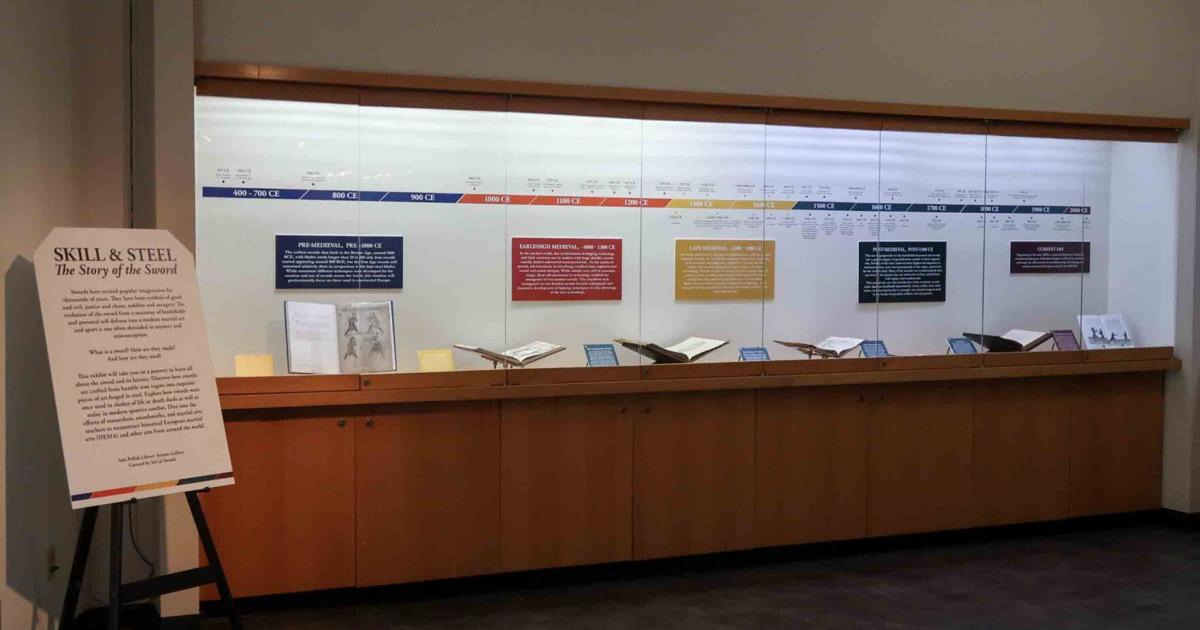
While some say traditional chivalry is dead, the medieval knights’ skill in swordfighting is alive and well, as seen in the Pollak Library exhibit “Skill and Steel.”
Located in the Salz-Pollak Atrium Gallery, on the south side of Pollak Library, the exhibit opens in ancient times, spanning the space in chronological order through medieval times, the Renaissance and finally to modern-day Olympic fencing.
Dan Cheung, the principal curator for the exhibit, said the project is a joint effort with SoCal Swords, which practices Historical European Martial Arts. HEMA’s primary focus is on the study of traditional sword-fighting techniques.
Located in Orange, SoCal Swords is also home to the largest sword-fighting event of its kind, with competitors traveling from all over the world.
“Skill and Steel” tells the story of the evolution in swordmaking, explaining the historical context behind the changes in production that have occurred.
The oldest piece in the collection is an original copy of Salvator Fabris’ book “Lo Schermo, overo Scienza d’Arme,” dating back to 1606. As stated in the exhibit, Fabris was a fencing master of the Renaissance, and the book, whose title translates from Italian to “On Defense, or the Science of Arms,” details “dueling and combat with combinations of rapier, dagger, and cape.”
Amongst the sword collection, there are a few antiques, including an original 18th-century British light-cavalry saber dating back to 1796.
While many of the swords in the collection are reproductions, they can still come at a hefty cost, averaging around $300 and ranging into the thousands, as the production requires meticulous craftsmanship.
“They are made from traditional methods using modern materials,” Cheung said.
Trish Campbell, the exhibit program coordinator at Pollak Library, describes the goal of these exhibits as being focused on visual storytelling.
Campbell leads a committee of five members, who ultimately choose the exhibits that will be presented throughout Pollak Library. The applications for the spaces are sent to Campbell, who along with the rest of the committee, ranks and discusses the applications, calculating their median score. The committee strives for inclusion and variety, showcasing a range of mediums and topics in the gallery.
“The more variety we have, hopefully, people who visit the gallery will eventually find something they really like,” Campbell said.
Matthew Barlund, a senior majoring in computer science at Cal State Fullerton, had never been to the space before. Having an interest in swords, he was drawn to the exhibit in passing and was most impressed by the Highland Sword, number 20 in the exhibit.
“I didn’t know that wasn’t actually called a ‘claymore,’ but I really like that one,” Barlund said. “That was one I always thought I would wield if I did.”
All the items on display have been sourced from the team’s personal collections, including centuries-old books, swords and a section dedicated to blacksmithing. Approximately half of the swords in the collection originated from Cheung’s personal collection.
Cheung described that it took about six months of work to finalize the project, with much of the help coming from volunteers of the club.
SoCal Swords also provided informative pamphlets at the exhibit that highlighted the club’s classes, which run seven days a week.
The exhibit, which has been set up since October, will remain open for another month, with the take-down scheduled for mid-December. The Salz-Pollak Atrium Gallery is changed out on a quarterly basis, with the next exhibit scheduled to open in January.