
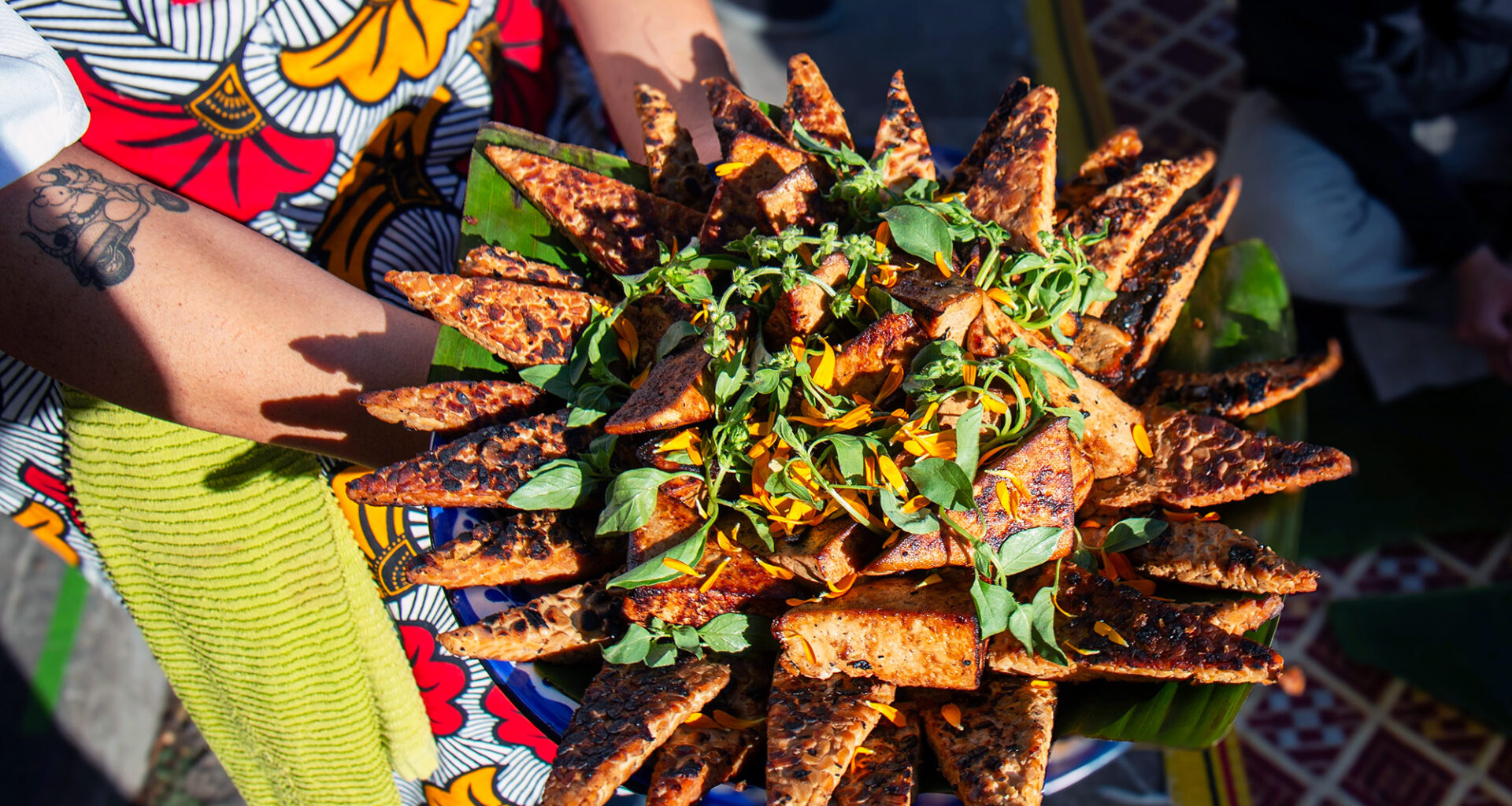
Dakota Pekerti, who runs Kamu Siapa Kitchen, a Berkeley-based Indonesian pop-up and cooking class series, won’t call himself a chef, but he’s spent years cooking for others and helping them develop their own cooking skills and concepts. He teaches small classes of up to four people on how to plan a pop-up event, recipe development consultation, Sambalogy (an intensive study of Indonesian Sambal), and meal prep.
Kamu siapa means “who are you?” in Indonesian. For Pekerti, this means “What food, what culture, has made you?”
Through his classes, he’s helped a lot of people turn their pop-up ideas into a reality. Leila Winn, who is in Pekerti’s grad program at UC Berkeley, is a passionate baker and has always thought about opening a high tea concept. She took Pekerti’s class and then asked if he would help her out the first couple of times, and now has hosted three pop-ups under the name “Cafe Goblin,” all of which have sold out. She now plans to hold quarterly pop-ups — “centering seasonal ingredients, complex tea pairings, and general yumminess.” Follow her on Instagram to stay updated about the next event.
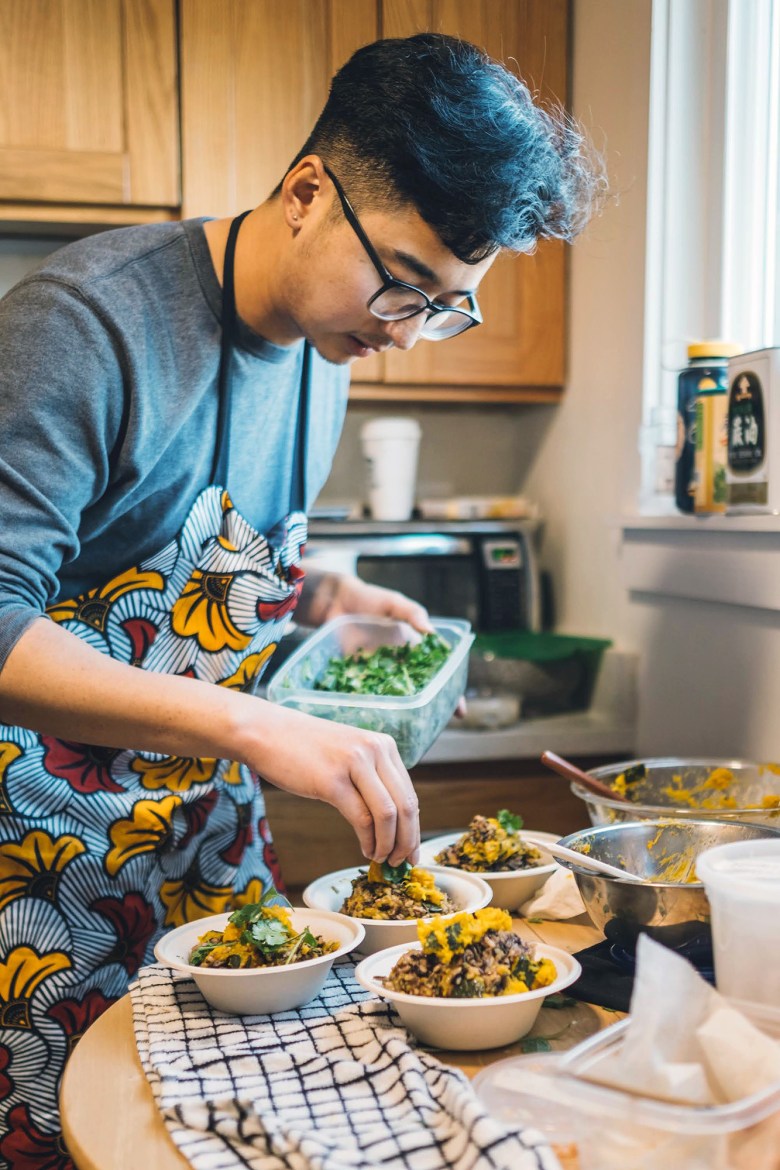 Dakota Pekerti launched Kamu Siapa Kitchen in 2019. Credit: Kamu Siapa Kitchen
Pekerti constantly fosters a community of food-minded people around him through teaching, volunteering his time, and cooking for himself.
Pekerti has been involved in cooking from a young age. The son of Indonesian immigrants to the United States, he grew up in Texas as one of the only Asian families in his neighborhood. His parents are “huge foodies,” Pekerti said.
“Food for them was a way of not just escaping the little bubble we lived in but also keeping a connection to Indonesia,” Pekerti said.
His parents would take him to other parts of the Dallas region to go to Vietnamese, Indian restaurants — other “Immigrant enclaves,” as Pekerti described.
“I was very lucky to get exposed to all these different types of food growing up,” Pekerti said.
There was exactly one Japanese restaurant in his town, Pekerti said, and the family who owned it took his family under their wing. He spent time watching them in the kitchen making tempura, rolls, and other dishes. From this foundation, his respect for food was born.
Since his mom didn’t let him mess around in her kitchen, Pekerti started to cook for himself in earnest while attending Swarthmore College in Pennsylvania, where the dining hall dished up “terrible” food.
“There were some days when it was pretty inedible,” Pekerti said. “And so what I ended up doing was trading in meal plan swipes for ingredients. I struck a deal with the director of the dining hall, and I was just like, ‘please, please, let me buy ingredients off you.’”
The dining hall director agreed, and Pekerti began cooking food for himself, his friends, and other students. This was the start of Pekerti’s “pop-ups.” He even ran a small “Iron Chef-style” competition with other students and the dining hall staff. When he studied abroad in Poland, there was no dining hall, so he took other students under his wing and taught them how to cook.
A couple of years after college, in 2019, Pekerti moved to the Bay Area for a job in the renewable energy industry. Here, his pop-ups started to take off.
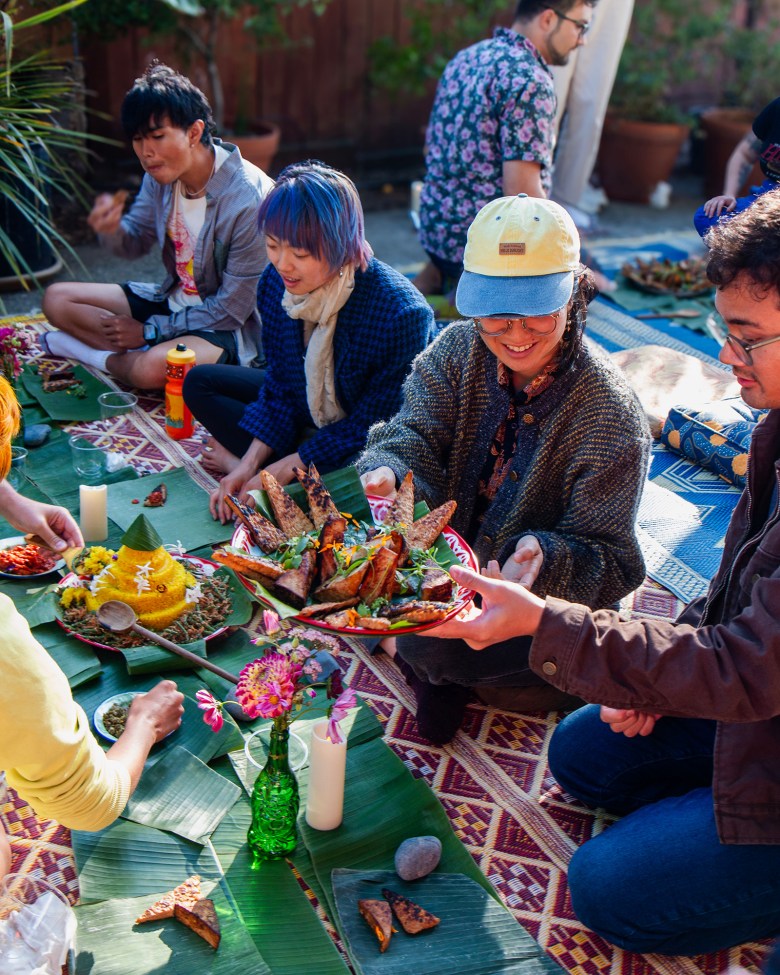 Pekerti’s pop-ups started taking off in 2019 when he moved to the Bay Area. Credit: Kamu Siapa Kitchen
“I just had all these recipe ideas I got from going to the farmers market, seeing all this local produce and just being excited about this whole Bay Area concept of eating seasonally,” Pekerti said.
He started inviting people over to test his recipes. It started off as groups of four to five people, and quickly started to grow. A couple of months in, Pekerti was cooking for groups of 20-40 people and people were telling him that he should really start charging to cover ingredients.
Pekerti worked a full-time day job, and then, once a month, hosted dinner parties.
“I was doing it all myself, just really testing new recipes and getting to a point where it was more like I was practicing the logistics of a larger pop-up on my own and organizing the menu to fit a larger audience instead,” Pekerti said.
It all came to an abrupt stop with the pandemic. Pekerti transitioned to posting cooking challenges on Facebook and invited people to participate. One reason was to raise money, which Pekerti donated to struggling local restaurants and nonprofits. A couple hundred people signed up.
“My path through food has been kind of organic and really just based on the situation at the time and life circumstances,” Pekerti said.
When things started to open back up again, Pekerti wanted to formalize the pop-ups he was doing, and that’s when Kamu Siapa Kitchen was born.
“Because we were coming out of the pandemic, I really wanted this space to be somewhere where people could reconnect and find new connections,” Pekerti said. “And gently drag people back into this idea of being in community again through the food.”
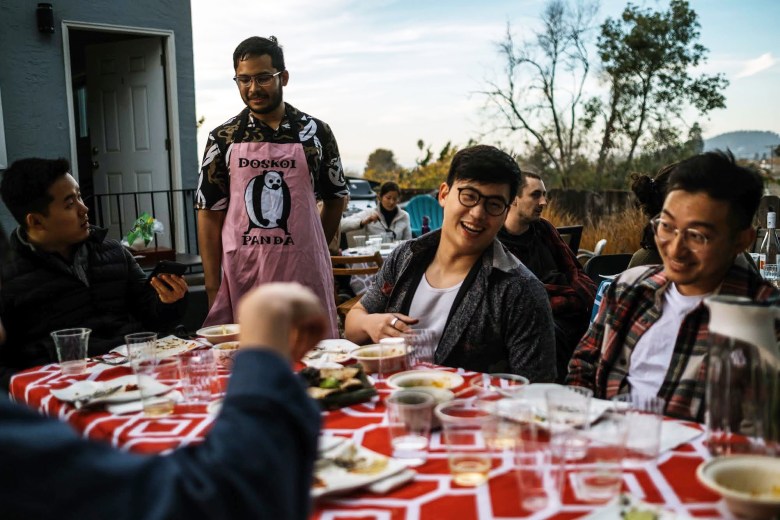 After building a following, including on Facebook, most of Pekerti’s events now sell out. Credit: Kamu Siapa Kitchen
With his Facebook followers and the people who attended his pre-pandemic dinner parties, Pekerti felt that he had enough people to start larger pop-ups. He’d also found friends and other people who were willing to cook with him and support him so that he wasn’t doing the pop-ups all by himself again. Every event sold out.
In 2023, Pekerti left the Bay after being disillusioned by his day job, and used a Fulbright Fellowship he’d been awarded in 2019 but had been delayed due to the Pandemic. He went to Indonesia, which he said was one of the best times in his life. While he was there, he held a pop-up to experience organizing one in another country.
“I barely cooked at all and just learned from street vendors,” Pekerti said. “I was doing what I call a bit of food ethnography, just studying all these ingredients and how they came to be, and the cultural historical implications of them.”
After that year, Pekerti came back to the Bay to attend a graduate program at UC Berkeley in the energy and resources group. With renewed excitement from his time in Indonesia, he was ready to cook again. Instead of returning to the pop-up styles from before, he decided to host cooking classes to ward off burnout.
“I’d been seeing and thinking about the fact that restaurant life and committing yourself wholeheartedly to live your life in food is just so hard,” Pekerti said. “I respect so much all these chefs and families who stake their lives on the restaurant business and make it work and put in the blood, sweat, and tears to do it. And I think throughout all that time, I could honestly say, I wasn’t ready for that.”
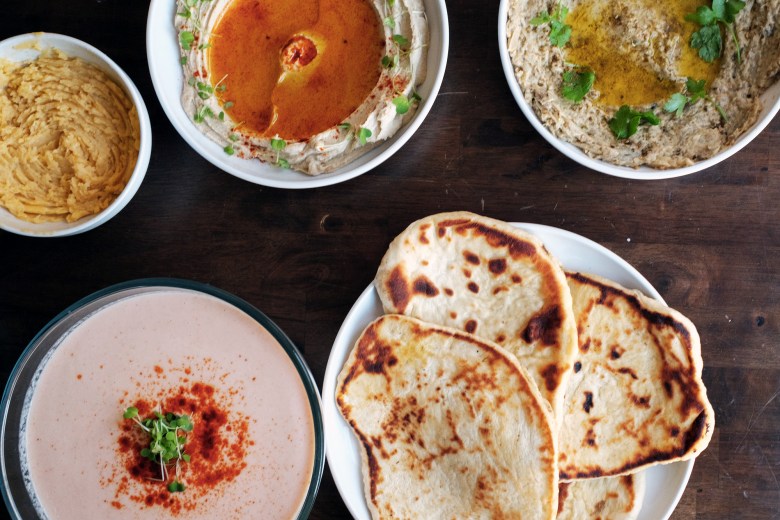 Kamu Siapa Kitchen hosts regular pop-ups and cooking classes, and Pekerti works with others to develop their food business concepts. Credit: Kamu Siapa Kitchen
The cooking classes are also a way for Pekerti to find other people who are invested in food and want to level up their skills or commitment to food as a hobby or potentially as a lifestyle. He also started staging at Chez Panisse once a week.
“I needed to up my skills if I was going to be the one teaching classes or teaching anyone about food,” Pekerti said. “I needed to get better and make sure I knew what I was talking about, which is something that has always been emphasized to me by all these elders that have been working with me from the restaurant industry.”
Now, Pekerti is at a point where he’s thinking about transitioning into committing even more of his life to food and wants to empower other people, like with Winn, who started the high tea concept, Cafe Golbin, to take this same leap into the food industry.
This really has been the core of what Pekerti has been working towards over the years. He doesn’t want a “cult of personality” or to be a leader, but instead to create a self-perpetuating community.
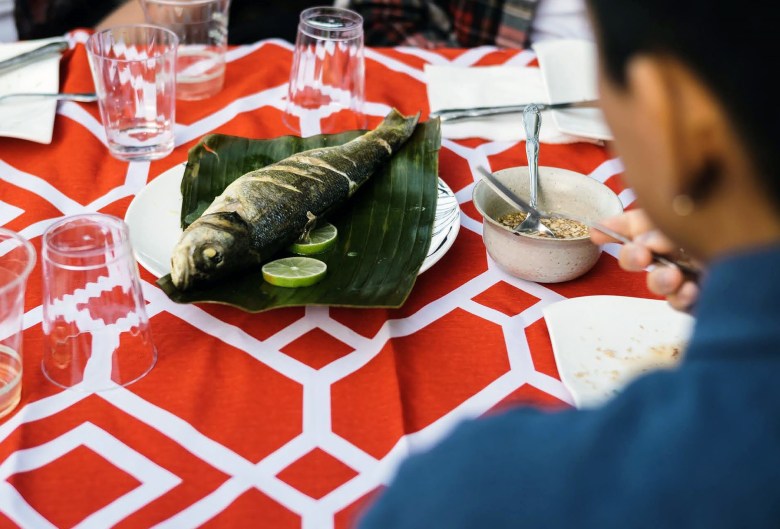 Pekerti has started hosting his own events after a post-pandemic pause, including a monthly “Chef’s Table.” Credit: Kamu Siapa Kitchen
“At the end of the day, I just really want food as a concept and cooking at a scale where anybody can create community in a meaningful way, without having to kill themselves in a restaurant,” Pekerti said. “I’m trying to envision something that is more hybrid between this whole pop-up restaurant concept, that is maybe more sustainable and more grassroots too.”
Pekerti is starting to host his own dinners again, what he’s calling a monthly “Chef’s Table,” and the last one at the beginning of November sold out. He has long-brewing recipes he’s yet to test, so this will be a forum to try his own recipes and get feedback, as well as more facetime with customers. His next upcoming event is a SNAP benefits fundraiser on Nov. 30 at Radically Fit in Oakland, where Pekerti will be making chorizo tacos. Keep an eye on his Instagram, website, and his monthly newsletter for more details on events and classes.
Through all of this cooking and learning and teaching, Nosh asked Pekerti when he would consider himself a chef.
“I think until you see me working in line every day in a restaurant, it is a whole different lifestyle, and a whole different weight to commit your whole livelihood and income and time to food,” Pekerti said. “And so I willingly admit I’m not there yet, but I do feel like I’m at a point where I am really enjoying helping empower people to take that step beyond home chef.”
Related stories
Vote now for the 2025 Nosh Awards
November 11, 2025Nov. 12, 2025, 2:31 p.m.
Cafe and bakery fills empty BAMPFA space with avocado coffees and Indonesian-inspired pastries
October 30, 2025Nov. 1, 2025, 12:07 p.m.
Martinis, missed connections and les eggs: The Oakland bar closure I never wanted to cover
November 7, 2025Nov. 7, 2025, 7:14 p.m.
“*” indicates required fields