
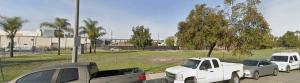

Union Pacific Park 2011

Playground being installed at Union Pacific Park 2025
From Union Pacific to Independence Park, South Fullerton’s story is one of patience —and policy failure.
After 20 years of waiting, Union Pacific Park will finally open, made possible by $350,000 in federal funds, $350,000 in park dwelling fees, and a donated playground. One mother raised her children in that South Fullerton neighborhood, beside a fenced-off, unsafe lot where a park was supposed to be.
Today, she’s grateful her grandchildren may have a place to play. But it shouldn’t take a generation for a park to arrive. That’s not victory—it’s a policy failure.
Research from the Centers for Disease Control and Prevention shows that children who grow up near parks are more active, less prone to obesity, and experience lower rates of anxiety and depression. Parks reduce heat, improve air quality, and give families safe, free spaces to connect. When communities go decades without them, the cost is measured not only in equity gaps but in the physical and mental health of kids.
Fullerton has been treating its south side as an afterthought, where families must wait years for park improvements in an already park-deficient area. Lacking a policy for allocating park dwelling fees, these neighborhoods will keep relying on luck, politics, or charity for basic investments.
What are park dwelling fees? They’re local impact fees collected from new housing developments—often in the millions—to mitigate the strain of growth on local neighborhood parks. But in practice, Fullerton pools all fees from all neighborhoods into one fund, which is spent at the council’s discretion. Despite being mostly generated on the south side, fees are primarily invested in the north side, home to 85% of the city’s open space.
The logic: parks on the south side qualify for state and federal grants due to their “disadvantaged” designation. But these grants are competitive and often denied.
The result: South Fullerton, where most new housing is planned, pays the price twice—denser neighborhoods waiting for parks that never seem to come.
Union Pacific Park is only one example. Independence Park’s gym has been closed for years, waiting for grants. State Senator Tom Umberg secured $1 million toward its restoration, but more is needed. Congressman Lou Correa earmarked $3 million last year in federal funds for Independence Park, only to see it erased by the new Congress.
Again, more waiting—and worse, a child was injured on the old playground before the city removed it. After that, the council allocated $2 million for the park in this year’s budget from the nearly $8 million in park dwelling fees generated from The Hub housing development on Commonwealth and Chapman. But Citystaff have informed me that they now need these funds to complete the gym, with the park only getting a playground.
Meanwhile, Lions Field, on the north side of the city, received $2 million from those same dwelling fees for turf replacement and other upgrades almost immediately upon the turf’s end of life. Acacia Park, also on the north side, got a new playground within six months. The contrast is hard to ignore: some wait a generation, others only months.
What about other deteriorating southside parks or those needing work in the future? We can’t just fix as we go. We must plan now not only for park renovations, but also for adding new parks and open spaces. I’m grateful to our Parks & Recreation Commissioners, who are advocating for a new Parks Master Plan—the last one was made in 1977, then rejected in 2021. Even if a new Master Plan passes, it won’t succeed without a funding policy.
I have proposed a policy to prioritize park dwelling fees in the areas where they’re generated —a nexus. It’s fairness for the whole city: when a development is built in a neighborhood, it should see direct reinvestment in its closest park or toward acquiring new open space. If no reinvestment is needed, funds could be used elsewhere.
I brought this proposal to the council last year, but it was rejected 3–2, with the majority arguing for flexibility in fund allocation. I want all our parks made beautiful, but flexibility without fairness becomes a license for injustice.
We’ll keep working with our state and federal partners to bring resources to Fullerton— but grants, earmarks, and donations are political, unpredictable, and temporary. They should supplement, not replace, our own investments. Residents in the north and south who believe in open spaces, environmental justice, and the basic dignity of every child having access to a park must unite.
We witnessed the power of community when we united to save Coyote Hills in North Fullerton and, more recently, South Fullerton’s first trail project, the UP Trail—both fights took years, but were ones we ultimately won.
Union Pacific Park’s 20-year wait is a story we can’t repeat. A mother shouldn’t wait until she’s a grandmother to see a neighborhood park open. South Fullerton’s children can’t keep growing up without safe places to play.
The true cost of waiting is the health and well-being of our future generation. A fair park dwelling fee policy is a sustainable way forward—so today’s kids, and their children, can enjoy the parks they deserve.
Like this:
Like Loading…
Related
Discover more from Fullerton Observer
Subscribe to get the latest posts sent to your email.