

The Oakland Police Department has repeatedly broken the law by sharing sensitive surveillance data with federal authorities, according to a new lawsuit filed on Tuesday in state court.
It’s the second time Oakland has been sued by Secure Justice, a nonprofit led by Brian Hofer, a former member of Oakland’s volunteer Privacy Advisory Commission. Hofer’s group first sued the city in September 2021 for allegedly breaking SB34, a state law that bars local police from sharing automated license plate reader data with law enforcement agencies outside of California. The Oakland Police Department was also accused of violating its own rules about sharing license plate reader data.
The city settled this case with Secure Justice in early 2024, with OPD agreeing to follow its own rules and state law for using its license plate camera system.
License plate reader camera networks are powerful surveillance systems that automatically capture information about passing vehicles, including license plates. Oakland’s existing system includes approximately 290 cameras around the city that indiscriminately scan 48 million vehicle plates each month, according to Secure Justice.
Under the department’s current policy, OPD is supposed to follow a multi-step process when other law enforcement agencies want to access and search OPD license plate records.
But Hofer claims OPD hasn’t followed its own rules and has been in breach of last year’s settlement. Hofer said the problem has become dire because of the way the Trump administration wants to use license plate reader data to carry out its mass deportation program, and the desires of some political leaders in Republican-led states to enforce strict anti-abortion laws. Third-party access logs for OPD’s database show millions of searches by external agencies, according to the lawsuit.
“By illegally sharing tens of millions of sensitive location data points from millions of individuals each month since August 2024, Oakland has exposed countless individuals to grave harm from the Trump Administration’s hate-filled policies and invaded the privacy rights of individuals not suspected of any wrongdoing,” Hofer’s group alleges in its lawsuit.
Oakland’s city attorney did not immediately respond to questions from The Oaklandside about the new lawsuit.
Some want more mass surveillance in Oakland, arguing it will help fight crime
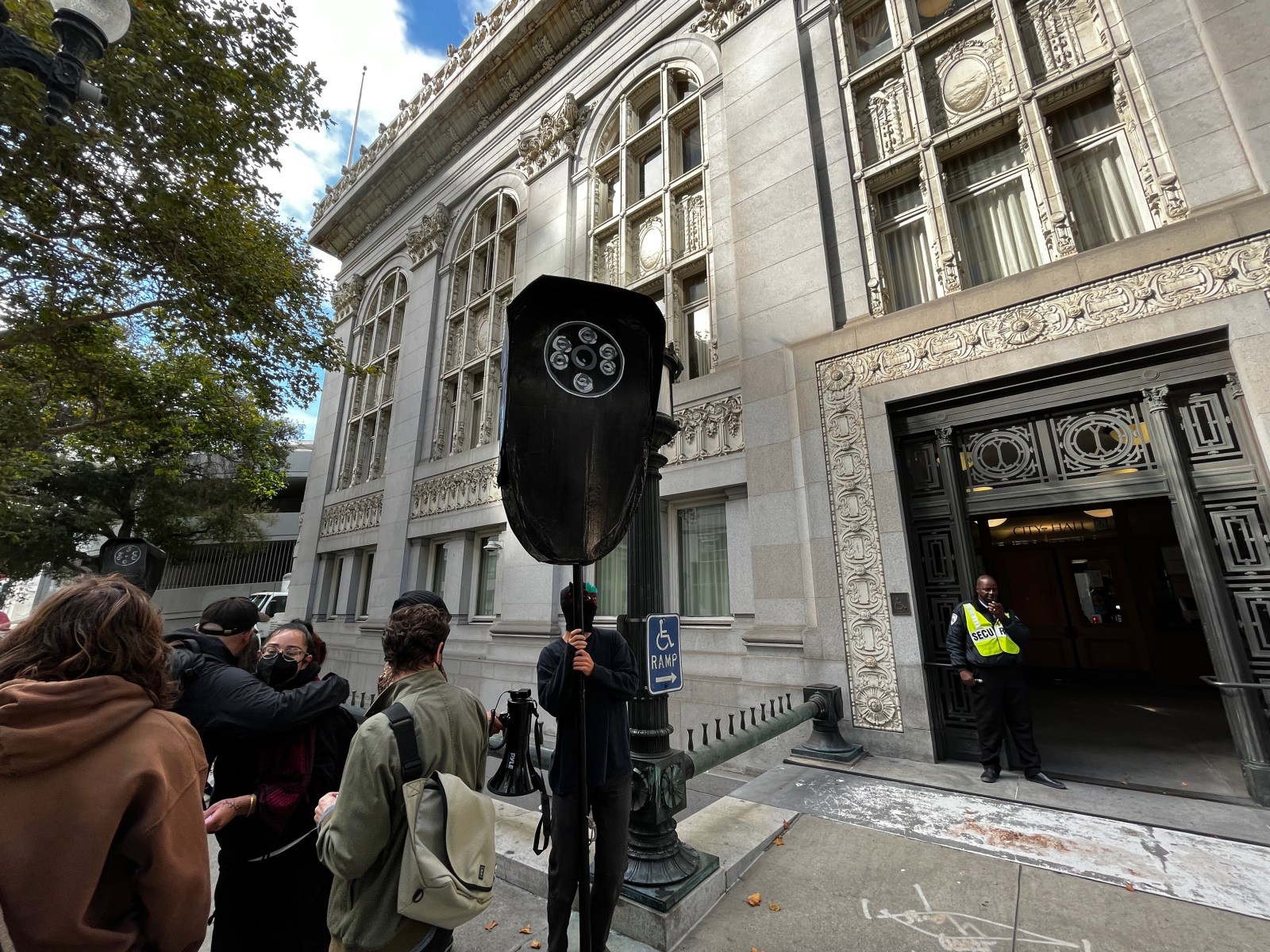 Anti-Flock activists gather outside Oakland City Hall on Sept. 5, 2025 to protest a police proposal to expand Oakland’s Flock Safety surveillance system. Credit: Eli Wolfe / The Oaklandside
Secure Justice filed its lawsuit on the same day that a City Council committee will consider awarding a $2.25 million contract to Flock Safety, the company that operates OPD’s 290 cameras. The committee will also decide whether to approve a policy that would allow OPD to incorporate private cameras in Flock’s system, significantly expanding the surveillance network.
Oakland approved an agreement with Flock in late 2023, and began erecting cameras last year. The project was cheered on by activists who say there’s too much crime in the city and the police need more powerful surveillance tools. Crime has significantly fallen over the past year in Oakland, although the city’s rate of crime remains above many other cities.
However, some community members began to raise concerns about the city contracting with Flock earlier this year after media reports emerged that the U.S. Immigrantion and Customs Enforcement was obtaining access to data from Flock systems through local police departments in other parts of the country.
During privacy commission meetings, OPD assured Hofer and other privacy advocates that as a sanctuary city, Oakland doesn’t share data with ICE. But in July, the San Francisco Standard reported that SFPD had accessed Oakland’s system and turned over data to federal law enforcement officials numerous times. These revelations, and broader skepticism about Flock Safety’s trustworthiness as a vendor, led the Privacy Advisory Commission to refuse to endorse OPD’s proposed expansion of its surveillance network.
The lawsuit alleges that OPD has also provided federal agencies with direct access to its ALPR data through Crime Tracer – a search tool for law enforcement that aggregates data from many different systems. The department made ALPR data accessible through Crime Tracer to at least six federal agencies, and “a significant number of non-California state or local agencies, from deep red states,” according to the lawsuit. And the department shares ALPR data through the Northern California Intelligence Regional Center based in San Francisco, which hosts agents from the FBI, IRS, DEA, and other federal law enforcement.
Secure Justice also claims that OPD violated an Oakland ordinance that requires the city to advertise services for a competitive bid if a contract exceeds $50,000. According to the lawsuit, OPD should have gone out to bid for the contract it wants to award to Flock, as well as the current contract with ShotSpotter, which provides OPD with gunshot detection monitors.
Hofer told The Oaklandside that OPD could theoretically stay in compliance with state and local law by refusing to share any of its data with other agencies. But he believes police departments are reluctant to erect barriers that might hinder cooperation. He said that OPD’s existing policy requires the department to manually approve each external request to access its system, but he claims the department abandoned that process.
Hofer acknowledged that some community members are pushing for Oakland to maintain the cameras because they believe they help OPD investigate crime. But he said the department’s conduct proves “they cannot be trusted with this technology.”
“I sue to change behavior, and the wrinkle here is that I already sued and it didn’t change behavior,” Hofer said. “I do think a court will have to consider our request more seriously to just shut it down.”
“*” indicates required fields