

Fresno is the top county in California for the use of pesticides containing PFAS, which can contaminate drinking water, soil and produce, linked to various health issues, according to a new Environmental Working Group analysis.
Between 2018 and 2023, EWG identified 2.1 million pounds of PFAS, also known as “forever chemicals,” sprayed on Fresno County crop fields, hundreds of thousands more pounds than any other county in the state.
Once sprayed, it can expose nearby communities and farming employees to the chemical studies show lead to an increased risk of cancer and reproductive and developmental harm, among other health issues, Bernadette Del Chiaro, senior Vice President of EWG California, told The Bee.
“It feels really important that the people of Fresno are kind of bearing that burden for the rest of us,” Del Chiaro said. “And there are alternative pesticides out there. So, we encourage farmers of Fresno and others to look at alternatives and be aware of this problem.”
Nearly 15 million pounds were sprayed statewide, with an average of 2.5 million pounds every year, exposing millions of Californians to the harmful chemical, according to the report.
Jared Hayes, a senior policy analyst and co-author of the report at EWG, a non-profit, nonpartisan organization that conducts research and advocates for public health and environmental protection, said the study shows the scale of use. The organization is known for its “Dirty Dozen” and “Clean Fifteen” lists, which rank produce based on pesticide residue, and its EWG Verified mark for consumer products.
“We tried to underscore how much of a problem this could be,” Hayes said, “because of the amount that’s being put out there on an annual basis that’s likely building up in the soil, entering into ground and surface water supplies that are often used as drinking water.”
What are PFAS pesticides?
PFAS are synthetic chemicals added to many kinds of pesticides to make them more effective, Hayes told The Bee. But these chemicals can accumulate in soil, be absorbed by crops and migrate into water sources. They never break down in the environment and can build up in the human body by consuming contaminated water or food, through skin contact or breathing polluted air, he said.
Studies show that 99% of Americans have PFAS in their bodies, including newborn babies, Del Chiaro said.
Exposure to some pesticides is known to increase the risk of cancer and reproductive and developmental harm. PFAS alone are linked to those same health problems, as well as other issues, including increased cholesterol, suppression of the immune system and reduced vaccine effectiveness, according to the report.
“They are only created in the lab,” Del Chiaro said. “Nature doesn’t have any way of dealing with these particular chemical compounds. It’s literally made for nature to not be able to deal with it, and then we are part of that nature. So, our bodies accumulate these toxins.”
For the report, EWG analyzed the use of 66 active PFAS pesticide ingredients identified in a peer-reviewed paper by EWG scientists and scientists from the Center for Biological Diversity and Public Employees for Environmental Responsibility, published in July 2024.
This year alone, the Trump administration has approved five additional PFAS pesticides for active use in the U.S. market, Hayes said.
Top counties for PFAS pesticide use in California
While Fresno leads in statewide use, the analysis reveals that residents across the San Joaquin Valley’s agricultural hub bear the brunt of PFAS exposure in California. Kern, San Joaquin, Tulare, Madera, Stanislaus, Merced and Kings counties are all in the top 10 of use out of 58 counties.
California counties leading in PFAS use from 2018 to 2023, according to the EWG analysis:
Fresno County — 2.1 million pounds
Kern County — 1.6 million pounds
San Joaquin — 923,000 pounds
Imperial — 898,000 pounds
Tulare County — 843,000 pounds
Madera County — 819,000 pounds
Stanislaus County — 817,000 pounds
Merced County — 811,000 pounds
Kings County — 659,000 pounds

Crop duster pilot Richard Deming of Kenny’s Crop Dusters brings his plane in low to spray fungicide on an orchard of nectarines north of Easton in this file photo. The ACLU wants the state to tighten regulations for pesticides applied to fields near schools.
What crops are sprayed with PFAS pesticides in Fresno?
The analysis found that PFAS pesticides are being used most heavily on some of California’s most renowned and profitable crops in Fresno and across the state, including almonds, pistachios, wine grapes, alfalfa and tomatoes.
Top 10 crops where pesticides that contain PFAS were applied in Fresno County from 2018-2023, according to the analysis:
Almonds — 826,457 pounds
Pistachios — 384,401 pounds
Tomatoes for processing and canning — 139,327 pounds
Cotton — 123,108 pounds
Grapes — 114,553 pounds
Wine grapes — 97,698 pounds
Alfalfa — 58,892 pounds
Peaches — 49,511 pounds
Nectarines — 24,982 pounds
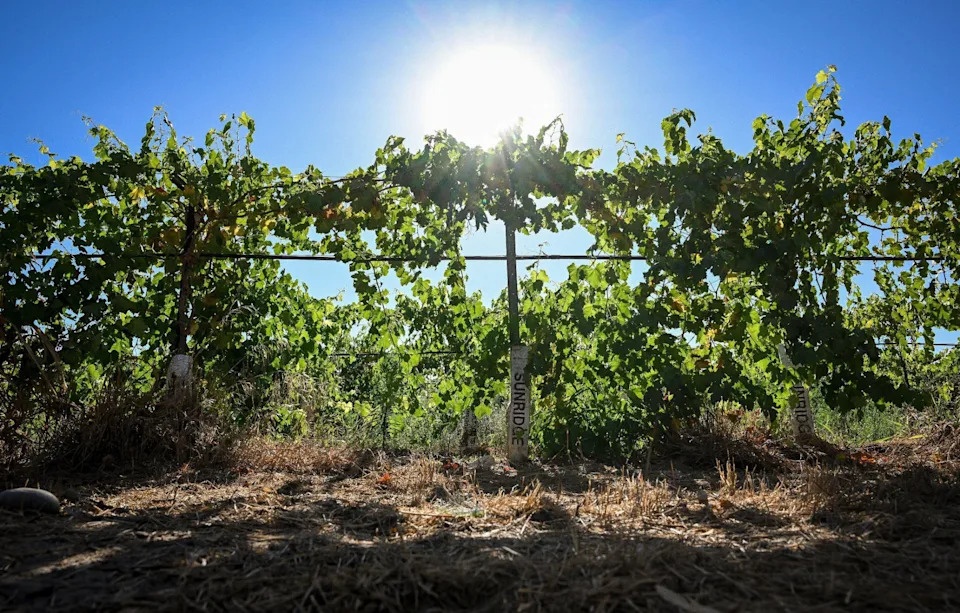
A vineyard row soaks up some early sunlight on longtime raisin grower Dwayne Cardoza’s ranch southwest of Fresno. Cardoza has been experimenting with a new hybrid raisin grape that dries on the vine rather than on trays in the sun, reducing labor costs.
Have there been any PFAS bans?
Under U.S. federal law, PFAS can be approved as active ingredients in pesticide products, playing a direct role by controlling the “pest” in a herbicide, fungicide or insecticide, according to the report.
Maine enacted the first statewide ban on PFAS pesticides in 2023, covering intentionally added PFAS and pesticides contaminated with PFAS, the report said. The ban will go into effect in 2030.
Denmark banned six PFAS pesticide ingredients in July 2025. The country cited PFAS groundwater contamination resulting from the use of these pesticides in agriculture. The report says that four of these banned PFAS pesticides are used in California.
Additionally, in March 2025, European regulators declined to renew the approval of the PFAS herbicide flufenacet due to concerns over thyroid health risks and groundwater contamination from its breakdown product, TFA.
Can I reduce my PFAS exposure?
One way to reduce PFAS is to use a water filter rather than drink straight from the faucet, but not all filters are created equal, Hayes said. EWG offers an online guide on the best filters to help remove PFAS from drinking water.
Both Hayes and Del Chiaro advise to carefully washing your produce and buying organic when possible.
“For consumers that are concerned about this issue, I just want to note that it’s important not to cut back on fruit and vegetables out of fear for these pesticides,” Hayes said. “The health benefits from eating fruits and vegetables tend to outweigh some of those exposure risks.”