
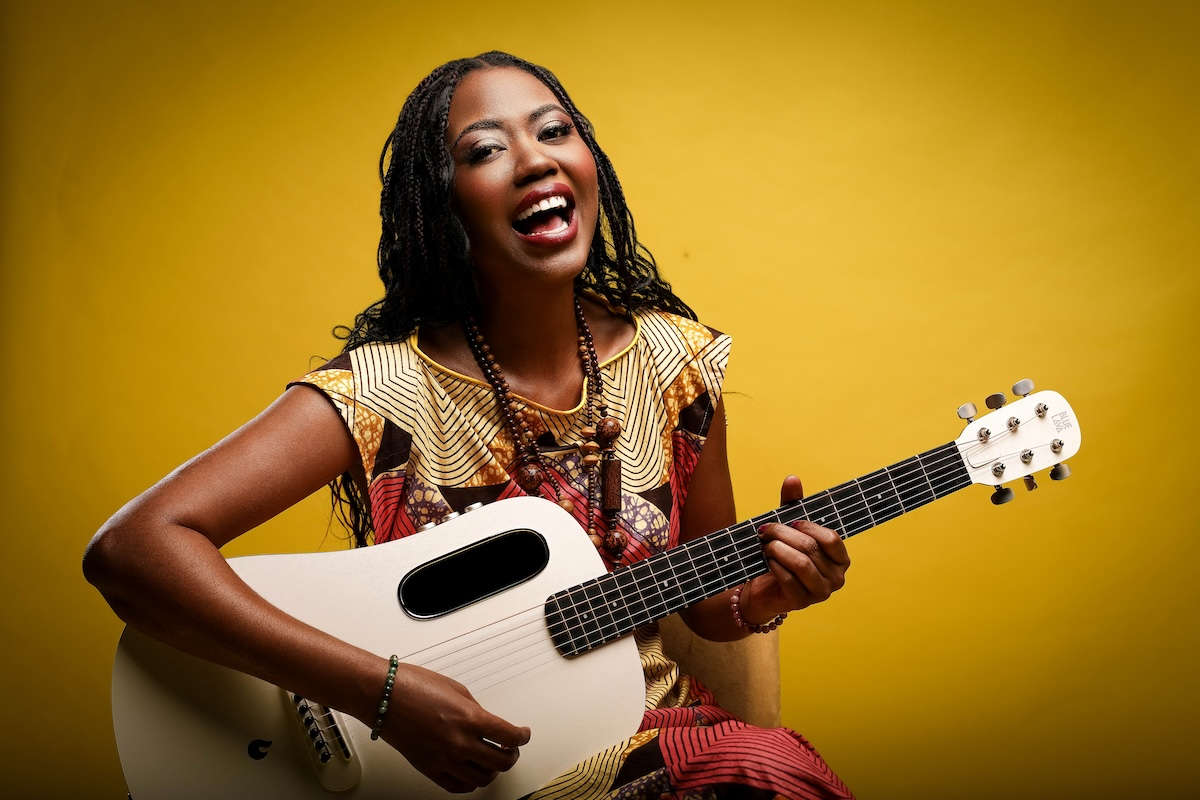
Out of an obscure corner in West Oakland, singer/songwriter Nia Cephas arrived like a modern-day oracle with a marvelous debut album, Cosmicpolitan. Positioned to be released by Little Village Foundation at a no-fee event Nov. 21 at Amoeba Berkeley, the album’s eclectic 11 tracks channel the influence on Cephas of bossa nova, samba, Middle Eastern folk, pop, blues, reggae and jazz music.
Timeless themes and wisdom-of-the-ages lyrics find flight on the wings of songs written by Cephas. Recorded over a one-year span at Kid Andersen’s Greaseland Studios in San Jose, every indication in her first release is that the 26-year-old is a fast-rising artist worthy of the spotlight.
Cephas is also a guitarist, and on the album some tracks have her playing acoustically with multi-instrumentalist Rick Andersen. Other songs are backed by a full band, notably including several award-winning musicians. Among the impressive group are keyboardist Jim Pugh, head of Little Village Foundation; Grammy-winning bassist Jerry Jemmott; drummer Gary Novak; and others. Cephas’ mother, Roseanne Duarte, gets into the act, singing backup and playing piano.
Cosmicpolitan was produced by Kid Andersen, Pugh and award-winning blues singer/songwriter Alabama Mike—who happened to play a vital role in Cephas’ career and, specifically, in “400 Years,” a song on the new album.
Cephas had the good fortune to cross paths with the celebrated Alabama-born, now-Oakland resident Mike on the front stoop of his cousin’s home. Learning she sang and played guitar, he invited Cephas to join them. She did, singing her “400 Years” and causing Mike to later have her sit in with his band for a show in Berkeley. One opportunity led to another and ultimately, to Pugh’s Little Village Foundation signing a deal to produce her first album.
In an interview, Cephas said she wrote “400 Years” during a time of intense emotional turmoil. It was 2020, when Covid and the Black Live Matters movement demanded attention—as did stories of unarmed people of color being targeted, injured or killed by police officers meant to protect them. Cephas’ father is African American; her mother, Brazilian.
“I always wondered if I’d have an experience where officers unduly stripped me of my rights,” Cephas said. “That song tells the story of African American people over 400 years. One line says, ‘Help us glow like a light bulb burn long.’ That’s a reference to inventor Lewis Latimer who assisted in creating an element in light bulbs that helps them burn longer.”
Other lines relate to additional historical stories and collectively support a declaration of resistance against oppression: “We not gonna take it no mo’.”
Another standout track, “Frequencia,” is written partially in Portuguese and unleashes Cephas’ spontaneous, scatting voice. “I was nervous about scatting, but I was alone in the studio with just Kid and myself,” Cephas said. “I felt very free. I was giggling and laughing. The Portuguese came in because my mother is Brazilian. It was hard to mix my African American and Latino cultures on the album, but I have dual citizenship and really, multiculturalism—my ancestry—is the foundation of America.”
“Borderland” is captivating, largely due to the Middle Eastern traditions that allow Cephas to vary the song’s tempos and to employ the two sides of her voice that can be gentle, lyrical and hypnotic, or flip without disruption into highly percussive tone and articulation.
“Kid plays the oud [a lute-type string instrument] that gives that Middle Eastern flare,” Cephas said. “I felt powerfully about the genocide happening in Gaza and had put together an [ad-hoc] group in Berkeley to protest. We started a movement that ended with a candlelight vigil. The song speaks on going into yourself and going what I call ‘god mode,’ which reflects my spiritual journey.”
That journey includes a horrific car accident that in 2019 nearly ended her musical career, if not her life. “I woke up in the hospital with tubes down my throat,” Cephas said. “I almost lost both of my legs, but they were able to put titanium rods within my femurs. All the nerves in my dominant hand were severed, and the bones were shattered.”
Cephas refused to accept the doctors’ prognosis that it would take one year to walk and that the use of her right arm was impossible without extensive surgeries. Instead, she walked in about two weeks and, after intense therapy, returned her arm to functionality.
“The experience solidified my belief in my true reality and the power and potential of the human body and mind,” she said.
Soon, Cephas embarks on a three-month tour in Brazil, where she is excited to connect with a culture and audiences who are part of her lineage. In the future she hopes to collaborate with artists and bands steeped in roots and mainstream music, along with other musical genres, such as electronic music.
Nia Cephas plays a free show in-store at Amoeba Berkeley at 5pm on Friday, Nov. 21. She joins Alabama Mike & the Revelators at The Sound Room, 3022 Broadway in Oakland on Dec. 7. For more info, visit gaiaversemusic.com.