
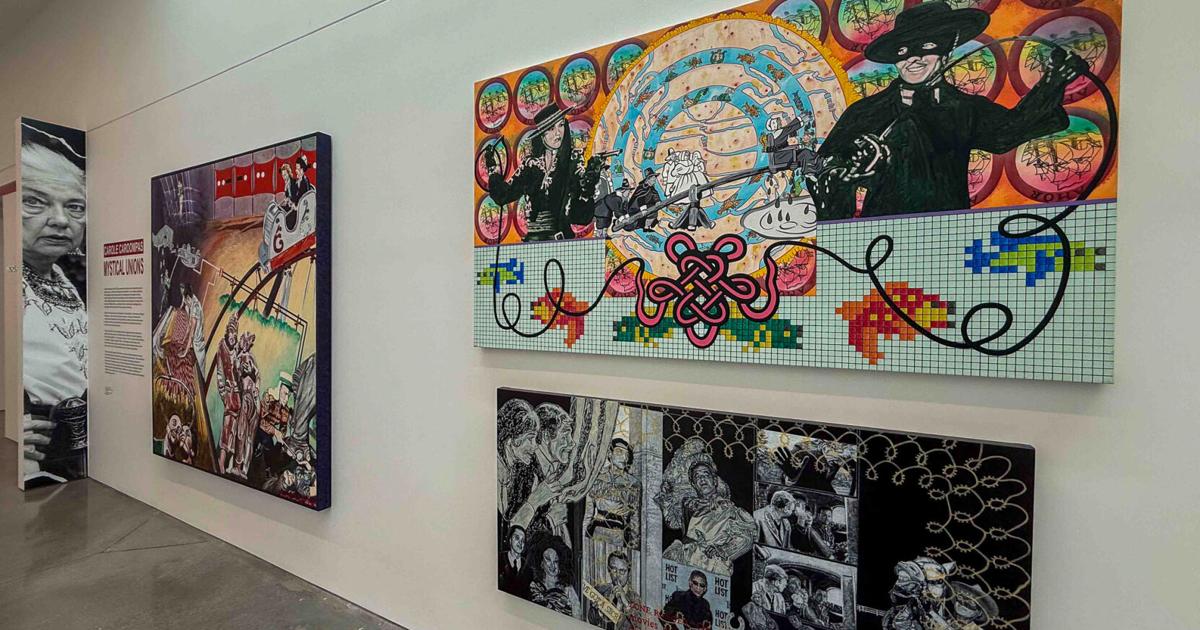
In the industrial blank space of the Nicholas and Lee Begovich Gallery, contemporary artist Carole Caroompas’ work lines the bright hallway, enticing onlookers with her imagery-driven artwork.
Opened to the public Oct. 4, the “Carole Caroompas: Mystical Unions” exhibition features a wall-spanning portrait that anchors the surrounding paintings, mixed-media works and personal ephemera of the trailblazing artist. The specially curated collection celebrates the life and legacy of the late Cal State Fullerton alumna while offering an intimate look into her artistic process.
To bring her work to campus, College of the Arts Director and Curator Jennifer Frias teamed up with Caroompas’ longtime friend and associate art education professor Mary Anna Pomonis, to sift through the journals, letters and sketches in the Carole Caroompas archives at the Getty Research Institute.
“It really felt like we were stepping into her creative process,” Frias wrote in an email to the Daily Titan. “Finding small personal notes or unexpected connections between her writing and the artwork was such a thrill, and being able to share some of those discoveries in the exhibition felt really special.”
Visitors to the exhibition can expect pop culture references, vibrant colors and layered symbolism deeply rooted in feminist theory. A collage of movie stars and religious icons, fairy tales and literary references, Caroompas’ storytelling interrogates how popular media constructs femininity and desire, often resulting in an evocative display of satire or accusation.
While Caroompas’ work may have once been considered visually overwhelming, its dense layers feel right at home in a technological world inundated with images and information. Likewise, the messaging still resonates with a modern audience as students recognize figures in Caroompas’ narrative critique of the status quo and can find familiarity in the intricate work.
Fourth-year art history major and CSUF gallery assistant Olivia Belida likens Caroompas’ work to another groundbreaking feminist artist Frida Kahlo.
“There’s so much symbolic imagery — it’s like you can get lost in it,” Belida said, referring to one of Caroompas’ paintings.
Though Caroompas did not pursue art seriously until working toward her master of fine arts degree at USC, her artwork is documented in journals as far back as her teenage years. Graduating from CSUF in 1968, the influence of her English degree is seen in the literary allusions scattered throughout her work.
“Heathcliff and the Femme Fatale Go On Tour: Dead or Alive” is a loaned piece from Pomonis’ personal collection. One in a series, the painting draws inspiration from Emily Brontë’s “Wuthering Heights,” reframing the tragic characters for a 20th century audience to ask the question: What happens when a woman’s sexuality is weaponized?
An embodiment of the spirited subversion of cultural norms within her artwork, Caroompas is remembered as a force of nature. Pomonis described her friend as unapologetically bold — a woman who refused to shrink her personality or her artistic ambitions.
“She was a very unconventional woman. She was married to her work, not to any man, and she was very open about that,” Pomonis said. “She was so fiercely independent and self-involved in a good way that she had the most active imagination, and she was completely at home with herself.”
As an educator at Immaculate Heart College, Cal State Northridge and Otis College of Art and Design, Caroompas instilled the same sense of confidence in her students. Her legacy continues through this exhibition, which was a learning experience for CSUF students who participated in every aspect of the exhibition design, from the research to the installation, even creating a custom Spotify playlist inspired by her work.
“(The exhibition) is presented so that it confronts you, which is very different from the way most people interact with paintings in a museum,” Pomonis said. “I don’t know how she would feel about that, but I do think she’d be very excited that students are learning from the work and writing about it and excited about it.”
By placing Caroompas’ work back on campus, the exhibition comes full circle. It honors the groundbreaking feminist artist and her contributions to Southern California’s art community while inviting students to imagine what’s possible.
“Caroompas’ work reminds us that being an artist means staying curious, bold, and willing to question everything, and I hope our students walk away with that same sense of courage and conviction in their creative voice,” Frias wrote.