
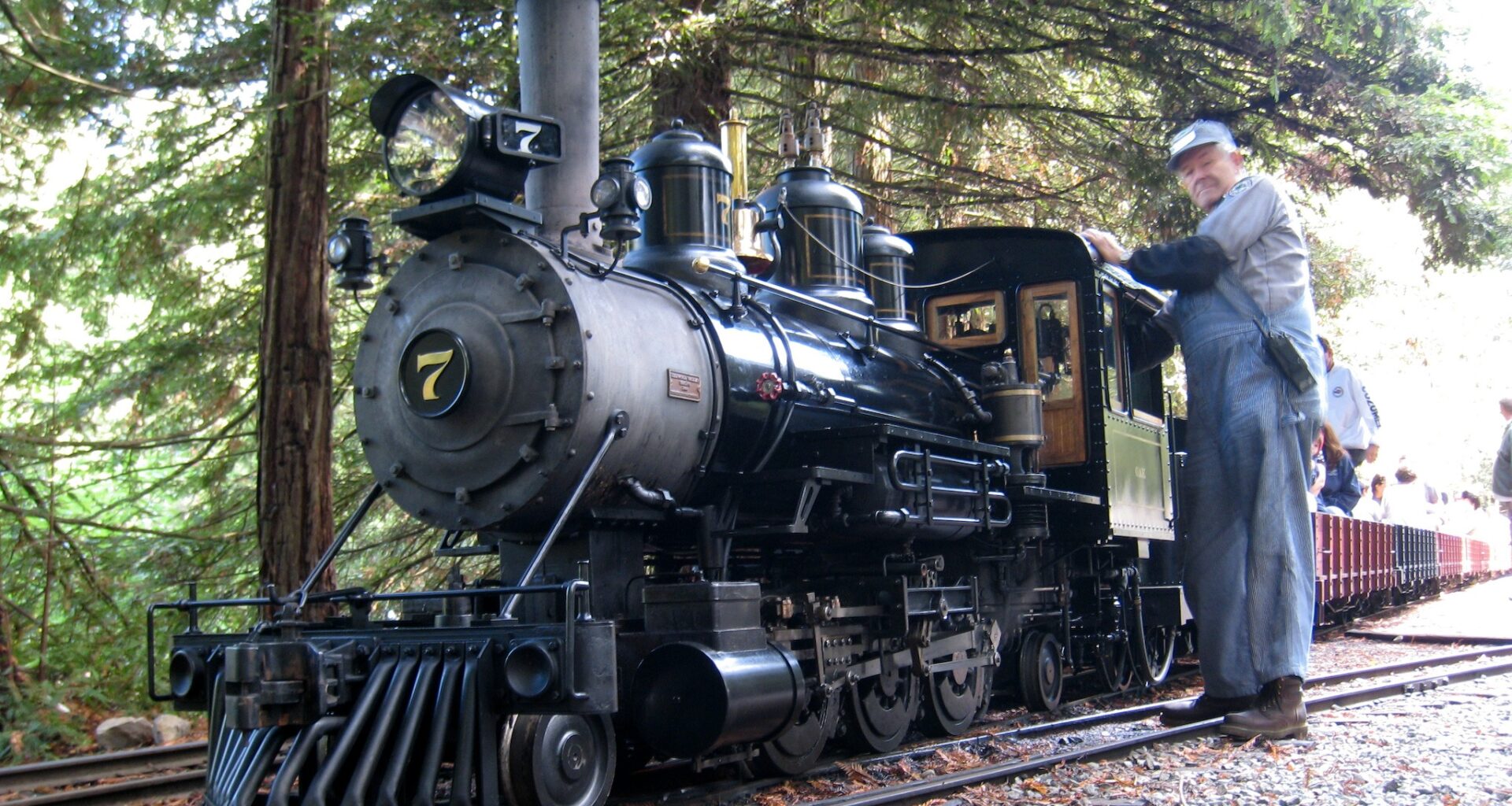
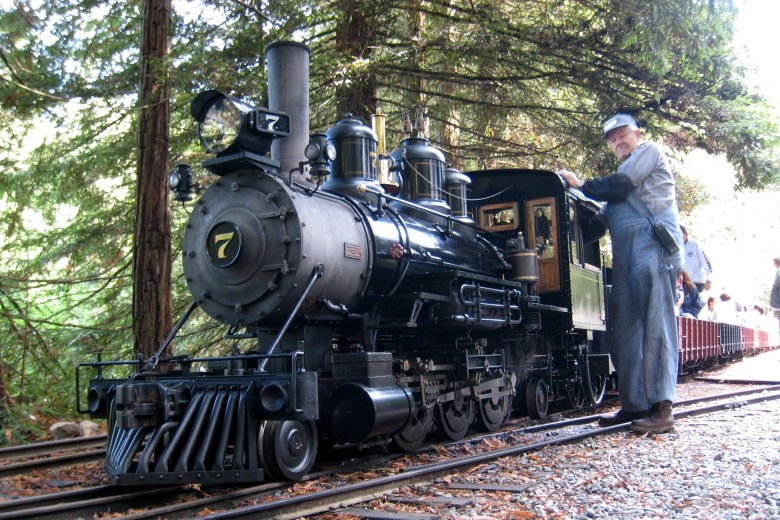
 The steam train has been a fixture at Tilden since the early 1950s. Credit: Doug Letterman
The owner of Redwood Valley Railway Corporation, fears the future of the Tilden steam train is at risk if she can’t get a long-term lease from the East Bay Regional Parks District, which owns the 48 acres the beloved attraction in the Berkeley Hills is located on.
The steam train has been a fixture at Tilden since 1952 and draws visitors from all over the Bay Area and beyond to ride on a 1.25-mile route through wooded terrain dotted with twinkling lights and miniature buildings made to look like a frontier town. The locomotives are smaller replicas of steam trains that once crisscrossed the country before being largely replaced by diesel electric locomotives in the 1940s and ’50s.
Redwood Valley Railway was created by Erich Thomsen, an engineer at Western Pacific Railroad who wanted to preserve not only the mechanics of the steam trains, but their unique culture. He pitched the idea of a miniature train to the East Bay park district as a way to draw more people to the new park. Since then, the trains have become wildly popular and today attract an estimated 250,000 visitors each year.
After Thomsen’s death in 1995, his daughter, Ellen, took over the operation. Today, Redwood Valley Railway includes four locomotives, a roundhouse, where the trains are stored, three barns, machine shops, a carriage house and two tunnels. All steam train components are built on site besides the boilers.
The company’s last lease ended in 2019 and since then it has been on a month-to-month lease. The park district gets a percentage of the revenue as part of the rental agreement while another portion of the proceeds remains in an account that EBRPD is supposed to use for maintenance of the grounds. At the same time, the number of visitors has grown by some 20% over the past five years, putting a strain on existing infrastructure, according to Thomsen. Engineers are assembling a fifth train, but don’t have any space to store parts.
“People think that the train will be there forever, but that’s not true,” said Thomsen. “I’m trying to work with the district, but haven’t gotten any decent explanation.”
Spokespeople for the East Bay Regional Park District declined an interview with Berkeleyside but said in a statement that “since 2019, the park district has endeavored to complete negotiations with Redwood Valley Railway Corporation to establish mutually beneficial terms for a new long-term agreement. … Staff have worked diligently with Redwood Valley Railway Corporation to address immediate operational needs while also planning for the train’s long-term future. Until a new agreement is signed, the train’s operations will continue under the existing lease on a month-to-month basis. … We remain deeply committed to the continued operations of this cherished and valued resource for the public.”
The discord over the lease comes at a time of upheaval for the park district, including the sudden resignation of general manager Sabrina Landreth on Nov. 6. Landreth has not publicly explained her decision, but said she stepped down because she felt pressured to act in ways that would have violated open government and personnel laws.
Operator threatens to move elsewhere via flatbed truck
Thomsen, who is in her 70s, said that her company is currently working on a succession plan so that it can continue after she’s no longer around. That includes creating a nonprofit that would run the company and building an office, library and archive on site. But without a long-term lease, she’s hesitant to make any investments.
One sticking point is the bathroom, which often backs up and floods the roundhouse where locomotives sit on racks. The bathroom is located near the parking lot and maintained by the park district. “I don’t know if it’s lack of attention or lack of money but EBRPD hasn’t been able to fix it,” Thomsen said. “I talk to the district’s operations and business services people periodically and sometimes there’s a little flurry of activity, but then nothing happens.”
The district said in a statement that it doesn’t know of any needed repairs to the bathroom and any overflow issues that have occurred were caused by human error and not any ongoing malfunction.
Thomsen has been so worried about the future of the Tilden train that last month she spoke at an EBRPD board meeting to voice her concerns. Since then, the company has been inundated with Bay Area residents sharing fond memories of riding the train and the peace and other-worldly feel of being in the trees.
“We would be devastated if the steam train closes,” said Tova Feldman Stern, an El Cerrito resident who was riding the train with her 3-year-old son, Asa, on a recent weekend. “It’s so relaxing and beautiful up here. It’s great for children and also good for adult mental health.”
Many Redwood Valley Railway Corporation employees and volunteers are deeply loyal to Thomsen and the operation, and say the steam train is a unique place that must be preserved. To them, the park is a way to preserve the technical knowledge about steam trains — essentially teapots on wheels, according to Thomsen — and educate visitors about their beauty and power.
“Back in the day, riding the steam train was considered real entertainment and it’s cool that something like this still exists,” said Harrison Hollidge, a docent and train operator at the park whose father was also an engineer there and who joined the Tilden steam train crew when he was 16 years old. “Children get to come up and experience something that’s beautiful, exciting and very technical,” Hollidge said. “It’s inspired a lot of young people, including many girls, to get into mechanical things, engineering and construction.”
Many of the steam train employees and volunteers are historical restoration buffs and a number have moved on to work on large steam trains like the one in Durango & Silverton Narrow Gauge Railroad in Colorado or the steam trains at Disneyland. “We’re kind of an incubator for steam train enthusiasts,” Hollidge said.
That means there’s no shortage of people who could continue the operation in the years to come. But without a lease, the operation may look for a new Bay Area location, moving its trains and track via flatbed truck to another site, or simply sell off its assets.
Thomsen hopes it doesn’t come to that, but all options are currently on the table, she said. “Families are looking for something inexpensive to do that’s local and we’re one of the few options left.”
“*” indicates required fields