
Malissa Tayaba, vice chairperson of the Shingle Springs Band of Miwok Indians, stepped forward from her seat Tuesday afternoon and stood before the Sacramento County Board of Supervisors and more than 150 speakers waiting their turn to deliver testimony on what has become one of the county’s most controversial solar projects.
“My tribe, along with other tribes in the region with ancestral connections to this location, voiced our concerns a multitude of times, to no avail,” Tayaba said.
Her testimony followed a presentation by Kimber Gutierrez, an associate planner for Sacramento County, who acknowledged that the construction of DESRI’s proposed Coyote Creek Agrivoltaic Ranch Project would result in significant impacts to the region’s oak woodlands and tribal cultural resources.
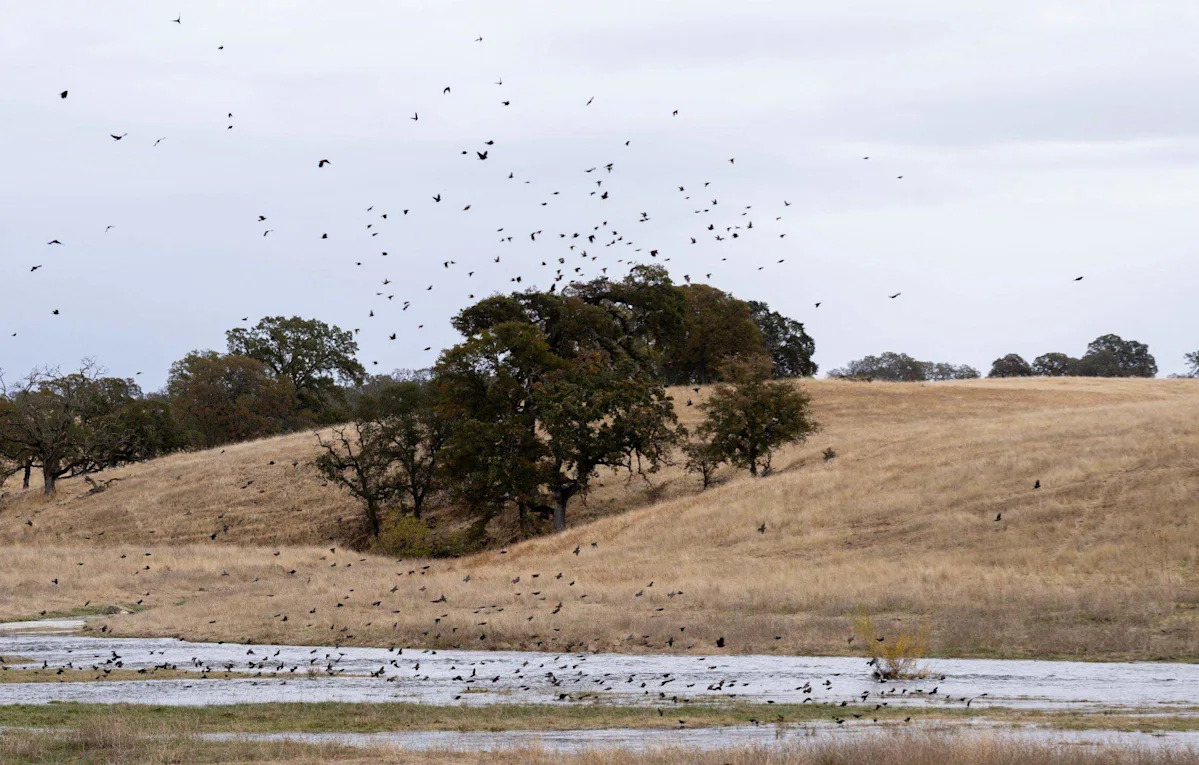
Noting that the tribes have seen no response to their concerns even after repeatedly raising them, Tayaba warned that allowing the project to move forward would cause “irreparable harm” and “desecration of cultural resources,” including village sites, burial grounds, habitat for plants, birds, and animals, and the destruction of oak trees that make up one of the last remaining intact oak woodlands in the region.
“The harm this project will inflict on our historical cultural resources and resting places of our ancestors alone cannot be quantified…the siting of this project is an example of the continuing unwillingness to listen to tribal voices and respect tribal history.”
Five hours later, the Board of Supervisors voted 5-0 in favor of the Coyote Creek solar project, granting final regulatory approval for the development.
Solar project moves forward as criticism intensifies
According to Gutierrez, the project’s solar facility will use about 1,357 acres of the site, an area equivalent to over 2.1 square miles.
The solar arrays, combined with a 100-megawatt battery storage system, are expected to provide power for roughly 44,000 homes and operate for about 35 years — at the cost of removing up to 3,500 native and blue oak trees.
Tuesday’s decision came despite strong opposition from environmental groups and local advocates, including Sacramento resident Lauren Brande, who argued that the crux of the issue is “not solar or no solar,” but “environmentally destructive solar or responsible solar.”
“While most impacts are mitigated, three remain significant and unavoidable — aesthetics, cumulative oak woodland loss and tribal cultural resources,” Gutierrez said.
Julie Newton, environmental coordinator with County Planning, noted that while the county worked closely with four tribes — Wilton Rancheria, United Auburn Indian Community, Ione Band of Miwok Indians, and Shingle Springs Band of Miwok Indians — over a three-year consultation period, the tribes remained opposed to the project.
Newton also noted that staff concluded there would be “a significant cumulative loss…because these trees are old. They are slow-growing, so that it is not expected that by replanting one for each one loss, that that would fully recover the tree removal on the project.”
County planning staff, nonetheless, advised the board to approve the Coyote Creek project and allow it to move forward. In their remarks, they noted that the project aligns with the county’s General Plan and Climate Action Plan goals and would advance SMUD’s 2030 zero-carbon targets, even as it carries several significant and unavoidable environmental impacts.
Newton explained that the project must permanently preserve an equal amount of oak canopy for every square foot lost, and that the developer is going “beyond” that requirement by proposing one tree planted or one acorn planted for each tree removed. However, multiple experts have warned that reestablishing mature oak woodlands can take decades to centuries, noting that seedling mortality rates are high and that many young trees often fail to survive due to heat, drought and competition from invasive grasses.
Meanwhile, Jim Gillum, a consultant representing the developer DESRI, emphasized the project’s economic benefits during the meeting, noting an analysis found it would inject about $365 million into Sacramento’s economy during construction, plus over $67 million in tax revenue over 20 years.
“This isn’t all about the dollars, but I think it is important to note the economic development associated with this project,” Gillum said.
And such a point resonated with supporters in the room.
“Coyote Creek represents responsible progress. … It balances clean power generation with open space protection,” said Alan Carter, a Sacramento resident. “It supports local labor with good paying jobs … and provides a regional climate benefit by reducing emissions.”
Opponents warn of lasting environmental loss
Among the advocates opposing the project was Ray Tretheway, a former Sacramento City Council member who spent nearly 40 years with the Sacramento Tree Foundation before retiring in 2020.
“In many ways, you’ve been dealt what I would call a trilogy of tragedies,” Tretheway said, citing SMUD’s lack of due diligence, the county’s disregard of General Plan principles, and what he called the Sacramento Tree Foundation’s failure to object to the loss of an ecologically significant blue oak woodland.
“I urge you to consider to not compound these mistakes tonight with your vote this afternoon. You can actually extend the longevity of these trees, which have life spans to 150 to 300 years to 600 years,” Tretheway continued.
Opponents of the project accused DESRI of misrepresenting the site as “bare, rocky ground” when initially approaching SMUD in 2021, while criticizing SMUD for failing to conduct adequate due diligence or an independent environmental review before signing the power purchase agreement.
Responding to the criticism, SMUD spokesperson Gamaliel Ortiz told The Sacramento Bee in an October email that SMUD is not developing the project, saying its role “is limited and distinct from the project developer, who is responsible for site selection, environmental studies, securing county permits and project development.”
SMUD’s absence at Tuesday’s meeting was a repeated point of criticism from opponents and even raised eyebrows from Board Chair Phil Serna, who said he felt “awkward” not seeing the “beneficiary” of a project that has become a “controversial subject.”
“If an agency has so much to gain … or the narrative being that they have this understandable and applaudable goal by 2030 to be completely renewable, you would think that they would have some kind of presence” Serna said.
Still, Serna joined the other four supervisors in voting for the project, saying the board must balance competing priorities while working to reduce the county’s carbon footprint.
Although SMUD previously projected the facility would be operating by early 2026, the permitting delays have pushed that schedule back, according to DESRI in October.