
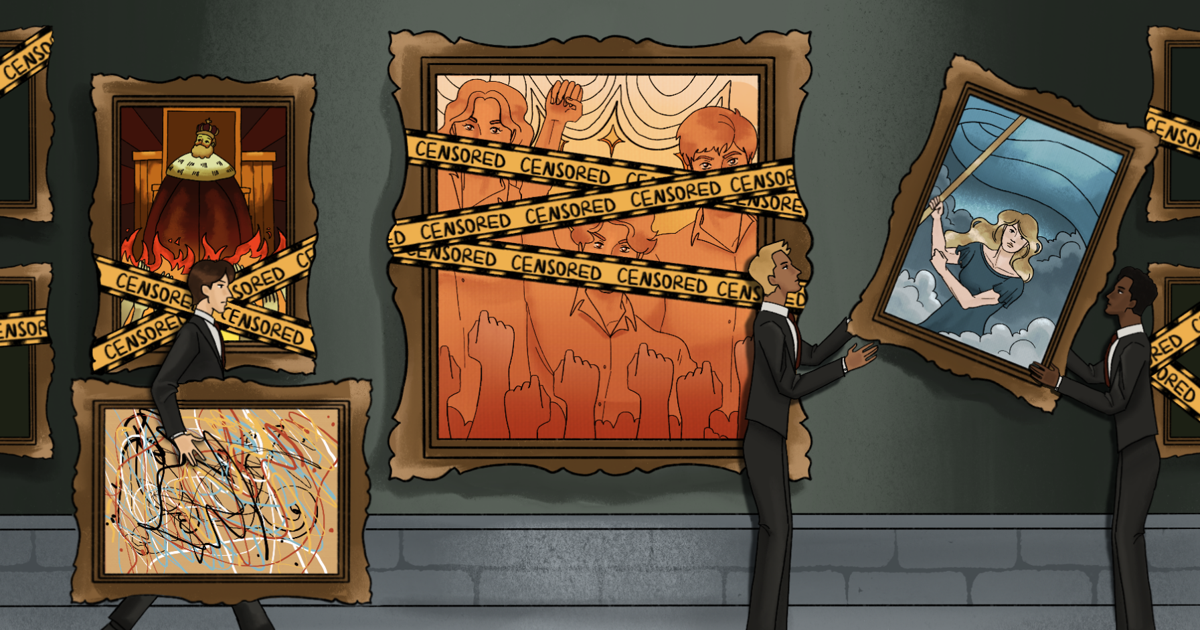
Egyptian pharaohs’ names were routinely struck from all public records following the toppling of their rule to justify the new regime to the public — this is called “damnatio memoriae,” or condemnation of memory. Scientific investigation in conflict with reigning religious institutions has been suppressed from ancient Greece to the Roman Catholic Church’s persecution of Galileo. “Uncle Tom’s Cabin” was banned in 1852 as its authentic portrayal of slavery stirred Northern sympathy.
At the root of every oppressive regime is a condemnation of memory, a warping of public knowledge to justify mistreatment through a fanatical or enigmatic perception of the injured people. This is an ancient, though reshaped, tactic that relies enormously on successful censorship. Art and storytelling, in their singular ability to humanize, are inherently in conflict with this system.
Successful censorship first uses the psychological influence of the story insidiously to seep into the public mind and behavior. Though it would be easy to assign it as much, oppression does not simply sustain itself on meaningless hatred; it requires manufactured ignorance and fear. Fabricated fear over how same-sex marriage would harm families — as perpetrated in advertisements for the Defense of Marriage Act in the 2000s, as well as recent UC Berkeley speaker Frank Turek’s book “Correct, Not Politically Correct; How Same Sex Marriage Hurts Everyone” — fuels the blockage of civil and political rights toward queer couples. Dramatized notions of heightened crime and inhumane individuals are displayed through media as the sole context for the United States’ record of 5 million inmates. In reality, this allows abusive and targeted oppression of marginalized communities through incarceration to fly under the radar, if not be celebrated.
This manipulation of knowledge is completed by the suppression of authentic stories, which is often ingrained in the legal system. In fact, incarceration and punitive enforcement are prime ways that censorship is legitimized. In relation to the aforementioned cases, queer stories are historically criminalized, and incarcerated individuals are stripped of narrative control through confinement and an inability to access resources. These patterns trickle down to the local level; just this semester, student demonstrators at UC Berkeley have had their information disclosed to the federal government, been arrested and been met with police confrontation. This not only places structural limitations on political and artistic expression but discourages future execution of it, even if individuals are released from physical enchainment.
Similarly, governmental funding cuts to the arts and sciences, after limiting ongoing projects, deter many students from increasingly critical studies — the artistic ones needed to connect and humanize and the scientific ones needed to mitigate health and planet injustice.
From the disproportionate incarceration of minority groups, artists and activists to the federal closure of research, educational and arts resources, these cycles only expand beyond campus.
Thus, physical repression aims to create a class of people who gradually censor themselves, thereby instilling a social system that sustains its own inequity. This has been echoed in works throughout various civil rights movements, from Paulo Freire’s “Pedagogy of the Oppressed”to Betty Friedan’s “The Feminine Mystique,” which depict racial and gendered cases of self-restricting internalization of oppression, and notably, the necessity of a consciousness of and opposition to this institution.
Increasing repression of art, the free press and research amid attempts to curb the human rights of minority groups inversely reveals the threat oppressive structures feel from these pursuits and thus the heightened criticality of their amplification. Shifting cultural perception and care for cases of injustice is a critical step toward equitable treatment. In this, the media of art and science threaten economic and social power imbalances, making them both targets of censorship and foundations of change through an empathetic disclosure of the truth.
Yet community understanding, solidarity and activity are essential to sustain them. Censorship weaponizes a monopoly on the diffusion of knowledge to target and isolate those with little power to fight against it. The final line of defense is to foster mutual support, persisting with and supporting the work that falls under fire before it is completely enclosed.
Thus, faced with intimidating threats and convincing ploys toward passivity, we must pinpoint our day-to-day relationship with such hidden and ingrained attempts at inhibition. And in opposition, we should mobilize the resources at our disposal — education, community and expression — to reinstitute suppressed stories of humanity and truth into public memory.