
University of California raises tuition as part of ‘stability’ plan. What you should know
The UC system is facing state budget cuts and major uncertainty over federal funding as it continues to navigate ongoing conflicts with the Trump administration.
The University of California’s Board of Regents on Wednesday voted to hike tuition rates for incoming students beginning in fall 2027.
The UC system is facing state budget cuts and major uncertainty over federal funding as it continues to navigate ongoing conflicts with the Trump administration.
In a recent message to students, faculty and staff, UC President James Milliken said the system is grappling with “one of the gravest threats in [its] 157-year history,” highlighting fears about potential cuts to the $17 billion in federal funding it receives each year — including $1.7 billion in financial aid for students.
What’s in the proposal?
The proposal extends UC’s “Tuition Stability Plan,” which went into effect in 2022. Under that plan, annual tuition increases were capped at 5% and tuition was frozen for each incoming class for six years.
The revised plan introduces the concept of “banking.” Basically: If UC would need to go over its 5% cap to keep up with inflation, it can “bank” the excess cost for another year when inflation might only go up by a couple points. The idea is that if UC can’t keep pace with inflation costs in one year, it can try to make up for them in years where inflation is less demanding.
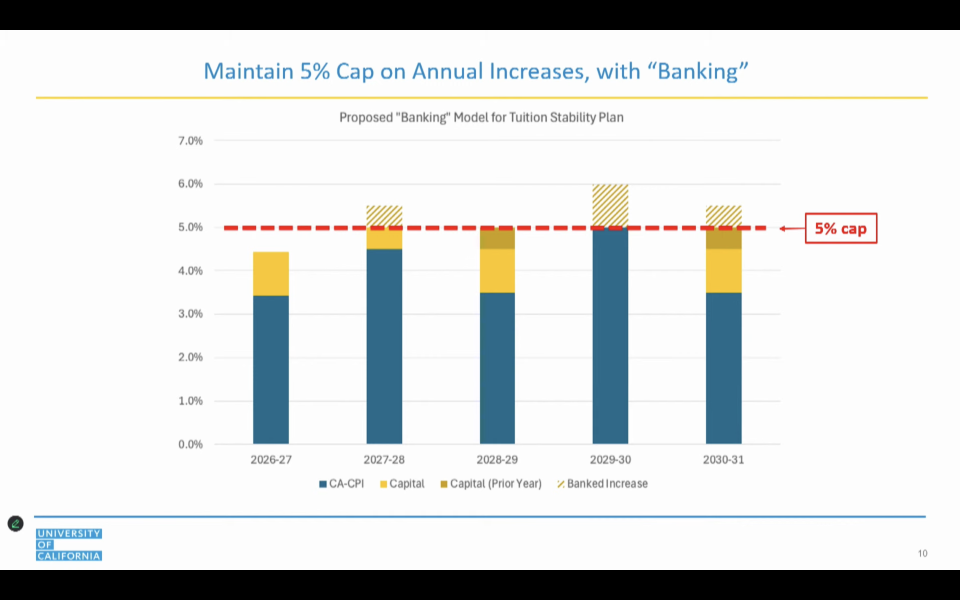
The UC system’s banking plan.
(
Courtesy University of California
)
The new plan contains other key differences, including reducing how much of the tuition increase is set aside for financial aid, from 45% to 40%, along with a 1% increase to help pay for new or improved campus facilities, or other priorities as determined by each campus leader.
What do students say?
The University of California Student Association (UCSA), which represents 230,000 undergraduates across nine campuses, opposed the tuition hikes, arguing that many students already are struggling to make ends meet.
“We understand that the university is in a really challenging fiscal period,” said Vincent Rasso, the group’s director of government relations. But he added that members should, at a minimum, oppose reducing the rate of tuition dollars that support student aid. And instead of using tuition to pay for capital improvements, UCSA asked that a portion of that 1% hike be used to fund retention programs and students’ basic needs.
The regents ultimately voted to allow the 1% hike to be flexible based on each individual campus’ needs.