
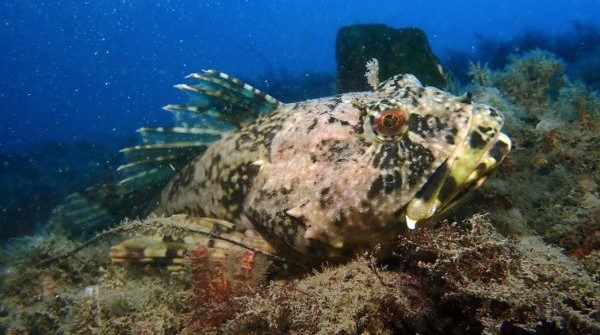
We’re all familiar with La Jolla’s sea lions, harbor seals, orcas, garibaldi and seabirds. But in this series of stories called Species of the Month, the Light sheds light on other, lesser-known marine creatures in local waters, their role in the ecosystem and more.
The species of fish called sculpin might be known in the San Diego beer community thanks to a Ballast Point Brewing Co. IPA of the same name. But to local swimmers, divers, anglers and scientists, it’s recognized for completely different reasons.
Sculpin has two particularly common groups found along the La Jolla coast: the woolly sculpin in the tide pools and the larger cabezon farther out.
“We have quite a few sculpin species that people might come into contact with,” said Ben Frable, a fish expert at UC San Diego’s Scripps Institution of Oceanography in La Jolla.
The woolly sculpin is relatively small compared with its relatives, reaching a maximum length of about 7 inches.
“They have really good camouflage to blend with algae and rocks in tide pools,” Frable said. “They can vary their color pretty heavily, so some are red, pink, brown or green. It’s not too dramatic, but pretty cool.”
The camouflage is one mechanism that helps them hide from predators such as birds and larger fish.
“Their skulls also have lots of points that jut out and spines that come out of their cheeks,” Frable said. “That gives them a bigger head, so the predator would need to be bigger and have a bigger mouth to eat them. So they have these great defenses with camouflage and the spikes.”
A sculpin’s only harm to humans would be if it were grabbed and a spine poked the person’s hand, Frable said. There is no venom or other harmful elements.
“In the tide pools, they go after small shrimp, worms and small mollusks,” he said. “They can also deal with extreme fluctuations in the environment, including a wide range of temperatures, salinity and water levels. They are pretty robust. They can survive for a decent amount of time in damp water and out of the water.”
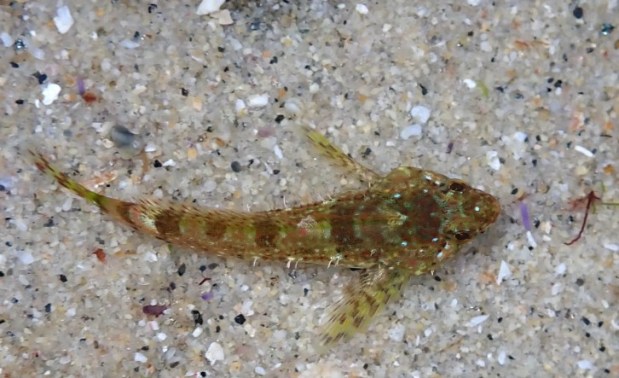 The woolly sculpin species often is found in La Jolla tide pools. (Charlotte Seid)
Outside the tide pools, the cabezon (Spanish for “big head”) lives in slightly deeper waters.
It can reach 3 feet in length and is popular among recreational fishermen.
“There is not a commercial market for them, but they have been popular for fishing since the Native Americans,” Frable said. “I have seen them in tide pools, but if you go snorkeling out of The Cove or The Marine Room, you might see them on the rocky reefs or in the kelp forest or in the canyons. They tend to live near the bottom of the ocean and are also equipped with camouflage abilities.”
The cabezon eats invertebrates and other small creatures found along the seafloor.
Frable said he doesn’t know how much a cabezon can change color but knows it “can change their shading from lighter to darker, kind of brown and white,” to blend with the surroundings.
However, some cabezon have a green or red tinge. Frable said a recent study suggests that “90% of the red cabezon are male and 90% of the green ones are female.”
Like the woolly sculpin, cabezon “have a big head, with [appendages known as] cirri on their face that are like sensory organs,” Frable said.
“They may be used for sensing changes in the water or things swimming around,” he said. “They might have an ornamental and camouflage function, but we don’t know.”
All sculpins have greenish blue blood, and sometimes their flesh can have that same color.
But people who think they know what a sculpin looks like because of the art on the label of Sculpin IPA might want to think again.
“That’s actually a scorpionfish,” Frable said. “It is a completely different family, and scorpionfish are more related to rockfish or lionfish. But fishermen call the scorpionfish a type of sculpin because of their resemblance and that they live in similar habitats.” ♦