
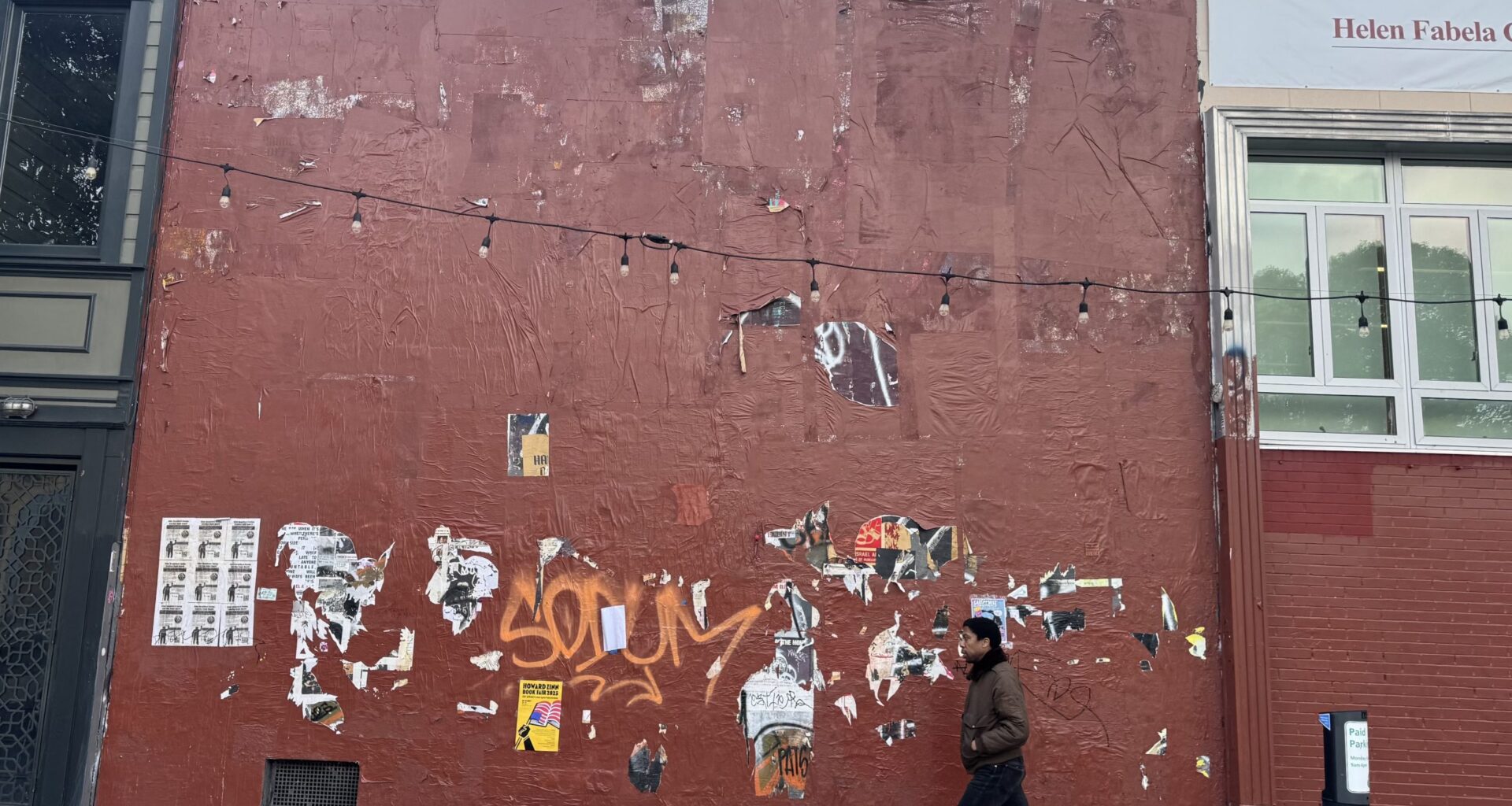
San Francisco’s graffiti abatement crew — intentionally, and perhaps only temporarily — painted over the Art Wall at the former Mission District police station that, for more than 20 years, has been a destination for hundreds of artists and amateurs.
There, on the southern facade of 1240 Valencia St. between 23rd and 24th streets, the artists have created a collage of ever-changing images referencing everything from the sex scandal in the Catholic Church to the massacre of 43 students in Mexico, gentrification and, more recently, Palestine, President Donald Trump, and Tesla boycotts.
The wall got its start when the artist and architect Bruce Tomb purchased the former police station at auction in 1998 for $560,000 and turned it into his home and studio. Tomb embraced the graffiti on the wall rather than fighting to keep it off.
The latter, he said, was “more work than I could do.”
Soon, it became a destination for artists like Shepard Fairey, JR, Patrick Piazza, Favianna Rodriguez, SF Print Collective and Jon-Paul Bail.
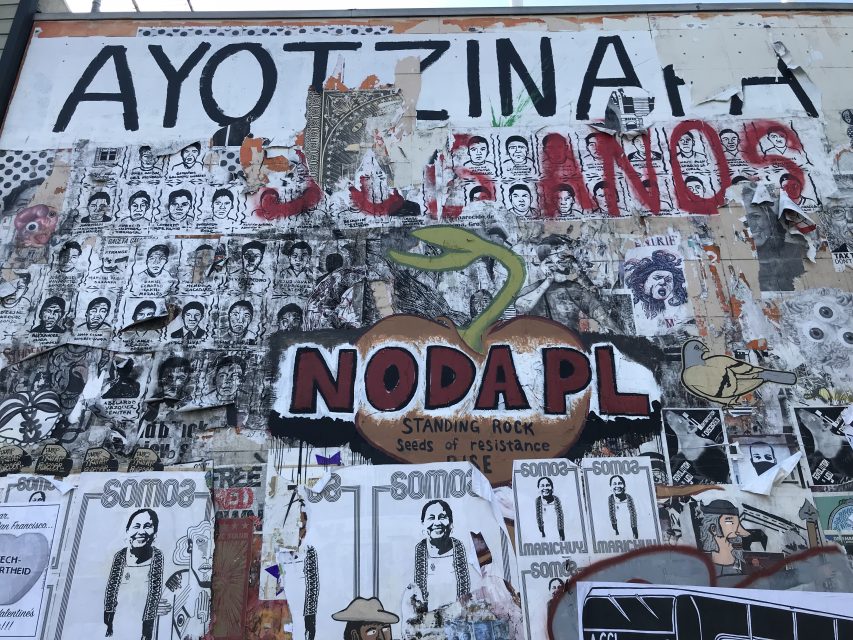 Messages remembering the Ayotzinapa 43 and the Standing Rock protest at the Valencia art wall on March 11, 2018. Photo by Joe Rivano Barros.
No one expected their work to endure for long, and its ever-changing facade was part of its charm.
When Tomb retired to Nevada, the Mission Neighborhood Center purchased the building in 2019 for $6.8 million to run a child-care center, but the wall remained.
Mission Neighborhood Center’s CEO, Richard Ybarra, said that his facility’s director told him that Public Works employees painted over the wall last week. The organization signed up for the city’s graffiti abatement program in 2024, after being cited repeatedly for graffiti violations.
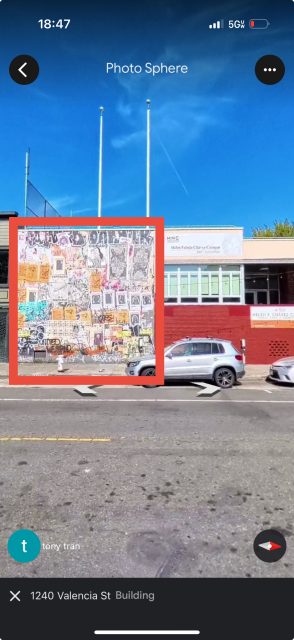 The image shows the section Mission Neighborhood Center said they told the city not to paint over. Photo courtesy of Richard Ybarra.
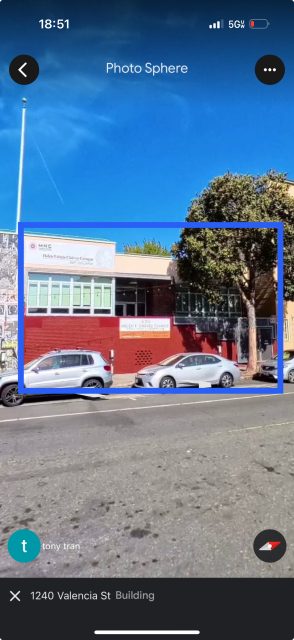 The image shows the section Mission Neighborhood Center said the city can paint over. Photo courtesy of Richard Ybarra.
Ybarra said, however, that the center only authorized Public Works to abate graffiti on another portion of the structure. Public Works said in an email that it could not find written records directing the agency not to paint over the wall. Ybarra said he did not have any records of his request to the city.
Tomb said he’s not worried. The wall, he said, has a way of taking care of itself.
“When something happened that many people understood as being the wrong thing for that site, it was taken care of by the community,” said Tomb. If buffed out, he said, within a week, “ “posters and graffiti would start to happen on the wall to overwrite that erasure.”
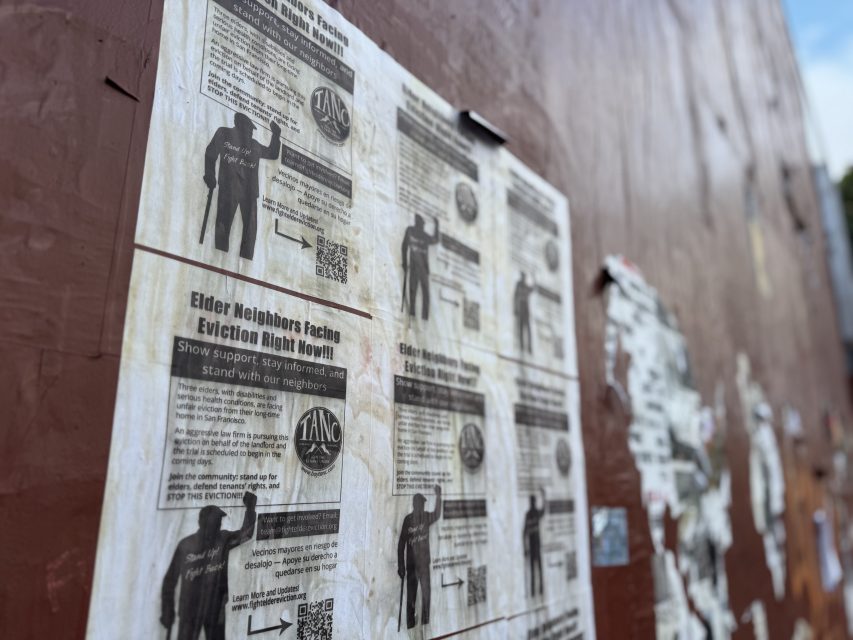 A poster was already place after Public Works painted over the art wall on Valencia Street, on Monday Nov. 17, 2025. Photo by Oscar Palma.
Annice Jacoby, an artist, activist and author of the 2009 book “Street Art San Francisco,” said, “It’s not just a bulletin board. It’s also been an incredibly important place of creative political expression with great potency.”
The public collaging, she added, has been influenced by artists such as Robert Rauschenberg, as well as the movement initiated by The Situationists. Jacoby recalled projecting images of the wall taken by Tomb outside of the de Young Museum during an event in 2010 celebrating San Francisco’s street art.
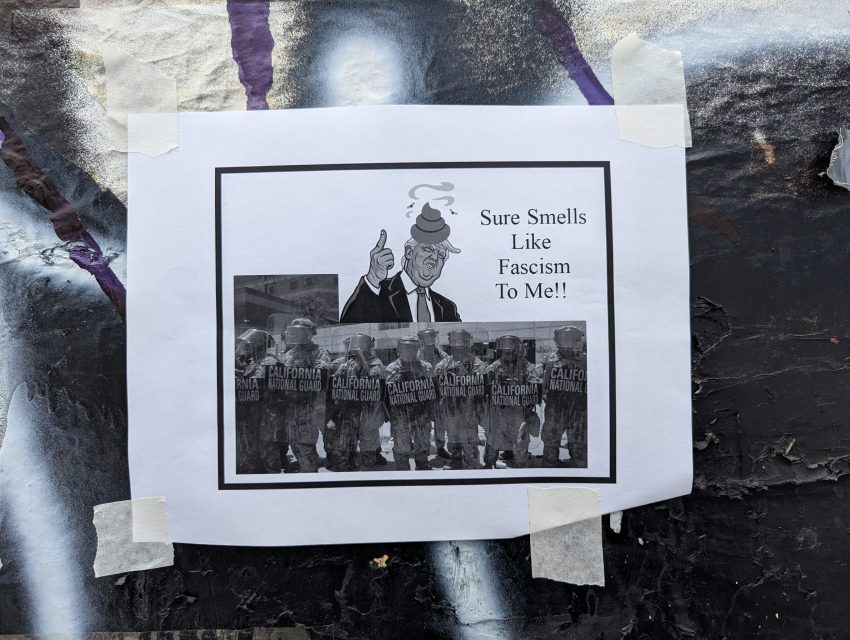 Photo courtesy of Cristiano Valli.
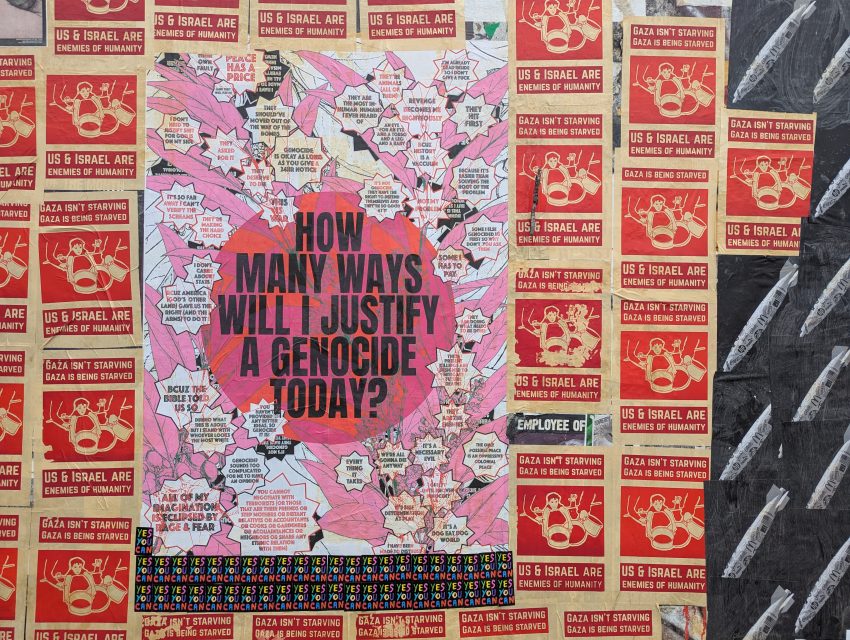 Photo courtesy of Cristiano Valli.
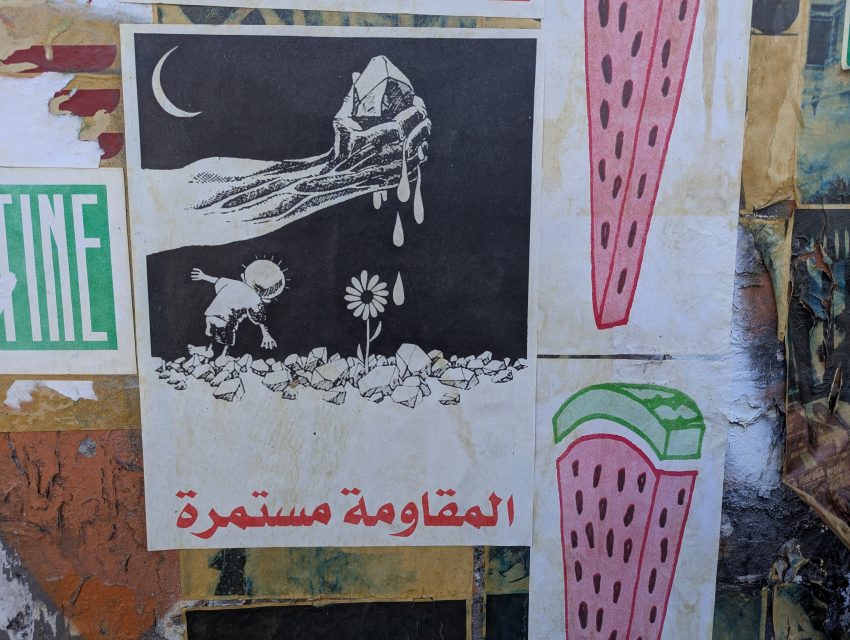 Photo courtesy of Cristiano Valli.
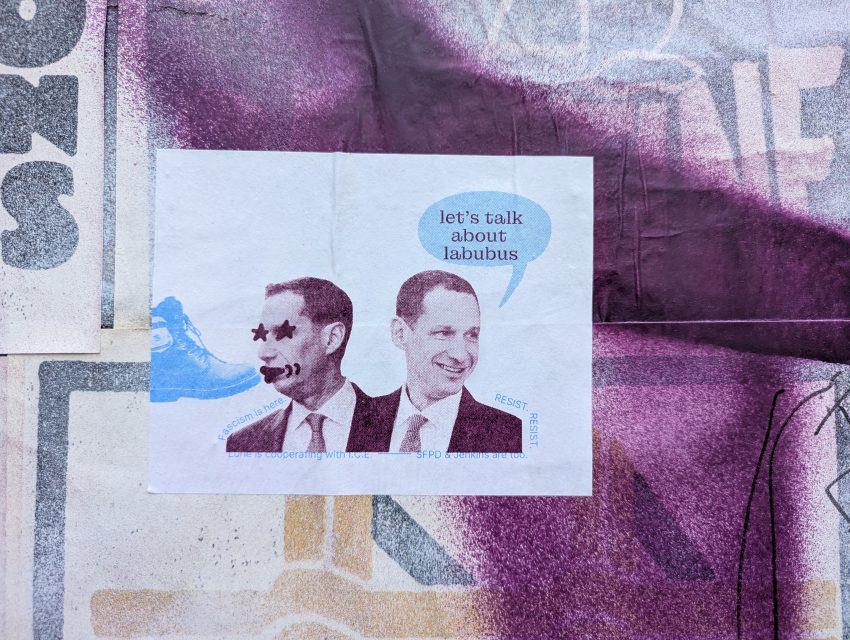 Photo courtesy of Cristiano Valli.
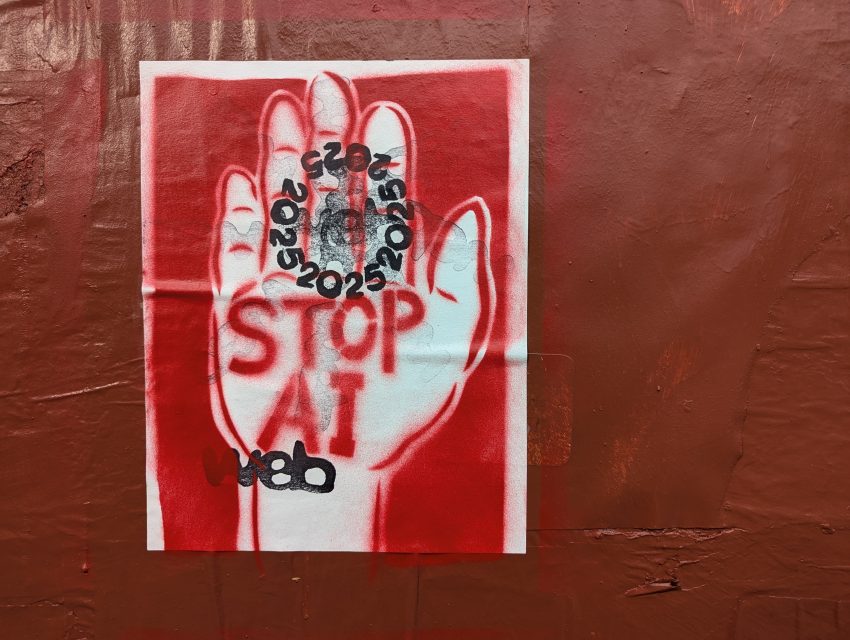 Photo courtesy of Cristiano Valli.
“The tiny little incidental things you have to look up close to take in. Then when you step back and you see the overall impact,” said Jacoby. For example: “Frida Kahlo was lying on her head sideways for a long time, and there were poems floating around her in dreams and responses,” she said.
“The anonymity of the wall is part of its beauty. No one is doing it for anything but to add to the meaningful and kinetic and dynamic energy the walls had all these years.”
Russell Howze, the creator of The Stencil Archive, a website documenting stencil works throughout the city, remembers coming across the art wall for the first time shortly after Sept. 11, 2001. During that time, he said, the wall was full of posters criticizing the war in Iraq, Fox News, the president and the vice president.
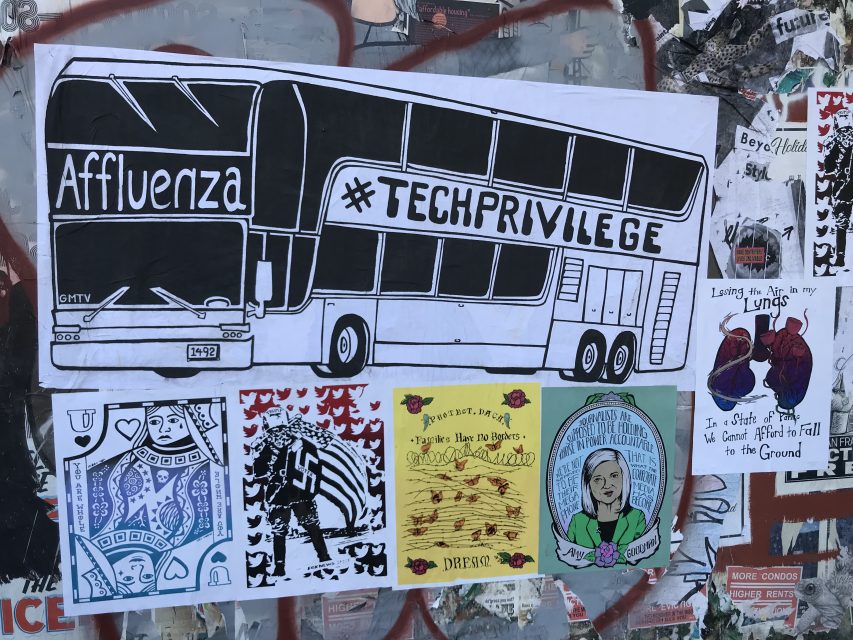 A tech company shuttle bus above various leftist posters on the Valencia art wall on March 11, 2018.
Howze documented dozens of stencil works on the wall.
“I feel very personally attached to this wall, because it’s always been there and it’s always been something interesting to look at and talk about,” said Howze, adding that, on numerous occasions, stencil artists contacted him to inquire for “free walls” to work on.
“It was always the wall. You know, it might be gone in a day. It might be gone in three days or a month, but it was always full of possibilities. Always exciting to even walk by.”
Some of Howze’s favorite memories from the wall are an art installation by Shepard Fairey and a parklet Tomb set up in 2015 with two podiums placed on opposing sides as if a debate would ensue. The project was directly connected to the wall and it was called the First Amendment parklet and the First Amendment wall.
At its opening, the artist René Yañez and the performance artist Guillermo Gómez-Pena took to the podiums.
Early on, Tomb named the wall, the de-appropriation wall “because it was all about giving back … instead of taking away or taking control of something.”
But to most, it was known simply as the Art Wall.
Although Tomb described his efforts to keep the wall as a “nightmare.” The city eventually retreated and some would say, even embraced it with a $8,000 grant from the Arts Commission for his free speech debating parklet.
Back in Nevada, Tomb said he still misses the wall.
Correction: An earlier version of the story reported that the wall had been painted over mistakenly, but DPW actually did what was requested.