
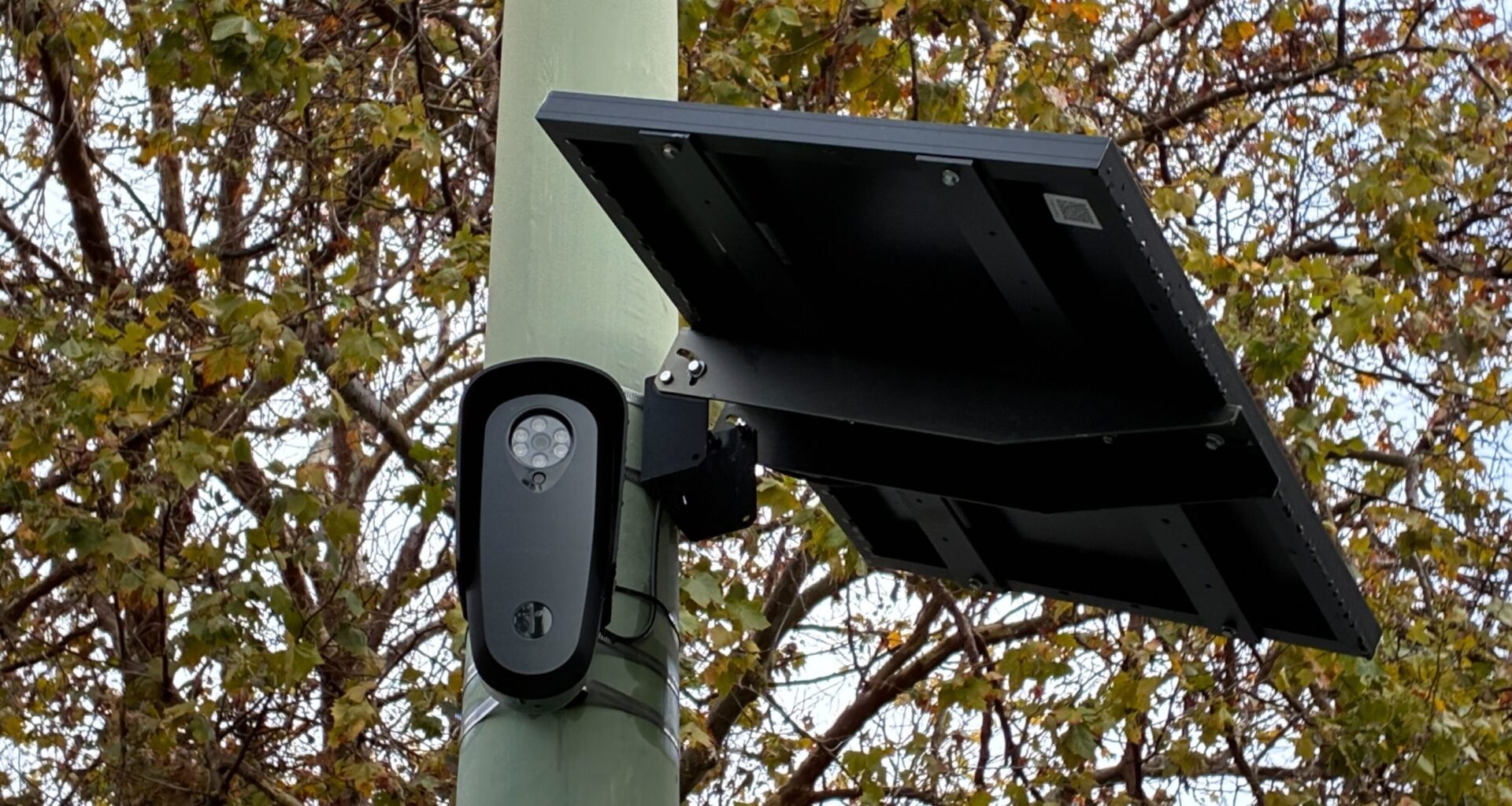
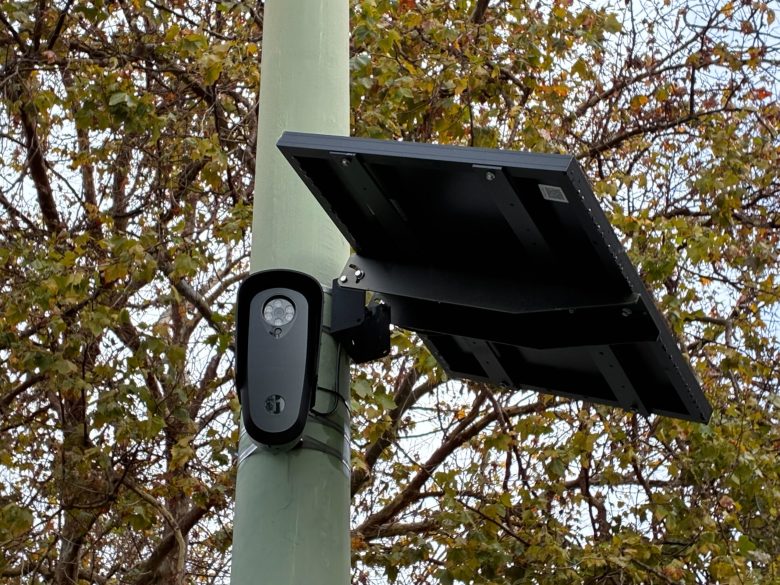
 A Flock Safety automated license plate reader camera in Oakland. The nonprofit Secure Justice has threatened to sue Berkeley unless it drops all its contracts with Flock, which manufactures Berkeley’s ALPRs. Credit: Darwin BondGraham/The Oaklandside
Facing threats of a lawsuit over its crime-fighting surveillance network, Berkeley is tightening its rules on who can collect data in the city and how, seeking to keep the data out of federal immigration agents’ hands.
Critics of the surveillance program say there’s reason to worry the Trump administration will abuse it to carry out its agenda of mass deportations, and that other states will do the same to enforce their restrictions on reproductive and other medical rights.
A two-year, $425,000 contract with Flock Safety for the Berkeley Police Department’s network of automated license plate readers (ALPRs), is up for renewal in the coming months, while a separate $310,000 deal for a network of fixed surveillance cameras was also supposed to go to Flock, but now may go to a different vendor.
Georgia-based Flock has come under national scrutiny for how its hardware passes data from agency to agency, including to Immigration and Customs Enforcement, or ICE. Officials in Chicago have accused it of violating a state law that forbids sharing certain data with immigration agents, and a number of sanctuary cities have cut ties with the firm.
Berkeley police say they are confident that the rules in place will keep data in existing or proposed networks secure, and that the surveillance technology is needed to keep the city safe with their department perpetually understaffed.
But opponents are not convinced, criticizing the department for a recent incident where the California Highway Patrol and police in Southern California were able to search Berkeley’s ALPR network for terms like “ICE” and “CBP,” the acronym for Customs and Border Protection. And opponents point to reports accusing San Francisco police of illegally accessing Oakland’s system and turning ALPR data over to federal law enforcement multiple times.
Secure Justice, a nonprofit that this week sued Oakland police over their alleged breach, has threatened to sue Berkeley unless it drops all its contracts, present and future, with Flock, alleging that the city has violated many of its own rules. If Berkeley is found liable it could be on the hook for up to $5,000 per violation, plus attorney fees; if a court rules Flock violated the ordinance, it could be fined $1,000 per violation.
The city denies any violation of state law or city ordinance, saying that despite Flock’s widely publicized troubles elsewhere, Berkeley’s network is locked down and secure. Berkeley “cannot base its contracting decisions on unsubstantiated speculation regarding Flock’s conduct,” City Attorney Farimah F. Brown wrote in response to Secure Justice’s demands.
One of the city ordinances in question, Berkeley’s Sanctuary Contracting Ordinance, prohibits the city from doing business in most cases with organizations that provide “data broker” or “extreme vetting” services to ICE. Attorneys for the city, while acknowledging recent revelations about Flock’s data from elsewhere winding up in the hands of federal immigration agents, said there’s no evidence the firm had hit either of those specific thresholds.
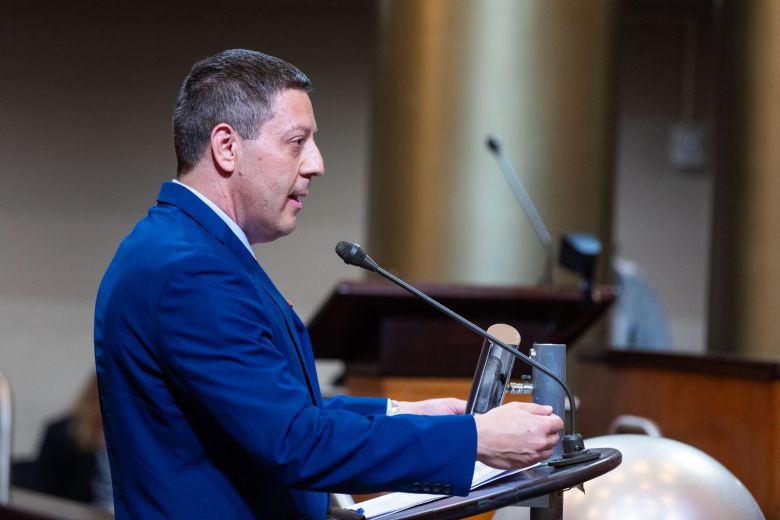 Brian Hofer’s nonprofit Secure Justice has asked Berkeley to cut off its relationship with Flock Safety. Credit: Estefany Gonzalez for The Oaklandside
While it’s still unclear what the City Council will decide about the pair of Flock contracts, it voted unanimously on Tuesday for a couple tweaks that make Berkeley’s Sanctuary Contracting Ordinance even more restrictive.
Instead of singling out ICE, the ordinance now bans Berkeley from contracting with any firm doing extreme vetting or data broker work for “any person or agency” working on federal immigration enforcement.
“If we are prohibiting our vendors from helping ICE with deportations, as the current sanctuary city contracting ordinance says, they should also not be able to help CBP with deportations,” Councilmember Cecilia Lunaparra wrote in an email.
And if the city determines there has been a violation, it would now have 30 to 60 days in most cases to fix it, rather than 90.
The idea is that shortening the window will put pressure on the city administration to evaluate possible violations faster and fix ones that turn out to be legitimate, reducing the time before someone could sue over the violations.
Brian Hofer, who heads Secure Justice, said he consulted on the ordinance and recommended the smaller window.
“Ninety days is a long time if real bad stuff is happening,” Hofer told Berkeleyside. “You could identify hundreds of thousands of people in that time.”
3 searches for terms like ‘ICE’ and ‘CBP’ on Berkeley’s license plate network
Berkeley police say they’ve set up their network to work exactly as it should: After some growing pains that involved a handful of questionable searches by outside agencies, they reported to the council that they have enough safeguards in place that none of the data their readers collect should end up in the hands of immigration agents.
Flock’s critics in Berkeley have pointed out that it was right around the same time that the council signed off on the proposed locations for the new cameras, this July, that BPD figured out that several agencies had been making searches on its ALPR network with keywords like “ICE” and “CBP.”
(There were five other searches that, at first glance, seemed related to immigration enforcement. But when BPD’s auditors dug deeper they found that the mentions of “DHS” in those searches referred instead to the Desert Hot Springs Police Department, and not the Department of Homeland Security.)
“BPD did not mention that it had identified a potential policy violation,” Josh Cayetano, who chairs the Police Accountability Board, wrote in a Nov. 4 memo listing concerns about BPD’s surveillance hardware. In its presentation BPD made mention of “data security issues that were reported in other jurisdictions and still, BPD did not mention, either in its papers or at the hearing, the breach that it identified. BPD, in other words, was less than forthcoming about the data security issues with Flock Safety.”
Police have continued to keep much information on their current Flock hardware, the plate readers, to themselves. Berkeleyside requested the agency’s first 10 months’ worth of ALPR data in August and the agency has yet to turn over a single record. Nor have BPD said which agency or agencies searched their network with the “CBP” search term, beyond that they were based in Southern California.
Police have said those three oversights — fewer than one fifth of one percent of external searches — should not happen again.
Not only did they kick the agencies behind those searches off their network, they completely disabled their network from responding to the sort of statewide searches that had included those search terms. They also “tightened sharing controls to exclude out-of-region agencies,” according to BPD’s annual surveillance technology report, though they have not specified precisely which agencies do or do not have access, despite numerous inquiries by Berkeleyside. According to the report, “no federal agencies, and no agencies outside of California accessed Berkeley’s ALPR network.”
Some cities in other states ended their contracts with Flock after the company disclosed that it had briefly partnered with U.S. Customs and Border Protection and provided the agency with access to ALPR data. In October, Oregon Senator Ron Wyden wrote in a letter to Flock’s CEO stating his belief that “abuses of your products are not only likely but inevitable” and encouraged local Oregon communities to remove the company’s cameras.
The backlash against Flock and ALPR cameras has been building in the Bay Area. On Wednesday, the ACLU, the Electronic Frontier Foundation, and other groups filed a lawsuit against San Jose over the use of warrantless searches of the city’s ALPR data, the East Bay Times reported. The plaintiffs claim this practice is unconstitutional and allows law enforcement — including federal agencies — to continuously monitor the movements of San Jose residents and visitors.
Berkeley police say cameras have been helpful in over 80 cases
Berkeley police note that the readers have been instrumental in several high-profile BPD arrests over the last 13 months.
“My district includes a number of what we call ‘gunfire corridors’ and the ALPR network has been used to identify suspect vehicles involved in the shootings,” Councilmember Terry Taplin, who has advocated for building out BPD’s surveillance capacity and represents Southwest Berkeley, told Berkeleyside in a phone interview. “I understand that technology is scary, but it is a valuable tool and it yields results.”
So far in 2025, Berkeley police have made “at least 52 arrests, including for commercial burglaries, robberies, sexual assault, homicide,” thanks directly to the readers, and used the network to help in another 29 cases, Arlo Malmberg, the civilian overseer of BPD’s Office of Strategic Planning and Accountability, told the City Council Nov. 10.
For context, BPD made roughly the same number of arrests, 52, in less than the last week for which data were available. It is unclear how many of those arrests were for felonies, and how many resulted in formal charges from the Alameda County District Attorney’s Office.
Flock is one of the biggest players in the surveillance market. Arizona-based Axon Enterprise, the firm that builds BPD officers’ body-worn cameras, also makes ALPRs, fixed surveillance cameras and drones, but hasn’t received the same scrutiny as Flock has — perhaps because its surveillance tech appears to have many fewer customers.
Berkeley Flock camera contract now in state of uncertainty
Berkeley was just one final hurdle — a single vote on a final contract — from a new contract with Flock to build a new network of fixed surveillance cameras.
That deal, more than two years in the making and that originally contemplated a different camera vendor, was meant to be inked Sept. 9 but City Manager Paul Buddenhagen pulled off a council agenda at the eleventh hour, asking to bring it back Oct. 28. At the time he said it was so the city could tweak the rules on how it would use the cameras, and also host a town hall-style meeting on the proposed hardware.
That town hall was supposed to be in October, only it never happened. And now city administrators are talking about bailing on Flock for that network.
“The city manager and BPD staff have been assessing issues regarding Flock cameras in other jurisdictions and evaluating other potential fixed camera vendors,” Matthai Chakko, a city spokesperson, said in an October email, responding to a Berkeleyside inquiry as to why the contract was never placed on the council’s Oct. 28 agenda. (Postponements, even repeated ones, are not uncommon for council agenda items.) “Due diligence requires more time. Once that process is complete, a date to return to council will be set.”
The Oaklandside reporter Eli Wolfe contributed to this article.
“*” indicates required fields