
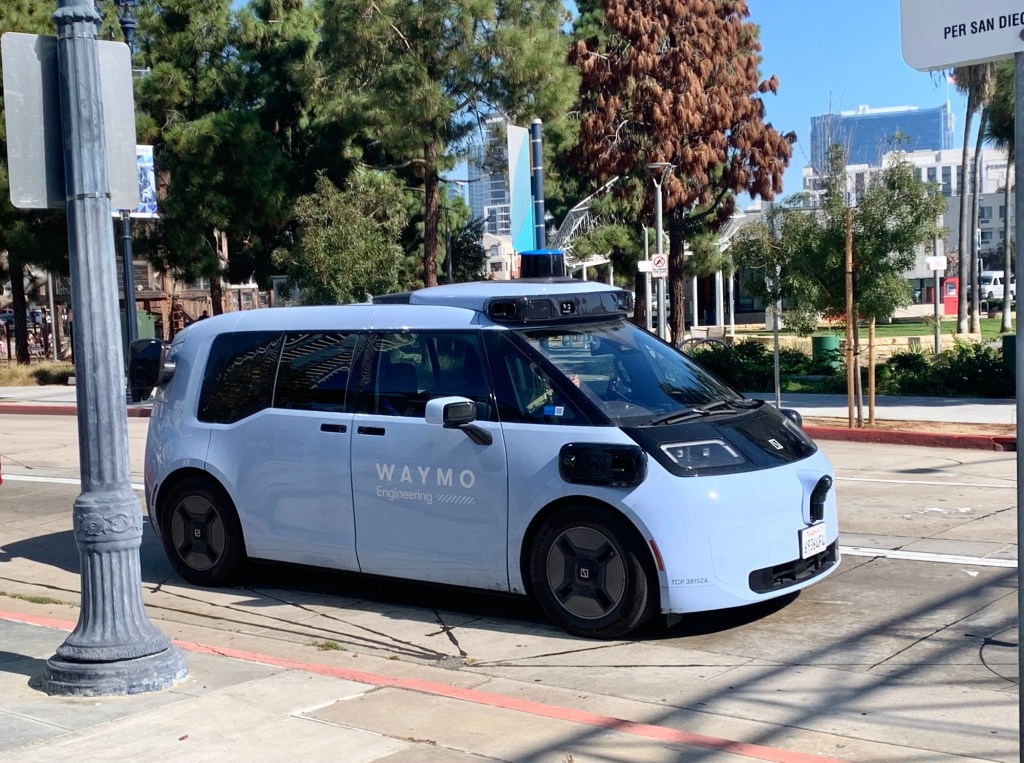
The pathway for robotaxis in San Diego may have hit a pothole.
Just weeks after officials at the autonomous vehicle company Waymo announced early steps to bring its ride-hailing services to San Diego in 2026, the Taxi Advisory Committee at the Metropolitan Transit System came out in opposition to driverless vehicles.
“My chief concern is what this means for people who are keeping a roof over their head and feeding their families by being drivers,” said San Diego City Councilmember Sean Elo-Rivera, who is also chair of the Taxi Advisory Committee.
The committee voted Wednesday on a series of recommendations, calling on the MTS Board of Directors to:
Urge the California Legislature and Gov. Gavin Newsom to restore local control over whether autonomous vehicles can operate in their jurisdictions and give communities the right to vote on their use.
Submit formal protests to the California Public Utilities Commission and the Department of Motor Vehicles about the respective permits and advice letters given to Waymo.
Prohibit driverless vehicles from operating at the San Diego International Airport to “protect airport ground transportation workers and ensure public safety.”
The DMV issues permits to manufacturers that test and deploy autonomous vehicles on California’s roads.
While the CPUC is best known for regulating investor-owned utilities, its responsibilities also include passenger transportation companies. The commission determines whether autonomous vehicle companies can operate within the state and oversees data collection and reporting requirements to help ensure safety.
“I don’t think we have to choose between innovation and humanity,” Elo-Rivera said, “but we need to take a moment to pause and ask about how we’re going to take account of the impacts on human beings before we unleash certain types of innovations” in light of the high cost of living in San Diego.
Waymo has already mapped out portions of San Diego roads and highways and on Nov. 3 announced what it called a “step-by-step” approach to bring fully autonomous ride-hailing services to the area by next year. Waymo officials would not give a specific date when they hoped to begin ferrying customers.
A fleet of all-electric Zeekr RT minivans has been spotted around town this month, further testing and assessing Waymo software. The cars have live humans behind the wheel, but the vehicles will be in autonomous mode.
The company’s robotaxis plan to be concentrated in central San Diego, in areas such as the Gaslamp Quarter, downtown, Grant Hill, Logan Heights and Pacific Beach — but not as far north as La Jolla.
But supporters of the Taxi Advisory Committee’s recommendations say driverless fleets threaten to undercut taxis, Uber and Lyft drivers, food delivery workers and package/courier service drivers.
“Waymo’s driverless cars are not fair competition,” United Taxi Workers of San Diego President Mikhail Hussein said in a statement. “If this moves forward in San Diego, many professional drivers will lose their main source of income … no machine can replace the human connection between a driver and their customer.”
The San Diego and Imperial Counties Labor Council, AFL-CIO has also come out against robotaxis.
“The addition of these automated vehicles to our region will benefit corporations, not San Diegans,” said the group’s president, Brigette Browning.
When asked about the Taxi Advisory Committee’s action, a spokesperson for Waymo said in an email to the Union-Tribune, “We look forward to bringing Waymo’s proven mobility and safety benefits to San Diego. In each new city, we prioritize continuous learning, engagement and collaboration with local communities and stakeholders to understand their needs and how to serve them best.”
The spokesperson did not say whether the actions of the Taxi Advisory Committee, if approved, would jeopardize Waymo’s plans in San Diego.
As for when the MTS board will discuss or vote on the committee’s recommendations, Elo-Rivera said no specific date has been scheduled yet.
Asked if he’s optimistic the Legislature, Newsom, the CPUC and the DMV will take the recommendations to heart, Elo-Rivera said, “I hope that we will be heard on this. I hope (they see) the value of taking the time to consider impacts and giving local communities the chance to determine in our own way how to best mitigate and solve for those impacts.”
Autonomous driving has captured the attention of tech companies and the auto industry, which foresee a radical change in the transportation sector.
Tesla CEO Elon Musk says he’s staking his company’s future on investments in robotics, autonomous vehicles technology and artificial intelligence.
Waymo has already logged hundreds of thousands of fully autonomous trips in five U.S. cities — Los Angeles, San Francisco, Phoenix, Atlanta and Austin, Texas. In addition to San Diego, the company has announced plans to expand to Miami, Washington, D.C., Detroit and Las Vegas.
San Diego Mayor Todd Gloria has come out in support of Waymo’s plans.
“By welcoming innovative and promising technologies like Waymo’s autonomous vehicle service, we’re exploring how to make transportation more accessible, more sustainable, and more connected for everyone in our community,” Gloria said in Waymo’s Nov. 3 news release.
But some potential customers are leery.
The death last month of a beloved cat that was run over by a Waymo self-driving taxi outside a dive bar in San Francisco sparked debate and internet memes that have expanded into a larger discussion about the growth of technology, automation and artificial intelligence in people’s lives.
A survey released by AAA in February said that 6 in 10 drivers in the U.S. are afraid to ride in a car without a human behind the wheel — although the percentage who say they are fine riding in them increased from 9% last year to 13% this year.
Waymo’s group product manager, Aman Nalavade, told the Union-Tribune earlier this month that he empathized, but said, “just give us one chance. Take that first ride with us and we believe it’ll be quite a magical experience … Usually, in my experience, five to 10 minutes in, you’re kind of just back to doing what you do in a normal ride-hailing or taxi cab, which is probably checking your phone and talking to your friends.”
The company touts its safety record, saying that compared to human drivers, the Waymo driver was involved in 11 times fewer serious injury crashes, 13 times fewer crashes with injuries to pedestrians and five times fewer crashes with airbag deployment.