
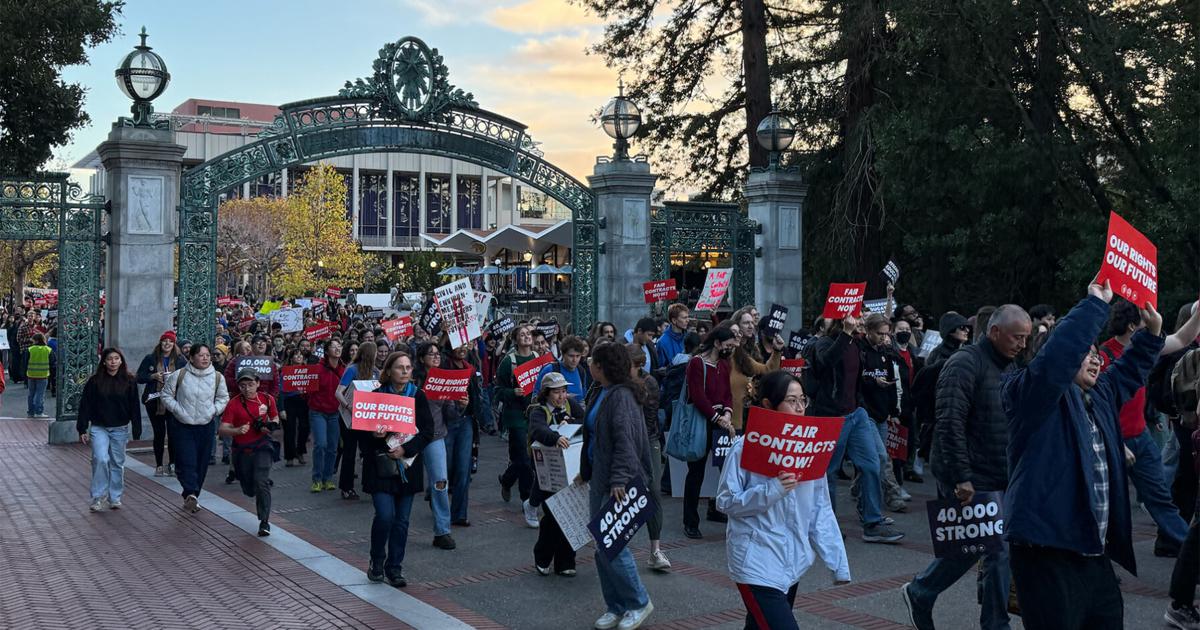
Hundreds of UC Berkeley academic union workers represented by United Auto Workers Local 4811, or UAW 4811, rallied on Sproul Plaza and marched across campus Thursday afternoon. The demonstration marked one of 11 “Our Rights, Our Future” rallies for better working conditions held across the UC system.
The rallies were organized by UAW 4811, along with Student Services and Advising Professionals, or SSAP, and UC Research and Public Service Professionals, or RPSP. The union has been bargaining with the UC system since July, with seven tentative agreements made so far. The “Our Rights, Our Future” rallies urged the university to move the process along faster and solidify contract agreements.
According to Iris Rosenblum-Sellers, the unit chair for academic student employees at UC Berkeley, the union’s top priorities in its new contract are fair pay, job security and increased protections for international workers.
Protesters’ signs read “40,000 Strong” in reference to the 40,000 UC workers represented by the union across campuses. Lauren Magdaleno, a UAW SSAP member and health educator with University Health Services, led a march from her place of work to Upper Sproul Plaza. She explained that the union is currently bargaining for more than 30 demands, including childcare.
“Childcare is one of the most expensive things that you might come across here in the Bay,” Magdaleno said. “I’m hoping that that’s something we can get a little movement on and have better benefits.”
The rally featured four speakers, all UAW members bringing attention to different demands the union has with the university. The first speaker, international worker and second-year graduate student research assistant in chemistry and physics Rahoul Banerjee Ghosh, conducts research with the Lawrence Berkeley National Laboratory on clean energy.
Banerjee Ghosh said they came to campus to turn climate change research into technology to “tackle the greatest challenges facing our planet.” They called out campus for staying silent as federal action has threatened climate change research with funding cuts and deported the international students who make this research possible.
They also noted that two of campus’s five recent Nobel Prize winners were immigrant scientists and urged campus to acknowledge immigrant campus workers in the same way. Banerjee Ghosh emphasized the pressure of managing costs of basic needs such as rent and food, on top of fearing for their immigration status.
“They’re willing to take credit for the work but not take care of the workers,” Banerjee Ghosh said. “Every international worker at UC is facing the same impossible choice between seeing our loved ones or risking not being able to return to our jobs.”
Another RPSP speaker highlighted the UC system’s complicity with National Institutes of Health federal funding cuts to research and what potential layoffs would look like for UC workers.
Job insecurity from research grant cuts combined with cost of living and student loans left this speaker’s colleagues distressed.
“There’s no question (that) UC leadership needs to work with the 40,000 workers who have the power to protect and expand their funding, not fall to the federal government’s attacks on research,” the speaker said.
The crowd marched to Memorial Glade at approximately 4:30 p.m., led by volunteers carrying banners that read “Our rights, Our future.” As they passed California Hall, protesters were urged to chant louder to get administrators’ attention.
One last speaker, graduate student researcher Tanzil Chowdhury, highlighted the critical link between the accomplishments the UC system prides itself on and the thousands of underserved UC workers. He warned that if the university continues to stall a fair contract, workers are ready to vote to authorize a strike.
“If you want UC to provide a world-class education to the next generation of Californians, if you want to secure funding for science and research, if you want to survive, then you don’t stand against the workers who make that possible,” Chowdhury said.