
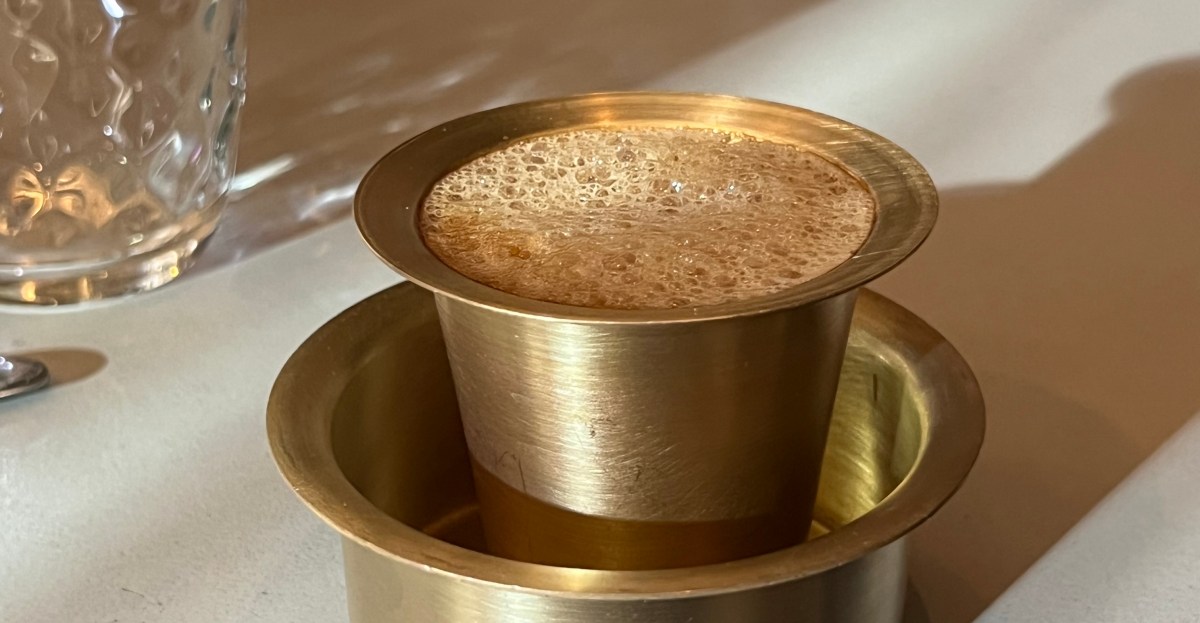
Varshi Srinivas makes coffee in San Francisco. But she makes it unlike anyone else in the city. With her pop-up No Filter Kaapi Club, she serves Tamil-style cold brew, riddled with sugary jaggery as a nod to the Indian festival drink pangam. She also serves a tiny gold drink called the Klassic Kaapi.
In India, it’s referred to simply as filter kaapi. Srinivas makes a “spicy” version with chai bitters. Her take on the drink makes her a part of a growing scene within the already growing South Asian coffee culture in Northern California. In January pop-up Brews United Coffee Co. launched from a San Francisco couple in life and coffee who started taking their cart around the city with filter kaapi, including a riff with ginger syrup called Karla the Fog. Also in 2025, a Kerala-style coffee shop opened in San Jose. Bingo Street Coffee opened this year in San Francisco’s FiDi serving Mysore-style filter coffee for $6.50 and an iced drink incorporating a similar style. Restaurants throughout the city have underlined their filter kaapi, too. Once again, San Francisco’s coffee scene is a petri dish for an ancestral drink launching into the specialty space.
“Filter” means something different in the United States. In India, the brewing vessel is as common in home kitchens as the Moka pot is for Italians. Method-wise, it brews similarly to the Vietnamese phin. There are bronze versions of the brewer, some copper-coated. Ground Arabica and Robusta beans are paired with chicory (the classic ratios are somewhere between 80 to 70 percent coffee to 20 to 30 percent chicory), with variations adding tamarind and other possible ingredients. The drink is brewed with boiled or steamed milk and sugar. It’s often referred to as meter coffee, poured from the tumbler above into the smaller vessel called the davara to aerate. It’s often done with flair — it looks a bit like Asturian cider pouring. Two coffee-growing regions in India, Madras and Mysore, for instance, have their own renditions. Though chai experienced an explosion in popularity the world over, Srinivas maintains that it’s just one part of the story when it comes to Indian drink culture.

Aramse Coffee’s SOFI 72 brews in a few different ways, including filter kaapi-style. Aramse Coffee
Srinivas grew up in Dubai drinking the little coffees served in brass cups. She remembers the democratic nature of the drink, how it was a cheap and punchy way to accentuate mornings, lunches, and get-togethers with friends. Not only did she want to introduce this drink to the chai-loving beverage hounds in the Bay, she wanted to show that good coffee can be affordable and quick. Her mission got her on the radar of Yeri Coffee, a New York-based Indian coffee roaster that now provides Srinivas beans for her drinks.
A San Francisco-based all-Indian coffee roaster has taken this mission seriously, too. When Tanya Rao at Kaveri Coffee began her business with pop-ups, she served a version of filter kaapi. These days, the roaster is working on an Indian brewer that would further vault this method into snobby coffee circles.

Drinks and food at No Kaapi Filter Club is highly specific fare in San Francisco. No Kaapi Filter Club
Aramse Coffee in Bangalore is trying to broaden the brewer’s scope with the SOFI 72 brewer, a clever abbreviation of “South Indian filter coffee.” The business wants to make it more approachable to the market sector that obsesses over water filtration and grinder temperatures. This new, no-bypass brewer hopes to brew beans of different roasts, brewed in a variety of ways in a stainless steel device. Friendly coffee overlord James Hoffman met with the team. Kaveri is the start-up’s first stockist in the United States, bringing an everyday South Asian kitchen tool to wider audiences. “Sometimes Indian coffee is just associated with this one style of brewing,” Rao says. “But Indian coffee has so many diverse flavors and ways of enjoying.”
It’s far from just pop-ups and specialty coffee pros serving chicory coffee in little cups. Srijith Gopinathan, the chef and owner behind San Francisco’s Copra in addition to Palo Alto’s Ettan and Menlo Park newcomer Eylan, grew up drinking coffee that way. He started serving it at Copra first, when he launched brunch at the restaurant in January 2024. At the glittering restaurant in the Fillmore District, the pastry chef on staff handles making each drink to order. The kaapi is tiny, almost like a ramekin atop a plate, that’s milky and just a bit sweet. The chef says that while this is not a known drink across menus in the country, the large Indian population in the Bay and the adventurous culinary culture here makes for a ripe moment for the drink. “Coffee is not new to the Bay Area,” Gopinathan says. “This kind of high, Michelin culture — it’s a no brainer [for Indian coffee].”

Two filter coffees alongside Kaveri chicory-infused beans. Kaveri Coffee
Importantly, this boom in interest for one sliver of the subcontinent’s culture comes during what some call a renaissance for Indian cooking. But food studies professor Krishnendu Ray points out in Best Food Blog that many U.S. diners do not have even the slightest grasp on the regions they’re engaging with on the plate. Filter coffee, while gaining acclaim and buzz thanks to its punchy Blue Bottle NOLA coffee-ish flavors and visual appeal made for TikTok, has been hiding in plain sight on menus for a long time.
Just ask Bino Jacob. He’s one of the owners of the Mission’s Udupi Palace, which expanded from New York to San Francisco almost 20 years ago. Their offering is a Madras coffee — possibly the only place in San Francisco offering this drink by that name.
They filter the coffee every morning, then serve it in mugs a la Americana rather than the traditional vessels. Still, Jacob says it’s the same thing as other Indian filter coffees. Moreover, he’s pretty nonplussed about the surge in popularity — he says the drink’s been on the menu for decades. “People love Madras coffee,” Jacob says, “people know what it is. Everybody orders it. These days you see more mixed drinks, more than the ’80s and ’90s. The newer generation is apt to taste all these drinks.”