
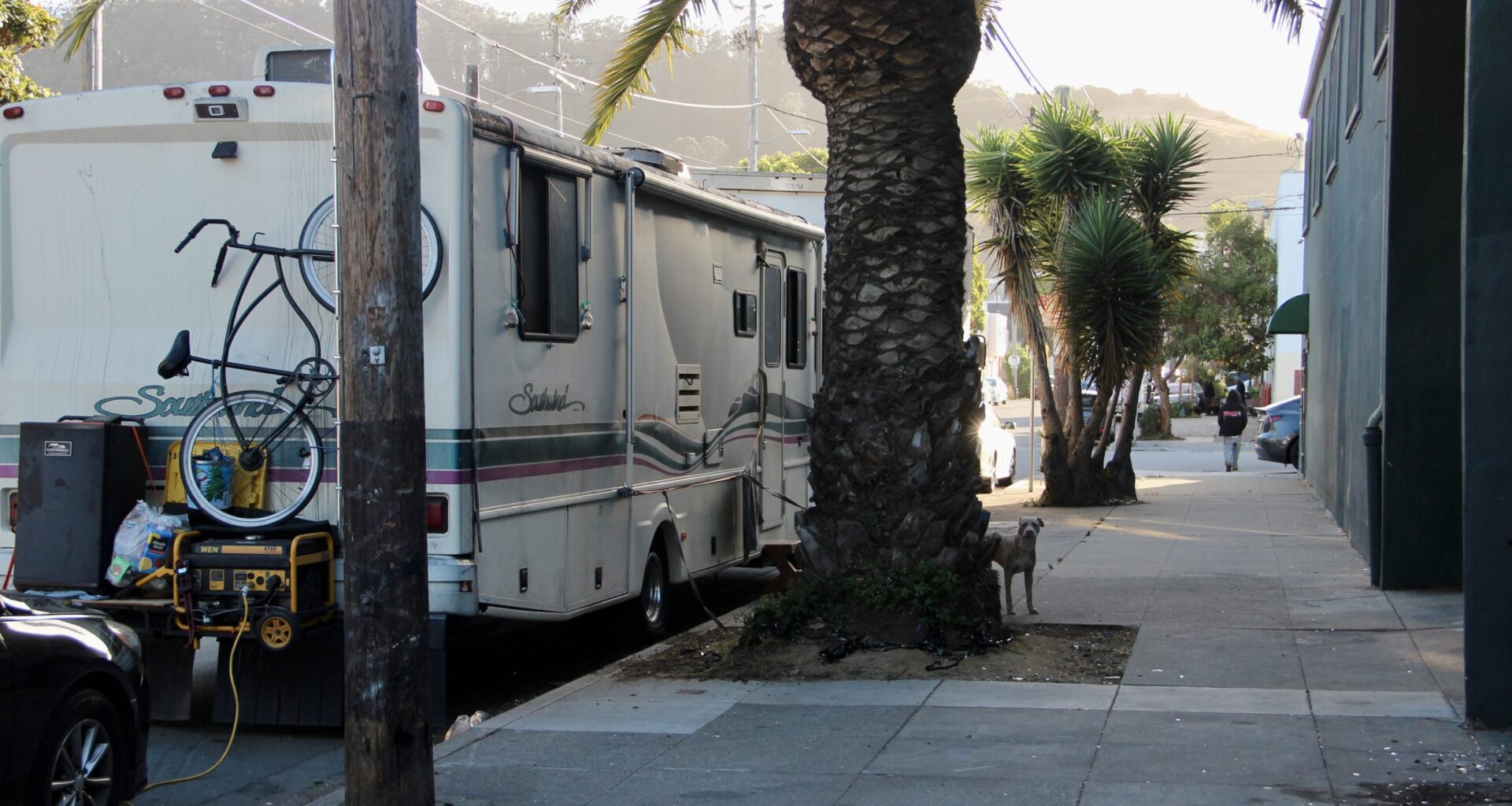
Mayor Daniel Lurie on Friday announced he is putting $450,000 toward a pilot program that will pay one month’s rent to property owners who agree to reserve vacant units for families and single adults who are currently living in RVs.
The program, part of Lurie’s $37.5 million “Breaking the Cycle” initiative on homelessness, will prioritize the residents of 325 RVs who have already qualified for a monthly rental subsidy offered by the city. Those RV dwellers also have temporary permits to park on city streets as long as they continue to work with a case manager to find a legal form of housing.
The $450,000 in reservation fees is in addition to $12.9 million that the city has allocated to help house this group, which will be used in housing vouchers, homeless outreach, and traffic enforcement.
“With this program, we’re putting one of those ideas into practice and helping families living in vehicles get into homes faster,” Lurie said in a statement. “Families living in vehicles should have a chance to access stable housing — and when families are ready for housing, we need to be ready too.”
The announcement comes on the heels of the Nov. 1 implementation of Lurie’s controversial RV ban, which made it legal to tow unpermitted RVs or large vehicles on any city street if they remain in the same place for more than two hours at a time.
RV dwellers are now essentially broken up into two groups: those who were able to get a six-month permit that allowed them to continue parking on city streets as long as they’re taking steps towards finding permanent housing, and those who did not get a permit and whose RVs can be towed any time.
It’s only those in the former group who are eligible for this new program.
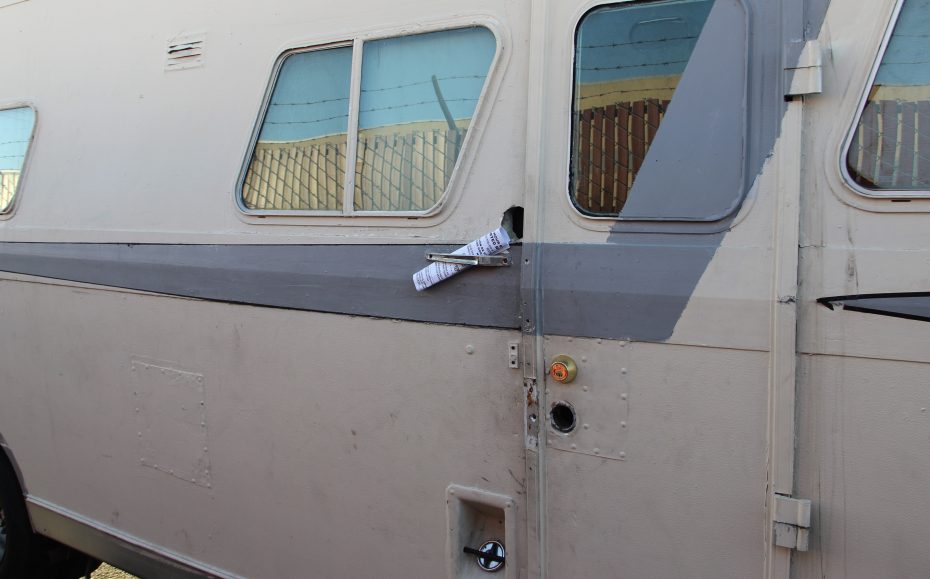 A flyer warning an absent RV resident that towing has begun was placed by the doorway to the vehicle on Thursday, Nov. 6, 2025. Photo by Marina Newman.
Critics say that San Francisco does not have enough vacant units to provide permanent housing for the hundreds of RV dwellers deemed eligible for a temporary permit — or the significant number who did not manage to get a temporary permit at all.
Many RV dwellers struggled to prove that they qualified for the extension permits and said they were frustrated when asked to interface with an AI chatbot that at times gave them wrong information.
The San Francisco 2024 Point in Time count found an estimated 1,442 people living in vehicles across the city — well over three times the 400 or so people who are currently covered by the temporary RV permits.
The mayor’s office cited a lack of available units to house this group of RV dwellers in search of new housing as a key reason for the new reservation fee program.
Landlords who successfully apply for the program and agree to hold vacant units are under no obligation to actually sign a lease with any of the RV dwellers who might apply — they will collect the fee no matter what. However, landlords can’t deny RV dwellers based on their income or credit alone, according to the mayor’s office.
Landlords and RV dwellers will go through a matching process coordinated by Catholic Charities to make sure it’s a good fit, the mayor’s office added.
So far, “a handful of landlords” have expressed interest in participating, according to the mayor’s office. To qualify, a landlord must have a vacant unit with a monthly rent that falls below the amount set forward by the U.S. Department of Housing and Urban Development in their small area fair market rent guidelines, which they adjust every year.
Based on the guidelines, those rents will vary depending on the zip codes. For example, in the Mission District, which has the 94110 zip code, $2,120 is the rent limit for a studio apartment, $2,540 for a one-bedroom, $3,080 for a two-bedroom, $3,930 for a three-bedroom, and $4,080 for a four-bedroom.
To apply, landlords will need to fill out a form online and agree to an inspection. Once a landlord has been approved, they will be paid a month’s worth of rent at the end of the 30-day period, regardless of whether or not their unit is rented out.
Lurie launched the “Breaking the Cycle” initiative in March 2025 with the goal of “fundamentally transforming the city’s health and homelessness response.” He launched the fund, which uses private philanthropic dollars to help implement the initiative, in May.
 Mayor Daniel Lurie attends a San Francisco Board of Supervisors meeting on Oct. 21, 2025. Photo by Mariana Garcia.
The mayor’s office and the Department of Homelessness and Supportive Housing said they will monitor the program to see if it’s a success.
“This reward is not just for the landlord, but for people to get a second chance,” said Wayne Huey, a licensed real estate agent who works as a rental housing broker in San Francisco. Huey heard about the new program from the mayor’s office, which has already begun holding information sessions on the pilot program.
As a rental housing broker, Huey said, he often finds himself helping landlords understand how rental subsidies work, and breaking down the stigma around renting to people who qualify for housing subsidies by assuring landlords that they will still get paid rent, but just through a different way.
Among the other benefits to prospective landlords listed on the city’s website: “Access to a pool of ready-to-rent tenants,” “housing specialists answer landlord questions & mitigate risk if it arises,” “lower turnover rate,” and “be part of the solution to end homelessness by doing what you already do.”
“This program would help provide housing for people who need housing in the short term,” Huey said. “One family at a time. One individual at a time.”
Additional reporting by Marina Newman