
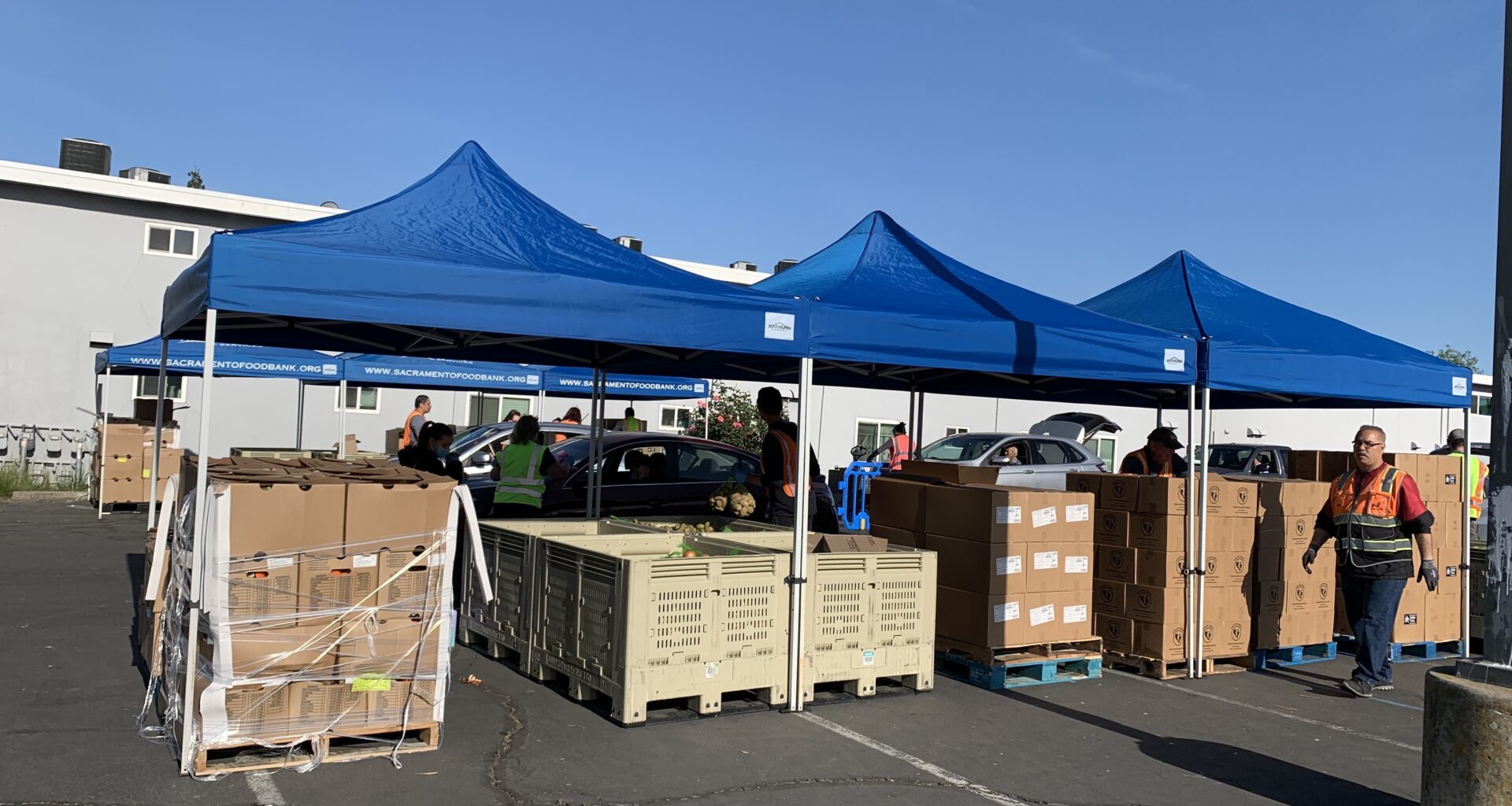
The holiday season is approaching, which brings an increased demand for local food banks and assistance programs.
This year, the need also comes on the heels of unprecedented uncertainty caused by the disruption of food benefits during the longest-ever government shutdown.
Insight Host Vicki Gonzalez spoke with organizations in Sacramento, the Central Valley and the North State about the challenges they are facing amid the surge in demand, and the resources they need the most.
Kevin Buffalino is the Director of Communications at Sacramento Food Bank & Family Services.
Leonard Hansen is the President and CEO of the Emergency Food Bank of Stockton-San Joaquin.
Joe Ayer is the Executive Director of Dignity Health Connected Living based in Redding, which serves counties across the North State.
This interview has been edited for length and clarity.
Interview highlights
It’s a busy time for all of you, tell us a little bit about the communities that you serve?
BUFFALINO: Sacramento Food Bank and Family Services is responsible as the food bank for all of Sacramento County. We have 110 partner agencies throughout Sacramento County. If you envision the anti-hunger network as a funnel, we’re at the top… We procure the food, give it out to those agencies, and then they get into the hands of our neighbors in need.
HANSEN: The Emergency Food Bank serves all of San Joaquin County and we have 107 sites that we serve throughout the county with various programs including a client-facing pantry here at the food bank.
AYER: We’re more than just a food bank. We actually do a lot of senior services and a lot of other kinds of food programs throughout nine counties, but we are the designated food bank for Shasta County. So we are definitely a lot smaller and definitely a lot more rural than my two counterparts here. We have about 23 partners and we serve about 8,000-10,000 people every month. About 4.5 million pounds of food every year, but equally busy in a county that is very impoverished. We go to places where there’s snow, to places that can’t always get reached. We have people come through our food bank line on four-wheelers to get their food because they’re very rural.
How has demand changed this year?
BUFFALINO: We are seeing historic demand. We actually just got our numbers for the month of October, and we fed over 372,000 people. Our organization has been around for 49 years. That is the highest month we’ve ever had in our 49-year history. Our previous high month was last October, October of 2024, and that was even an 8% increase over last year. So, it has continued to grow ever since COVID. It’s continued to grow over the past 5 years, and it reached an all-time peak last month with the government shutdown, the delay in those CalFresh benefits, and then the holiday is all coming together and creating this hunger crisis we’re seeing.
HANSEN: We were serving about 450 cars a day at the food pantry itself in January. In the last six or seven weeks, it’s been 620 cars a day. So that’s 35% more and that’s driven by the immediate issues that occurred with the government shutdown and the changes with SNAP. That hasn’t ameliorated, and here in San Joaquin County we have a notable increase of almost twice as many people coming to the food bank as they did in 2019.
AYER: We only have five staff that work this department here and hundreds of volunteers. But in the recent weeks, we have definitely seen an increase. We have an emergency food counter that’s open daily and normally we see three to four a day that come through, which I know is probably funny to my city friends. But lately it’s been up to 25-30, which is quite a bit for us and that’s a pretty heavy load. In our drive-through distributions, our main distribution at the Redding site, we have distributions that we may see 300-400 people come through and we’ve definitely seen about a 25% increase in those distributions.
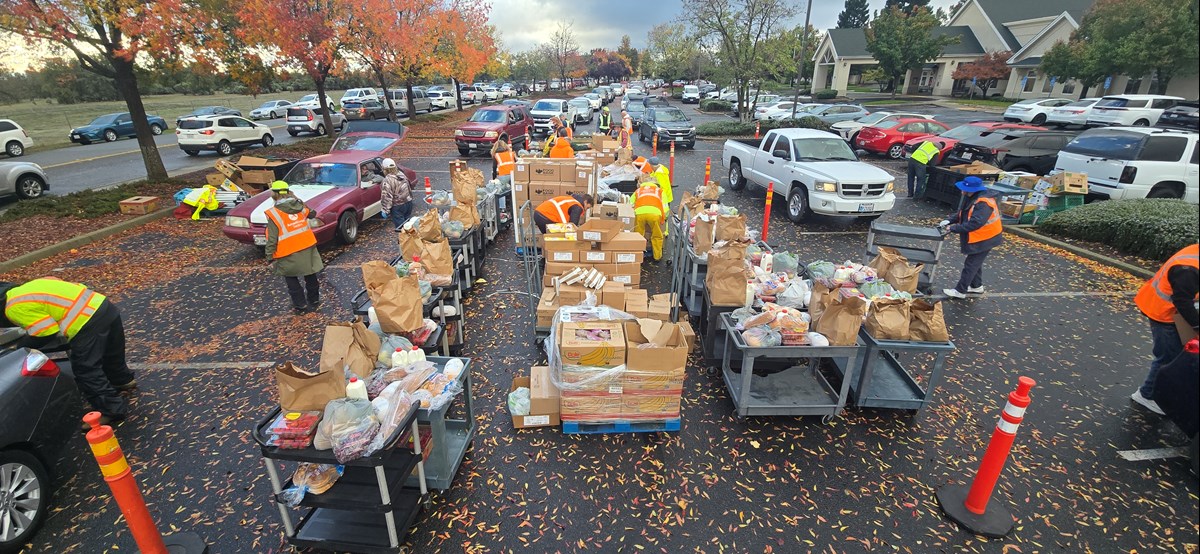 Dignity Health Connected Living serves as the designated food bank for Shasta County, and has links to service and food programs in nine counties across the North State.Courtesy of Dignity Health Connected Living
What are some of the biggest misconceptions around food and security that you’d like to dismantle? What would you like people to better understand?
BUFFALINO: I’d say the biggest one we hear is that people think the majority of the people we’re serving are either unhoused or unemployed, where that truthfully is a very small percentage of the people we serve. Most of those coming through the distributions are housed. Most of them have one income, if not multiple incomes, in their household.
For us the two populations we’re seeing a lot of right now are seniors who are on a fixed income… [The] benefits that they’re receiving in their retirement just can’t keep up with the cost of living. And another one are families who are on a single income. It’s really hard to feed children, to feed your entire family on just one income with the cost of utilities, the cost of groceries right now.
HANSEN: Kevin is correct and accurate for Stockton as well. One of the other things that we work on at our food bank is “food is medicine.” We found through a partnership… that almost 60% of Stockton is either pre-diabetic or diabetic. And we are serving that with tailored meal boxes and nutrition education, online classes and classes here at the food bank. We get actual references from community medical centers and Dignity Health… and last year we served over 4,000 patients. That is something that at the levels of income that our average recipient earns, it’s not something they would normally have.
What are your greatest needs right now?
BUFFALINO: For us it’s certainly monetary donations. There are a lot of people who reach out wanting to donate canned goods or those types of things. And we’ll certainly accept those things or we’ll put them in touch with one of our partner agencies who will accept those. But for us monetary donations are really the best way. We can stretch that dollar a lot further than you can at the grocery store. The $10 that you give to the food bank can actually turn into three meals, it’s about $1 for every three meals.
Helping hands are always enormous for us as well. We’re heading into the holidays and then into 2026, we’re already booking out some volunteer shifts then. We use almost 1,000 volunteers every month to do the work.
AYER: I often refer to us as being very scrappy in what we do. We’re able to do it with those five employees, but we have several hundred volunteers that also are part of that. And these are volunteers that are not just in Redding but they are out in our rural areas [like] Lakehead, Burney, places that people don’t go very often. That’s where we need a lot of volunteers.
We also would say that we do need financial donations as well. Donations to us, we are able to use that money in an expedited way. We’re able to multiply it in lots of ways because we buy at a much different rate than an individual does. We will take individual donations of food and things, but typically the other ways are better.
HANSEN: Donations were down and all year long we’ve had a scramble, even with regular large donating organizations. There are several really large warehouses here, and their sales are different and sometimes down, and their opportunities to give to us have been more difficult. We of course are still grateful for all that they do, but we drive a little farther and we move a little farther to find more food.
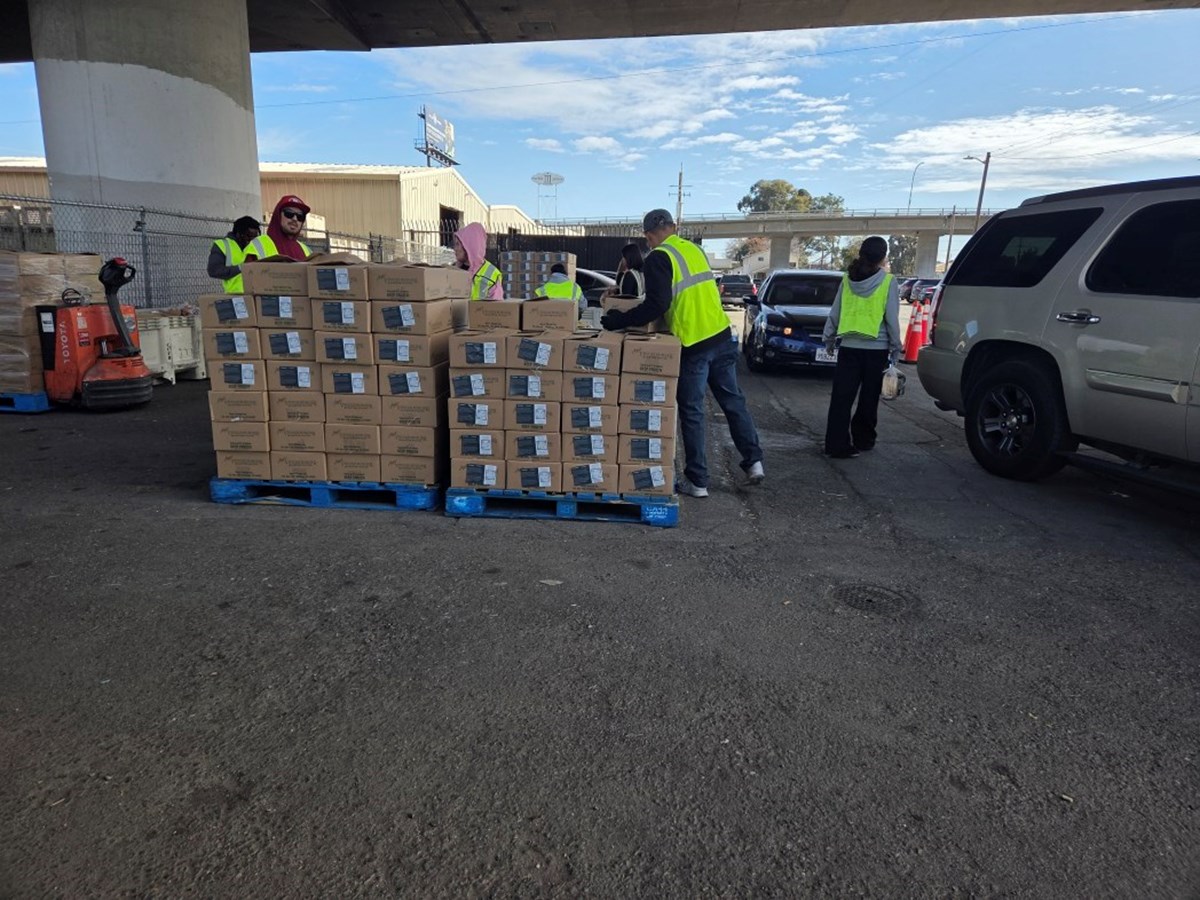 Members of the Emergency Food Bank of Stockton-San Joaquin stack boxes of goods. Officials noted a significant increase in participants following the government shutdown.Courtesy of Emergency Food Bank of Stockton-San Joaquin
We have been blessed by a considerable amount of actual food drives in the last four or five weeks. We had over 100 barrels picked up yesterday, so the actual food coming in has been terrific. As Kevin said, we can stretch a dollar and it is most useful for us to do that. We can also offer an opportunity to support the food bank. If you want to come down on Thanksgiving morning and make room for your stuffing by doing a 5K or 10K with us… with the Run and Walk Against Hunger. It’s our 21st year and that’s our major fundraiser. And I’ll of course leave that open for my friend in Sacramento who does the same thing.
BUFFALINO: Yes, we have Run to Feed the Hungry coming up, it’s our 32nd year. That’s on Thanksgiving morning and it’s actually the largest Thanksgiving day fund run in the country. Started with less than 1,000 participants and last year we had nearly 32,000.