
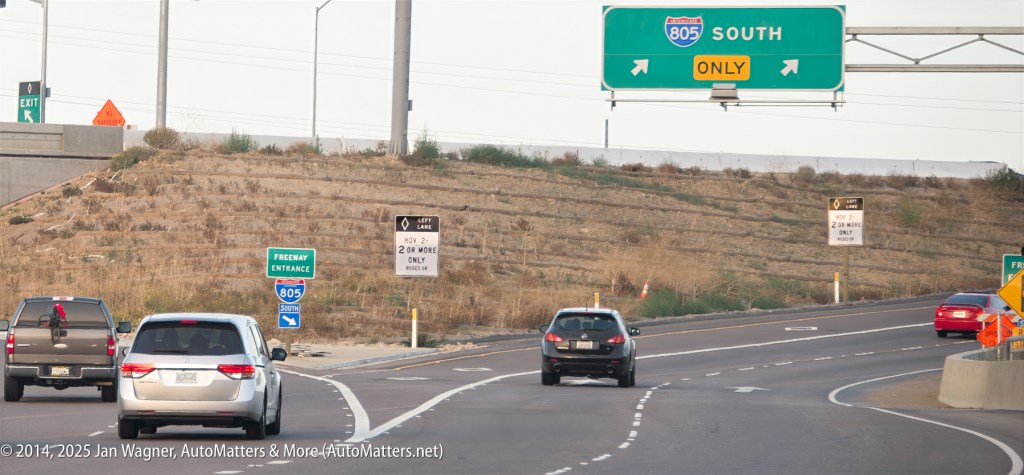
On Oct. 1, 2025, the Clean Air Vehicles decal program ended. That means that vehicles in the State of California — and elsewhere — with a set of state-issued carpool lane stickers (CAV decals) may no longer drive in the High Occupancy Vehicle (HOV — carpool) lanes with only a single occupant in the vehicle.
According to the State of California’s Department of Motor Vehicles, all cars must follow posted vehicle occupancy requirements. Drivers who violate the law may receive a citation. The DMV stopped accepting applications for CAV decals on Aug. 29, 2025.
The reason is because the federal regulations that allowed states to issue Clean Air Vehicle (CAV) decals expired on Sept. 30. CAV decals will no longer be valid in California, or elsewhere in the United States. The federal government’s decision not to extend the program made ALL decals invalid as of Oct. 1, regardless of the date they were issued.
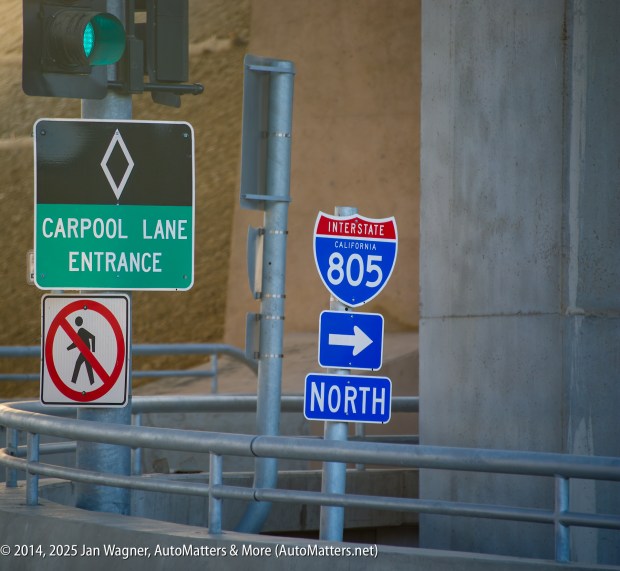 Direction to an HOV lane
(Jan Wagner)
“This is a great program for climate-conscious Californians,” said Director Steve Gordon. “We have issued over one million decals since this program was approved, which has helped to foster a change in how we drive. Californians are committed to lowering their carbon footprint and these decals helped drivers be good stewards of our highways and environment. By taking away this program, hundreds of thousands of California’s drivers will pay the price. It’s a lose-lose and we urge the federal government to retain this program.”
According to the California DMV, HOV lane access for single-occupant clean vehicles in California was first authorized in 1999, with the most recent reauthorization of the program coming in 2017. The California DMV began issuing Clean Air Vehicle decals to qualifying vehicles under the current program on Jan. 1, 2019. CAV decals expired on Jan. 1 of the fourth year after they were issued. Now, all CAV decals became invalid as of Oct. 1, 2025.
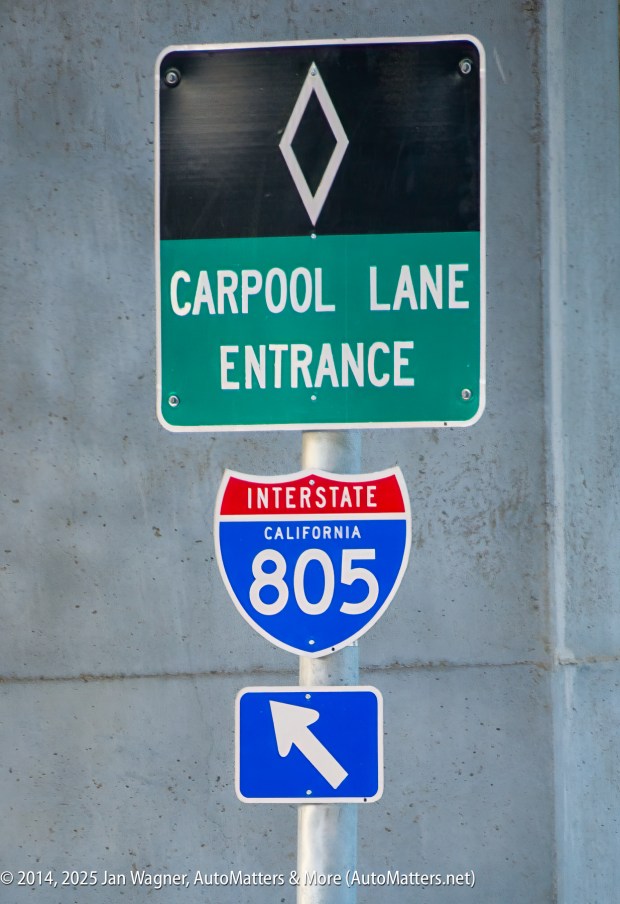 Directional sign to an HOV lane on the 805
(Jan Wagner)
This program had good intentions, but also had direct benefits to California drivers. I purchased my 2012 Toyota plug-in Prius for many reasons, including its great gas mileage, practical hatchback body style and legendary Toyota quality, but what moved the plug-in Prius to the head of the list of the vehicles that I had been considering was its eligibility for California’s carpool lane stickers. I have solar panels on the roof of my house, so I hired an electrician to wire my garage for faster charging than with the 120-volt plug.
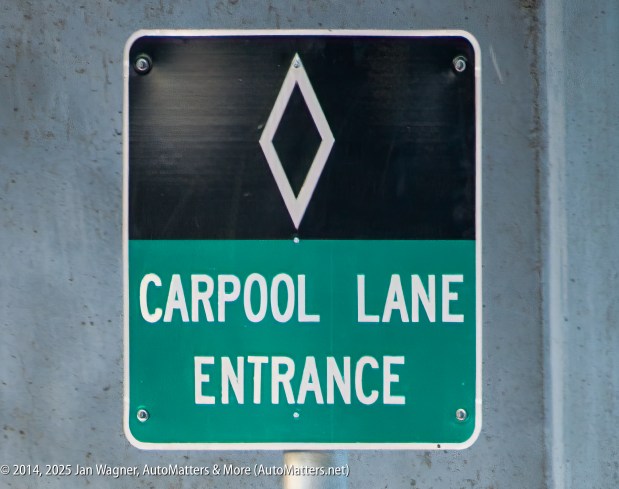 HOV lane sign
(Jan Wagner)
To cover events and places for “AutoMatters & More” columns, I often drive north. These events include the Grand Prix of Long Beach, the LA Auto Show, theme parks, special events and more. This requires that I drive on our crowded Southern California freeways.
Back when my plug-in Prius was new, vehicles that qualified for the HOV decal program were few and far between. As a result, the HOV lanes were relatively uncrowded. They offered smooth sailing for me. I often cruised past numerous vehicles that were barely moving in the other lands of the freeway.
That prompted me to eventually purchase another plug-in hybrid vehicle when it came time to replace my Prius plug-in hybrid. That new vehicle, which I still own and drive as my primary, everyday vehicle, is a 2021 Toyota RAV4 Plug-In Hybrid. It is a much better all-around vehicle for my needs, and it has the added benefit of longer EV range (switch-selectable). This vehicle is rated for up to 42 electric miles, and I often achieve that.
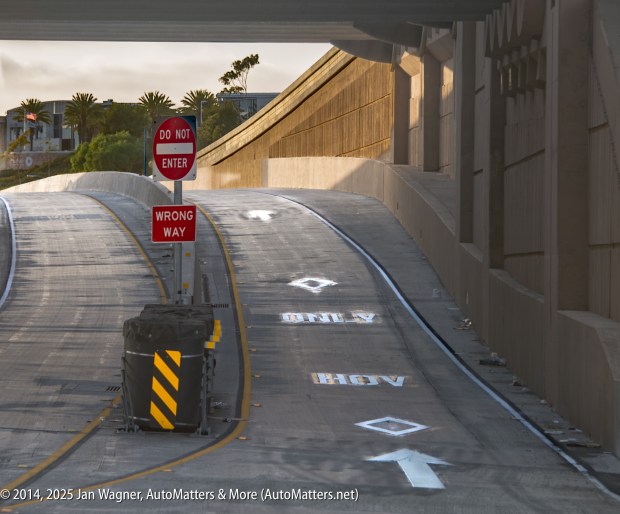 On-ramp to an HOV lane on the freeway
(Jan Wagner)
Over time, more vehicles qualified for the HOV decal program, and the HOV lanes became much more congested. Nevertheless, driving in the HOV lanes was still preferable much of the time.
I was pleasantly surprised when the expiration dates of my HOV decals were extended. Those extensions eventually carried me through to the end of the program.
Now the HOV lanes are much less crowded. People who drive in them must meet the vehicle occupancy requirements. As I sit in bumper to bumper, slowly moving traffic in the regular lanes, I see the vehicles sail past in the HOV lanes. I remember and miss the days when I used to be able to do that.
For more information, visit: https://www.dmv.ca.gov/portal/news-and-media/federal-government-ends-clean-air-vehicle-cav-decal-program/.
To explore a wide variety of content dating back to 2002, with the most photos and the latest text, visit “AutoMatters & More” at https://automatters.net. Search by title or topic in the Search Bar in the middle of the Home Page, or click on the blue ‘years’ boxes and browse.
Copyright © 2025 by Jan Wagner – AutoMatters & More #907