
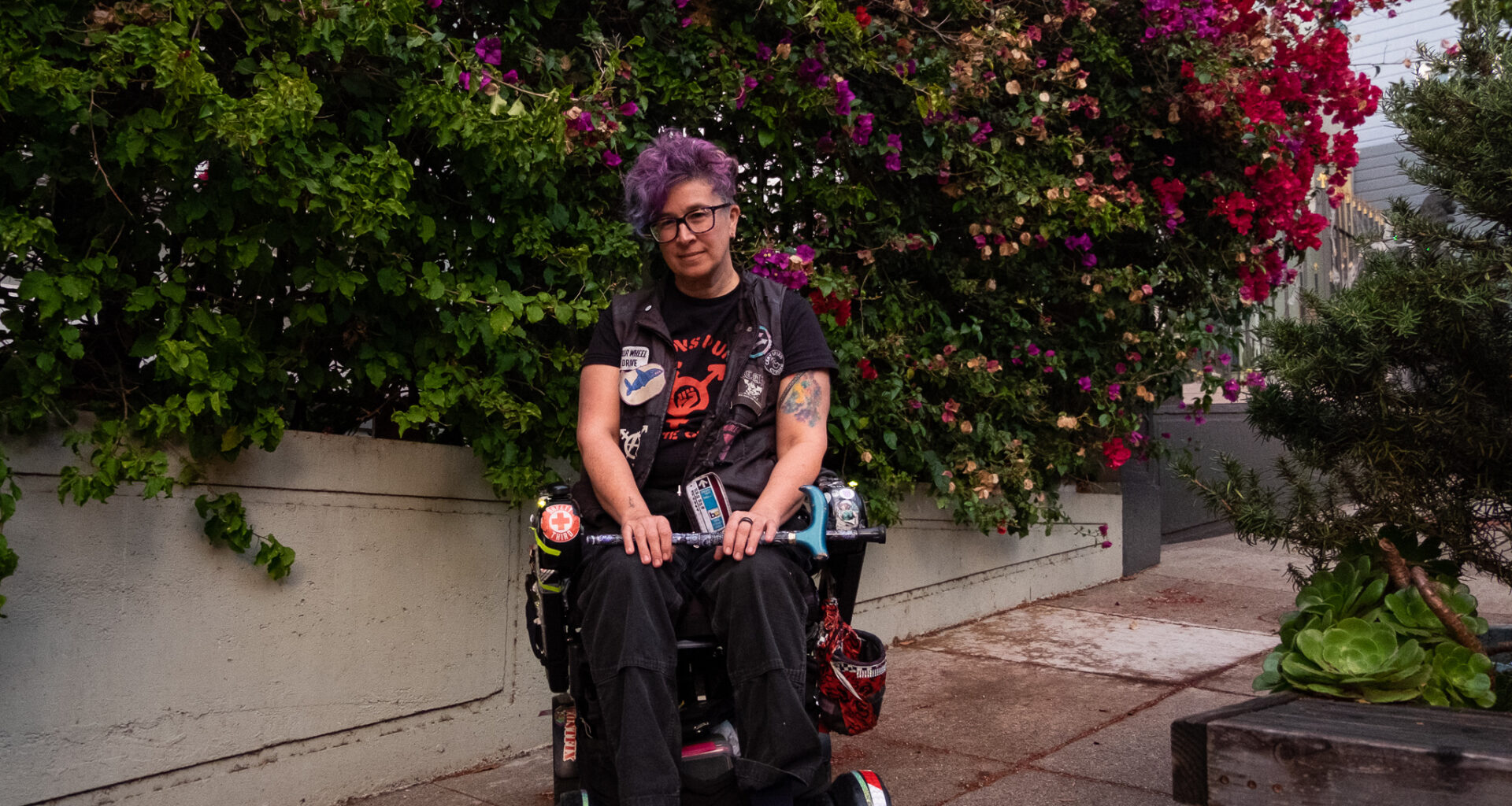
Fiona Hinze can see it coming when she spins around the streets of San Francisco: An indicator showing that her wheelchair battery is running out of juice.
Hinze is always with someone when she’s out with her power chair. When the battery dies, she switches on the manual mode, takes the chair out of gear, and asks her companion to push her chair — which weighs a couple hundred pounds, plus her body weight — to her car.
“Really, you just focus on getting somewhere safe,” said Hinze, director of public policy at the Independent Living Resource Center, a disability-rights advocacy group in San Francisco.
Hinze, like other wheelchair users, keeps a mental map of possible charging locations: the library, friendly restaurants or cafes. Sometimes, chair users ask public-toilet attendants if they can plug into the city’s outlets, even though that’s against city rules.
Wheelchair users are forced to strategize like this because San Francisco, unlike other even smaller cities, has zero public electric-wheelchair charging stations, according to a 2024 report presented to the Mayor’s Disability Council under Mayor London Breed.
City officials say they are working on the issue, but wheelchair charging offers a unique set of problems, and wheelchair users complain about a lack of progress.
Allen Jones, a wheelchair user and former District 5 supervisor candidate, was frustrated to see the city touting EV charging ports, for instance, while leaving electric-wheelchair users in the dust: San Francisco has more than 1,100 publicly accessible charging ports — a 470 percent increase since 2019 — for electric vehicles, and none for wheelchairs.
“We who use an electric wheelchair to get around town should not be left to fend for ourselves,” Jones said. The lack of charging ports means wheelchair users are often effectively confined to different parts of the city.
“I live downtown, and would love to spend time in Golden Gate Park,” Jones said. “But I can’t, because the distance drains my wheelchair batteries to the point of making a round trip nearly impossible.”
Slow progress
The 2024 report on wheelchair charging found that each charging station costs just $749, compared to around $1,200 to $3,500 for electric-vehicle ports. They have been installed in other cities around the country. Seattle, for example, installed a power-wheelchair charging station at its central library earlier this year.
“It does seem like something that wouldn’t cost a lot to be implemented as a pilot project,” said Liz Henry, a chair user and part-time worker at the Disability Cultural Center, which provides free charging at 165 Grove St. near Civic Center.
“See if people use it. See how much it costs in electricity and equipment. See if it creates social problems. I think it would be worth it,” Henry said.
The city has already received funding for wheelchair ports. In March, the San Francisco Municipal Transportation Agency was awarded a $2.2 million grant to expand charging access in San Francisco.
Most of the funding will be used to install electric-vehicle charging stations, but it also promises “e-bike and assistive mobility device charging infrastructure at up to two locations.”
SFMTA, in a statement, said it will be designing and implementing two “mobility device charging hubs” in its off-street parking garages, but the agency did not specify the locations.
The agency is also looking to include wheelchair charging in its mobility hub program, which aims to create spaces in the southeastern part of the city — from Bayview to the Excelsior — that will connect transit and community services all in one place.
“The SFMTA recognizes the need for charging personal mobility devices,” the statement reads. “Staff are actively keeping that in mind as opportunities and funding arise.”
One obstacle is the “proliferation of new and potentially lower-quality lithium-ion batteries” in power wheelchairs, which can damage mobility devices and increase the risk of fires and injuries, according to a statement from the San Francisco Human Services Agency. The agency oversees the Office on Disability and Accessibility.
“Given these new developments, which pose serious safety considerations, these charging stations will and must be carefully designed in order to ensure safe operations for all,” the statement reads.
The Recreation and Parks Department, for its part, said it has installed an outlet that can charge wheelchairs in the Botanical Garden in Golden Gate Park. But users need to bring their own chargers.
The department is adding “a small concrete pad to improve access and maintain nearby seating,” and finalizing signage.
But for Jones, who has been advocating for public electric wheelchair charging stations since 2022, these efforts are too little, and too slow.
Stuck in the chair
Advocates are particularly worried about unhoused wheelchair users.
Just like electric cars, different electric wheelchairs can make it different distances before needing to power up. Some users have access to better chairs or spare lithium batteries, like Henry, the wheelchair user who lives in Bernal Heights.
They call their spare battery a “luxury” that lets them travel from their home to Berkeley by BART and back, run a couple of errands, and “be okay.”
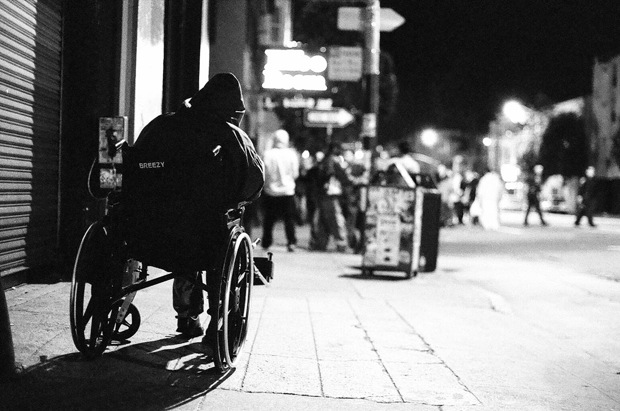 Breezy sits in the wheelchair in the Mission. Photo by Armand Emamdjomeh in 2009.
But for those living on the streets, it’s challenging enough just to make sure chairs aren’t stolen, Henry said, and to keep track of where their chargers are.
While Henry can usually get away with charging their wheelchair at a cafe or restaurant, merchants might turn away someone who is visibly homeless.
And it usually takes two to three hours of charging to get someone going, said Vincent Lopez, a wheelchair repair technician with the Independent Living Resource Center. That means people in wheelchairs have to stay put, and the location of a charging station matters.
“You have to feel safe, because sometimes you’re stuck there for several hours,” said Hinze.
For now, people whose wheelchair batteries are running low can ask for help from people like Lopez.
Under a contract with the city’s Human Services Agency, Lopez works from Monday to Friday to respond to people who face a dead battery or broken chair on the street. He brings a portable charger, batteries and a cord, and can pick people up in a wheelchair van and take them somewhere safe.
But it’s an imperfect solution. If a breakdown happens late at night or on the weekend when Lopez isn’t available, people could still be stuck.
To prevent that, Henry would like to see a high-speed portable wheelchair charger become part of the standard emergency response from the city’s street teams.
“If you’re stranded, you could call and they can charge your chair on the street and then you would be independent again,” Henry said.
But widely available charging stations could prevent that situation, they added. “That’s better than people being stuck in the corner all night with a wheelchair that won’t go anywhere, and possibly having to call emergency services, who may or may not help them.”