
This is the sixth and final part of a series exploring electric bicycles, their local impact and the ongoing controversy that surrounds them.
With e-bikes and other electric mobility devices being credited with revolutionizing travel for young people, one might assume they are here to stay. But creating a culture of safe e-bike use could be seen as an uphill battle.
From education to parental involvement to changes in the bikes and roads, improving e-bike safety likely will take a multifaceted approach. Here’s a look at some of the recommendations from various people involved.
Retail
As the landscape of e-bike sales and use changes, retailers are along for the ride.
La Jolla resident Kyle Dugger is the founder of Ride1Up, a direct-to-customer e-bike store located between Old Town San Diego and San Diego International Airport. He made his first e-bike in 2015 and opened the business three years later.
He saw e-bikes simply as a better way to get around rather than a revolution in travel.
As time goes on, he said, he expects e-bikes to become lighter and safer.
“E-mobility in general is going to go nowhere but up in terms of the product and use case improvements,” Dugger said. “Batteries are going to continue to get lighter … [and] safety will start to become less and less of a concern as the tech grows more mature and sophisticated.”
In the meantime, Tracy Sheffer, co-owner of Pedego Electric Bikes La Jolla, said she explains to parents that they are as responsible for their children riding safely as the children are.
“We all assume that kids know the rules of the road because they drive in the vehicle with us, but they’re on their phones [and] they’re not paying attention,” Sheffer said. “And even if they were, until you start driving you don’t necessarily understand the rules of the road. It doesn’t actually make sense to you until you’re behind that wheel.”
Series story gallery: Charged Up: The Rise of E-bikes
Parents
La Jolla resident Katherine Nguyen Williams, a child psychologist and mother of four sons, said parents should make talking with their young e-bike riders as much of a conversation as possible, instead of a lecture.
While it is good to “talk to kids,” there is a fine line between dialogue and the point when teenagers will “roll their eyes,” she said.
“There are definitely some research-based guidelines that parents can use,” Nguyen Williams said. “Like, start with curiosity and open questions.”
“Ask them about what interests them about an e-bike, what feels safe or unsafe, and what they think they might do in certain scenarios,” she said. “Ask them questions to lower their defenses and really make it a conversation.
“When they feel heard and considered, they are more likely to follow the rules.”
Questions can include “What would you do if a car pulled out quickly in front of you?” or “What would you say if a friend was pressuring you to do something unsafe?”
By letting the rider come up with the answers, he or she is more likely to remember them, Nguyen Williams said.
She also recommends developing a set of rules that both the child and the parents can agree on and creating a “contract” with the terms under which a rider can have and keep an e-bike.
“Frame it so they see safe riding as a way to independence, not just you controlling them,” she said. “If you sit down with them and co-create the rules and then go over them clearly in a way everyone can agree to, they are more likely to comply.”
However, she cautioned the rules must not be up for interpretation and that consequences must be established in advance.
Another point parents need to nail down, Nguyen Williams said, is that owning and riding an e-bike is a privilege, not a right.
“That sets the tone that it … can be taken away if the rules are not followed and that the parents are the one that can do that,” she said.
The parents also can be partners in safe e-bike ownership.
For example, a parent might be responsible for making sure the bike is charged, but the rider must be responsible for letting the parent know if something needs to be repaired, she said.
Nguyen Williams said she also encourages parents to remember that the part of the brain that manages quick decisions and the ability to fully understand safety doesn’t develop entirely until a person’s mid-20s (that’s why the minimum age to rent a car is 25 and why insurance rates drop at that point).
“Be their executive functioning until they are able to,” Nguyen Williams said. “And keep the conversation short, don’t have one big lecture. Their attention span is only so much. So keep the conversations frequent but small.”
From a public safety perspective, San Diego police officer Dustin Welsh said he wants parents to, first and foremost, understand the differences between e-bikes and e-motorcycles “and the legality and intended use for both of them.”
E-bikes offer pedal assist with motors that can reach top speed of 20-28 mph. E-motorcycles, also known as e-motos and e-dirt bikes, do not have pedals and are powered by motors that can reach speeds up to 50 mph or more.
E-bikes are legal to ride on public streets; e-motos are legal only for off-road use.
“Parents need to know the serious injuries a child can sustain from the speeds the e-motos can achieve when ridden on the roadways,” Welsh said. “The e-motos were never made for roadways from the manufacturer, so they don’t have certain features to make them more visible, [such as] full-time headlights, turn signals and brake lights.
“Kids riding the e-motos also lack the knowledge of roadway laws and experience, which makes it dangerous for drivers and riders both. Even with the best riders … accidents still happen.”
Regulations
Sheffer said it’s too early to know whether government agencies will require certifications for e-bike ridership, but she has heard demand for that from parents and customers, as well as in public forums and classes.
“I am very hopeful that for kids that are under driving age, there will be some sort of certification in the future — that they will need to take an e-bike certification course and carry a card with them, just like we do with a driver’s license,” Sheffer said.
“The main issue is just the rules of the road — and it’s no different than riding a bike, whether it’s an e-bike or a regular bike.”
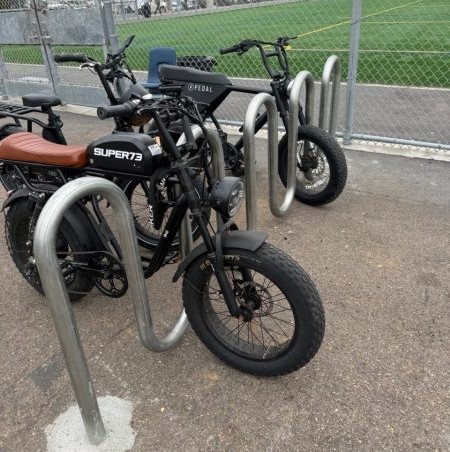 E-bikes are stored in new racks at Pacific Beach Middle School. The racks are made to accommodate the longer, heavier bicycles, compared with traditional bikes. (Provided by Kristen Everett)
California Assemblywoman Tasha Boerner (D-Encinitas), whose 77th District includes La Jolla, introduced a bill in February 2024 proposing to require would-be e-bike riders without a valid driver’s license (i.e., those younger than 16 or who haven’t taken driver education courses) to take an online e-bike safety training course, complete a written test and receive a “license” (state-issued photo ID) to operate an e-bike.
However, in ensuing months, various state departments weighed in and found the proposal to be too expensive and labor-intensive.
The bill, AB 2234, was amended to a pilot program to prohibit children younger than 12 from riding e-bikes in San Diego County areas that opt into it. The bill was signed by Gov. Gavin Newsom in September 2024 and went into effect in January.
As of last week, six cities in the county — San Marcos, Coronado, Chula Vista, Poway, Carlsbad and Santee — either had adopted the AB 2234 age restriction or were in the process of doing so.
Dugger said he wouldn’t necessarily suggest a certification process but added that driver education courses or some sort of local class could benefit riders younger than 16.
Sheffer said she informs customers of e-bike safety courses and best practices for new riders.
“The safety of our children is the most important thing,” she said. “E-bikes play an amazing role, and we are so pro-e-bike.”
Street design
Bird Rock resident Harry Bubbins, a biking advocate and member of the La Jolla Community Planning Association board, said multiple measures, including “smarter street design,” should be taken to help “unlock the full potential of e-bikes.”
He believes solutions should include creating protected bike lanes, lowering vehicle speed limits in key corridors and taking other steps to promote calmer traffic.
Leaders “must approach this from a holistic, enabling perspective focusing on safe infrastructure rather than knee-jerk punitive restrictions that only reduce mobility opportunities for residents of all ages,” Bubbins said.
Respect Bird Rock, a local group of which Bubbins is an organizer, has advocated lower speed limits on La Jolla Boulevard since the group’s founding in 2022.
“The traditional model of wide streets designed primarily for fast-moving car traffic is unsuitable and even dangerous for any community,” Bubbins said. “To support more walkable neighborhoods, we must redesign our streets to safely accommodate more people using various modes of transportation — people walking, cycling, taking transit and making local deliveries, in addition to drivers.”
With many trips lasting three miles or less, Bubbins believes e-bikes offer “a massive opportunity” to change travel habits.
“By prioritizing a protected network of bike lanes and calmed traffic, we can ensure a student riding to La Jolla High or a senior citizen going to The Cove feels completely safe,” he said. “This is how we reclaim our village from congestion and rediscover the joy of moving through our own community.”
Circulate San Diego — a nonprofit that partners with local governments, school districts, private planning firms and other organizations in an effort to create more mobility choices — also pointed to the prospect of reimagining roads.
Adding additional bike lanes, especially protected ones, could ensure safety not just for e-bikers but for cyclists in general.
“I think the lanes are the most important thing, but then the other thing that could happen is things that are often called traffic calming or a ‘lane diet,’” said Circulate San Diego Chief Executive Colin Parent. “There’s things that cities can do to slow down traffic and make sure the roads are safer, not just for bicyclists but also for pedestrians and motorists themselves.”
However, critics of adding bike lanes argue that cars would get less priority and traffic congestion could increase. Not to mention possible backlash against further condensing roads.
Future
Dugger gave a cautionary read on the growth of e-bikes, saying any inconvenience added to roadway traffic most likely will be disliked by the public.
“In terms of it changing transportation, it’s tough to say,” he said. “The American mindset is focused around cars, and we don’t want to get rid of our rights as drivers — most people don’t want to do that. There’s a sort of entitlement with drivers in the U.S., and California is no real exception there.”
“That’s a decision that the public and city leaders have to make,” Dugger said. “What’s best for the city, and can I handle that initial outrage?” ♦