
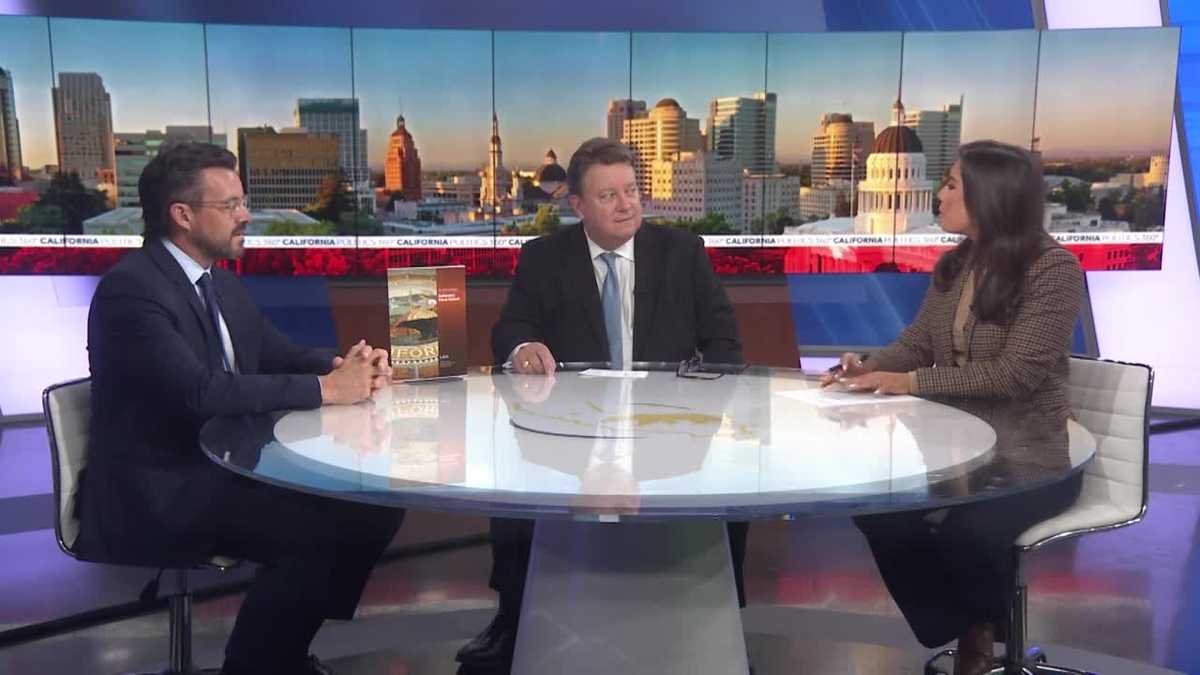
California’s legislative analyst, Newsom’s Department of Finance weigh in on state’s budget problem | California Politics 360
California state lawmakers and Governor Gavin Newsom have one big responsibility, and that’s to figure out how to spend taxpayer dollars. Joining us now is California legislative analyst Gabe Pettig, whose office advises the state legislature, as well as HD Palmer, the deputy director of external affairs for the California Department of Finance, Governor Newsom’s Department of Finance. Thank you both so much for being here. Thanks for having us. Gabe, I want to start with you. This week your office released its budget outlook, which is sitting here on the desk. You’re projecting an $18 billion budget shortfall for the upcoming year, and you also raised some red flags about the state’s structural budget. But for the everyday Californian who is relying on their state lawmakers to figure this out, essentially, what what is your message to them? Well, the message to the everyday Californian is that currently tax collections are coming in quite strongly, and that’s reflected in our outlook in the sense that over the budget period that we’re looking at, revenues would be up $11 billion relative to what was assumed before. However, on the expenditure side, the costs are running at *** higher rate than the growth. Expenditures and so in our estimates there are about 16 billion higher and so $16 billion higher in revenues, but only 11 billion higher in $16 billion in higher expenditures and only $11 billion higher in revenues is $5 billion in additional expenditures and when you add it to the deficit we were looking at back in June of $13 billion you get to 18 billion. And then I think maybe the bigger issue is that we have some concern about the sustainability of the recent tax collections. They seem to be fueled very much by what’s going on in the stock market, all the enthusiasm around AI, and we are concerned that that’s not likely to be sustainable. And so our revenue forecast is lower than it would be if we were just assuming those trends continued. The way they have been throughout the year, so the state is essentially at this moment spending more money than it is bringing in potentially in the scenario that you’ve laid out. That’s the trajectory that they’re on at this point. Does the Department of Finance agree with this assessment so far? We would agree in *** couple of different areas. One, that the pressures that Gabe and his team have outlined are ones that we’ve underscored and the governor has underscored throughout the year, things like Record levels of uncertainty from the federal government in terms of policy. Extreme volatility in the stock market, *** perennial issue for us, and growing costs and caseloads for *** number of our key state programs such as Medi-Cal, the state’s version of Medicaid that provides health care to about 15 million Californians, 1 out of every 3. So those pressures we think are going to continue. We will likely have some slightly different numbers in the governor’s budget when that comes out in January, but we too have projected that we have long term shortfalls that we do need to address, and the governor will have his proposal for how to deal with these challenges come the first week of January. I just want to stay with you because I mean Mr. Paddock, the LAO’s outlook. Basically says this is *** critical moment we’ve reached *** critical point where lawmakers and the governor will essentially may have to either cut spending or potentially find other ways to raise revenue, raise taxes essentially. We spoke earlier this week you noted that you know the governor may go in this direction of trying to control spending he has been clear in years past that he does not want to raise taxes, but I mean, are there any specific programs that the Department of Finance might recommend to him? There are *** range of options that we will have for him. I’m not going to get ahead of what kinds of decisions the governor is going to make after Thanksgiving that would fall under the category of what one of my former bosses called *** career move, and that wasn’t meant for positive professional development. So I’m not going to get ahead of what he’s going to decide other than we will present *** range of options for him to consider and then given where we think. The budget outlook is going to be again it will be slightly different, we believe, as it always is from where the LA’s estimates are for *** number of reasons. He’ll make his decisions, but I’m not going to get ahead of what he may or may not do just because we’re still in the process of finalizing and fine tuning our forecasts and our estimates. Gabe, I know the LAO stopped short of making specific recommendations to the legislature, but can you provide maybe any broad programs, broad areas that the LAO may recommend in the months to come? Yeah, well, what I think I could offer are some thoughts on the approach that we think the legislature should take, and it reflects the fact that in recent years that this will be the 4th year in *** row where the states faced *** deficit and in the past 3 years, *** lot of the solutions to the deficit have involved some. What we call one-time solutions, shifting funds around, borrowing money internally from other funds of state government and that sort of thing, drawing down on the state’s budget reserves and at this point those options have become attenuated. The range of them is narrower and so. You know, when we look at that coupled with the fact that in the future years, in the subsequent years after this budget year, we see *** pretty sizable structural deficit facing the state, we really would encourage the legislature to consider more of an ongoing approach, making ongoing reductions to programs or ongoing increases to revenues. Some combination of that to bridge the gap between revenues and expenditures is what we think is. OK, I mean California’s financial situation has seemed like *** roller coaster since the pandemic, *** record nearly $100 billion surplus shortly after the COVID-19 onset to these back to back to back years of budget shortfalls. HD, I mean how would you explain what has happened here over the last few years to just the everyday person? Um, you’re right, there’s never *** dull moment in our job at the Department of Finance and and engages in his teams just because it is so volatile and things are changing and because we are such *** big entity, uh, 40 million people, the 4th largest economy in the world if you just took our GDP alone. So there are *** lot of factors that affect us that can change us very quickly. Uh, that other states don’t face probably the, the one thing to bear in mind is for folks is how volatile our revenue stream is, and that’s *** blessing and *** curse if you will, because we have so many high tech firms that are leading the nation in the world in development, uh, and they are generating *** lot of money and one of the things that happens with our revenue. Stream is that we have *** very small group of taxpayers who derive *** lot of their income from things like capital gains and stock options, and that’s fueled in large part by what’s going on in the tech sector. So when the tech sector is doing well, these individuals are doing well and as *** result, our revenues are doing well. *** couple of very quick numbers to give you an idea about that. There are about *** little more than 17 million tax returns that were filed in California two years ago, the most recent data that we have. You just take 1% of those returns and they generated over 36% of all of the revenue that was provided in personal income tax. Take 1% or 0.1 of 1% of that 1%, about 17,000 tax returns, roughly filling gold in one arena. Uh, they projected that about $17 billion came from just that 0.11%. So small swings in the fortunes of those narrow bands of taxpayers can have dramatic swings both up and down in terms of our revenue. That’s one of the reasons that the legislature adopted changes to the so-called rainy day fund proposition too. To put more money into that account and make it harder to draw out of it when we’re in *** downturn. So there is *** certain amount of an insurance policy or shock absorber that’s there. Gabe referred to that in terms of the withdrawals from the rainy day fund, but that is not the only issue that we have to deal with in terms of trying to. Address whatever next year’s shortfall may be as well as the long term problem that Gabe has outlined. Gabe, I see you nodding your head here. I mean, do you pretty much agree with that? And is should the state rely so much? I mean, is there *** way that all of this could be restructured? To maybe not have so much volatility, so much unpredictableness when it comes to how much money the state is bringing in. Well, certainly there’s *** way, but over the years, the voters and the policymakers have have weighed in multiple times to land on the kind of structure that we have that HD just highlighted. And I think at this point we’re kind of living in the world that we have and our advice is to acknowledge the fact that we’ve had *** really good run with this personal income tax. There are various market indicators our staff is looking at that give them some concern about the valuation levels in the stock market, and when you compare to prior times in history. It seems like when some of these factors line up, you’re getting up to within *** year or two of when there could be *** market downturn, and if that happens, I mean, as HD knows we’re really in *** world of hurt. Our forecast factors in some of this risk, but not the explicit assumption of that happening. And if it did, we would really be looking at ***, you know, tens of billions of dollars in lower revenue, and that would really blow *** big hole in our budget. And so we think the process should begin now of thinking about that risk, factoring it into the budget decisions that the legislature will be making, and that’s again why we kind of think that that ongoing approach is what is called for and then there’s no daylight between us and the LAO on that issue. The one thing that is certain is. These are these runs, these good runs in revenue are gonna last forever. We saw it in the late 1990s when the dot-com boom was in full flower and then when that collapsed, revenues went down overnight. Um, the question is when is that downturn going to occur, um, if we were able to sit here, both of us, to tell you with precision when the S&P 500 is going to turn in the wrong direction. We probably shouldn’t be sitting here. He and I ought to be down in Vegas playing the sports book because we would have *** visionary level that most people don’t have. That’s one of the huge challenges that both we, I would say, and the LAO have is because of that concentration of, of wealth, because of the reliance on. Things like capital gains and stock options is really hard to forecast where that’s gonna go, and things can change really quickly in an instant. All right, well, we’ll keep an eye on it. We know you both will. This is the first time we’ve brought you two together on air to talk about this, so we really appreciate you. Thank you. Yeah, thank you very much.
California’s legislative analyst, Newsom’s Department of Finance weigh in on state’s budget problem | California Politics 360

Updated: 8:25 AM PST Nov 23, 2025
California lawmakers and the governor have one main responsibility: to figure out how to use taxpayer dollars. California Legislative Analyst Gabe Petek and Gov. Newsom’s Department of Finance spokesman H.D. Palmer joined California Politics 360 this week to discuss the projected $18 billion budget shortfall the state could face next year.Petek’s office advises state lawmakers on state financial decisions, while the Department of Finance plays a similar role for the governor. The Legislative Analyst’s Office released its annual budget outlook for the upcoming year, which recommended state lawmakers consider taking significant steps to deal with not just the projected shortfall in the near future, but even larger deficits expected in the years to come. “Ongoing reduction in programs, ongoing increases to revenues, some combination of that to bridge that gap is what we think is called for,” Petek said on California Politics 360.Gov. Newsom in previous years has disagreed with Petek when it comes to the state’s projected deficits. Palmer signaled this year may be different. “We would agree in a couple of different areas. One, the pressures that Gabe and his team have outlined are ones we’ve underscored throughout the year,” Palmer said. Palmer also pointed to impacts from the federal government’s policies, plus cost and caseload pressures to the state’s healthcare program for lower income residents known as MediCal. Both Petek and Palmer stopped short of saying which programs they would recommend for possible cuts. See the full discussion in the video above. KCRA 3 Political Director Ashley Zavala reports in-depth coverage of top California politics and policy issues. She is also the host of “California Politics 360.” Get informed each Sunday at 8:30 a.m. on KCRA 3.
California lawmakers and the governor have one main responsibility: to figure out how to use taxpayer dollars.
California Legislative Analyst Gabe Petek and Gov. Newsom’s Department of Finance spokesman H.D. Palmer joined California Politics 360 this week to discuss the projected $18 billion budget shortfall the state could face next year.
Petek’s office advises state lawmakers on state financial decisions, while the Department of Finance plays a similar role for the governor.
The Legislative Analyst’s Office released its annual budget outlook for the upcoming year, which recommended state lawmakers consider taking significant steps to deal with not just the projected shortfall in the near future, but even larger deficits expected in the years to come.
“Ongoing reduction in programs, ongoing increases to revenues, some combination of that to bridge that gap is what we think is called for,” Petek said on California Politics 360.
Gov. Newsom in previous years has disagreed with Petek when it comes to the state’s projected deficits. Palmer signaled this year may be different.
“We would agree in a couple of different areas. One, the pressures that Gabe and his team have outlined are ones we’ve underscored throughout the year,” Palmer said.
Palmer also pointed to impacts from the federal government’s policies, plus cost and caseload pressures to the state’s healthcare program for lower income residents known as MediCal.
Both Petek and Palmer stopped short of saying which programs they would recommend for possible cuts.
See the full discussion in the video above.
KCRA 3 Political Director Ashley Zavala reports in-depth coverage of top California politics and policy issues. She is also the host of “California Politics 360.” Get informed each Sunday at 8:30 a.m. on KCRA 3.