
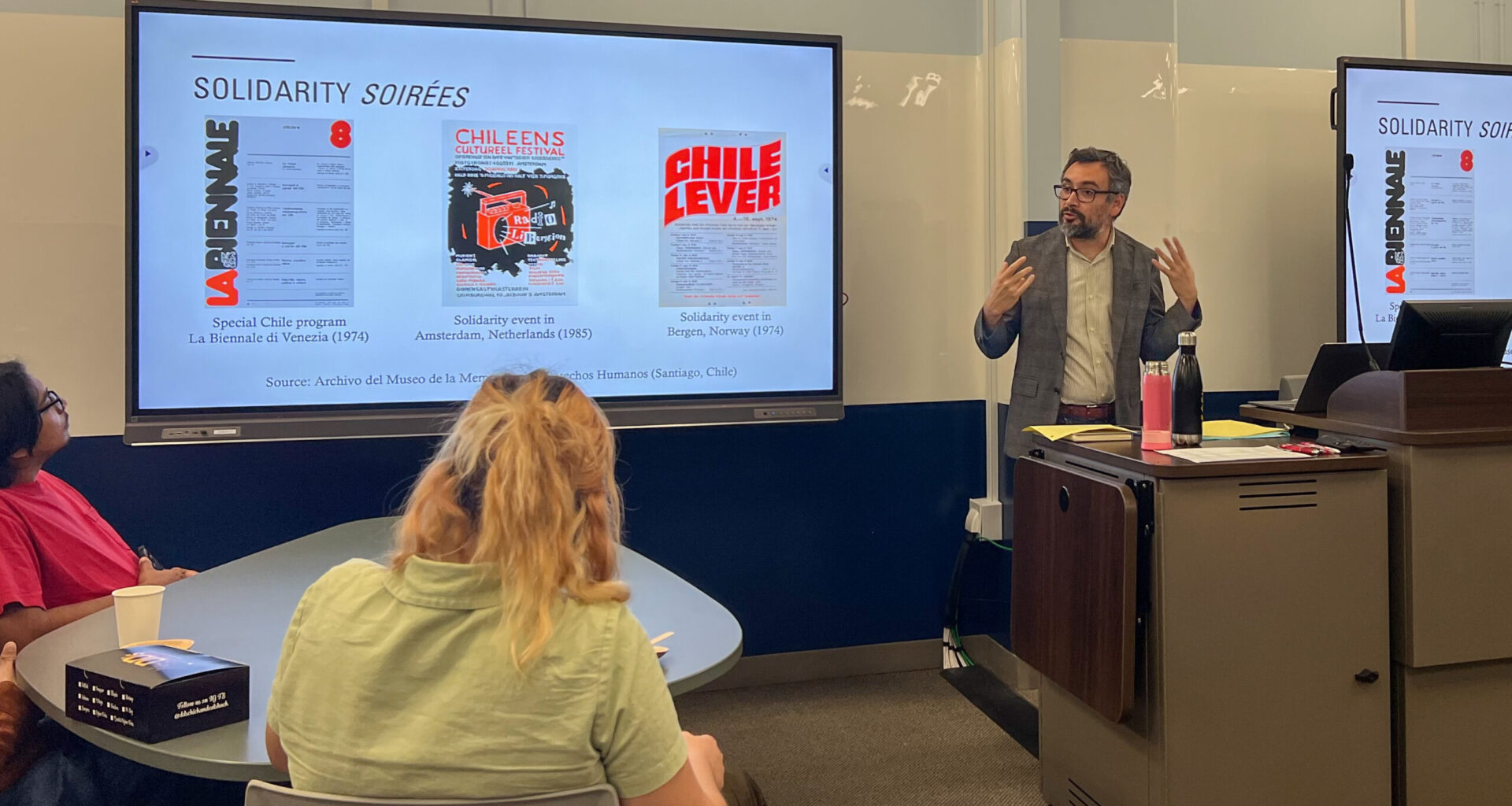
When Long Beach State film historian José Miguel Palacios arrived at the University Library for his book launch on Nov. 6, he was met with a packed room of students, faculty and community members.
“I wasn’t expecting such a good turnout,” he said. “It was very lovely, and it was quite moving for me.”
One of his closest colleagues, Associate Cinematic Arts Professor Seung-hoon Jeong, described the event even more emphatically. “I have never seen such a big academic event on campus–so many people came.”
The excitement reflects Palacios’ own regarding his newly published book, “Transnational Cinema Solidarity: Chilean Exile Film and Video after 1973.”
The project follows the global history of Chilean filmmakers who were forced into exile during the Augusto Pinochet dictatorship, which lasted from 1973 to 1990.
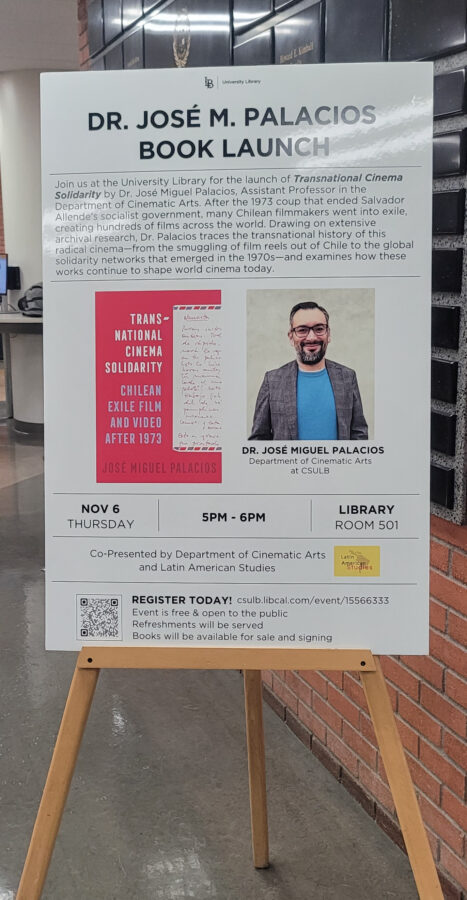
José Miguel Palacios said he was pleasantly surprised by the large turnout for the book launch event on Nov. 6 at the campus library. Palacios said the book took about 15 to develop. Photo courtesy of Bethany Price.
His book is the first comprehensive study of that specific Latin American film movement, focusing on the network of solidarity that kept Chilean cinema alive across borders.
The project began during Palacios’ doctoral research.
“The writing of the book kept me busy for the past five years, but the project began 15 years ago,” he said. “There was still not much knowledge about this phenomenon.”
His book follows Chilean filmmakers who were exiled to Canada, Sweden, Mozambique, Venezuela, the United States and beyond.
Because their stories were dispersed across continents, much of the research required digging through personal and institutional archives from different countries.
“A lot of these materials have been forgotten or silenced,” he said.
Jeong noted the significance of this recovery for the Latin American film field.
“Chilean cinema has not been well-advertised or promoted in the world of cinema studies,” Jeong said. “Even within Latin American cinema, the major references were Argentinian, Brazilian, Bolivian, not Chilean.”
Jeong emphasized that the information in Palacios’ book extends beyond national cinema, as many of the filmmakers featured in the book worked outside Chile and contributed to film collections in other countries.
“What is the concept of nation in this case? This is at the borderline between national cinema and transnational cinema,” Jeong said. “[The work is] very sensitive to the danger of nationalism… even though he wants to write a book about Chilean cinema. That’s the dilemma.”
At CSULB, Palacios teaches transnational cinemas and Latin American film, among other subjects, but students say his impact extends beyond his courses.
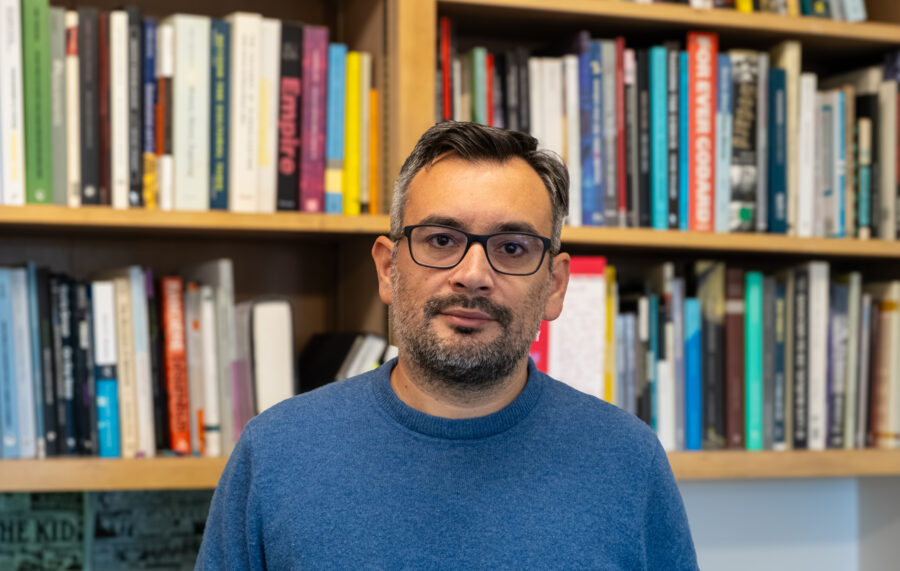
Jose Miguel Palacios, an assistant professor in the Department of Cinematic Arts at CSULB, pictured on Nov. 19. During the upcoming Spring 2026 semester, Palacios will be teaching CINE 365 – Cinemas of Rebellion and Resistance, CINE 388A – European Cinemas and CINE 490 – Special Topics in Cinematic Arts. Charlotte LoCicero | Long Beach Current
Jimena Meza Gonzales, a film production major, credits Jeong with helping shape her academic confidence. Even though she’s not in his class this semester, she said Palacios still checks in on her.
“I had him for Film History 1 [CINE 201], but I felt I learned more from him than the actual class,” Gonzales said. “He was really a support system for me, and helped me find resources.”
Gonzales said seeing his book published only reinforced her admiration.
“I think he’s accomplished as an academic, and he really cares about his students,” she said.
For Palacios, studying exile cinema meant examining how artists pushed past borders to create political and artistic alliances.
“Solidarity creates these bonds despite our linguistic, cultural [and] national differences,” he said. “It enables us to have a more global history.”
He argues that the history of exile did not end with the fall of the dictatorship. Many artists never returned to Chile, and their children and grandchildren continue exploring themes of displacement to this day.
“We live in a world ruled by social explosion and displacement,” Palacios said. “Newer generations have found value in these histories of solidarity.”
Palacios brings this global and political approach to the university through courses such as Cinemas of Rebellion and Resistance.
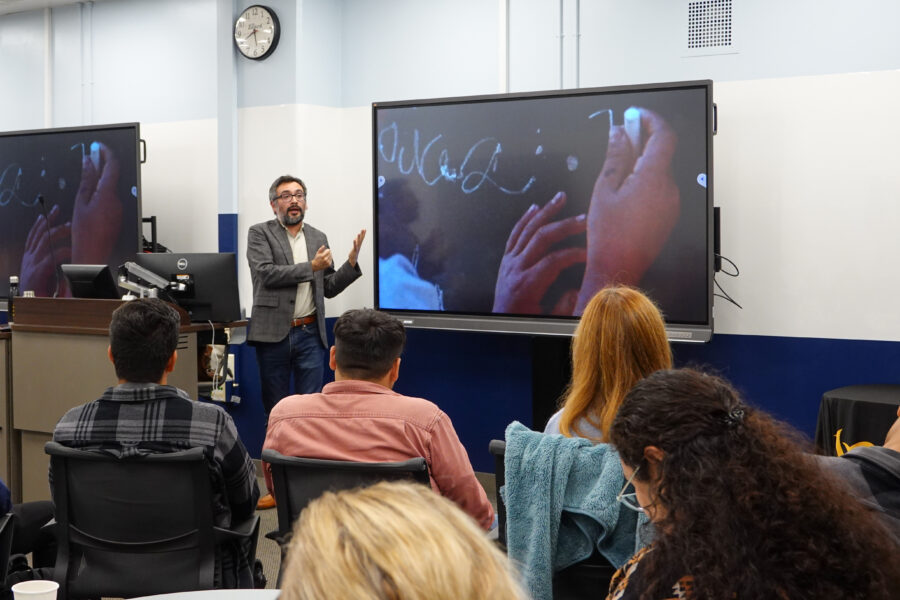
José Miguel Palacios showcases a clip from a Latin American film during his Nov. 6 book launch for his non-fiction work, “Transnational Cinema Solidarity: Chilean Exile Film and Video after 1973.” Photo courtesy of Paige Paulsen
“Everything I do is connected to a more politicized understanding of filmmaking,” he said.
Jeong said his presence strengthens the department. “He has been my best colleague and friend.”
Palacipos will present his research at Tulane University this December and travel to Barcelona for a retrospective on two filmmakers featured in his book.
He plans new archival research centered on exile and displacement, and seeing the campus respond so strongly to his book renewed his motivation.
For students like Gonzales, the excitement is contagious.
“He’s accomplished,” she said. “But also, he’s just a really good professor.”