

Oakland is among a growing number of law enforcement agencies that have pledged to boost the number of women in their ranks. The effort is spearheaded by the 30×30 initiative, which aims to have women make up 30% of police recruits nationwide by the year 2030. More than 400 agencies have signed the 30×30 pledge, committing to reporting data on staffing, rooting out discrimination and examining procedures for hiring and promotion.
But many agencies, including OPD, have struggled to meet that goal.
In 2021, when OPD signed on to 30×30, 15% of the department’s officers were women.
Four years later, that number remains largely unchanged.
The department has created a lactation space and accompanying policy and is developing workshops for women interested in OPD jobs, said Sgt. Michael Romans-Rowe, who oversees the agency’s Background and Recruiting Unit.
“We’re looking at panels that will have command staff, officers, retirees that are able to bring their perspective to a woman that’s interested in joining law enforcement and specifically with our agency,” Romans-Rowe said.
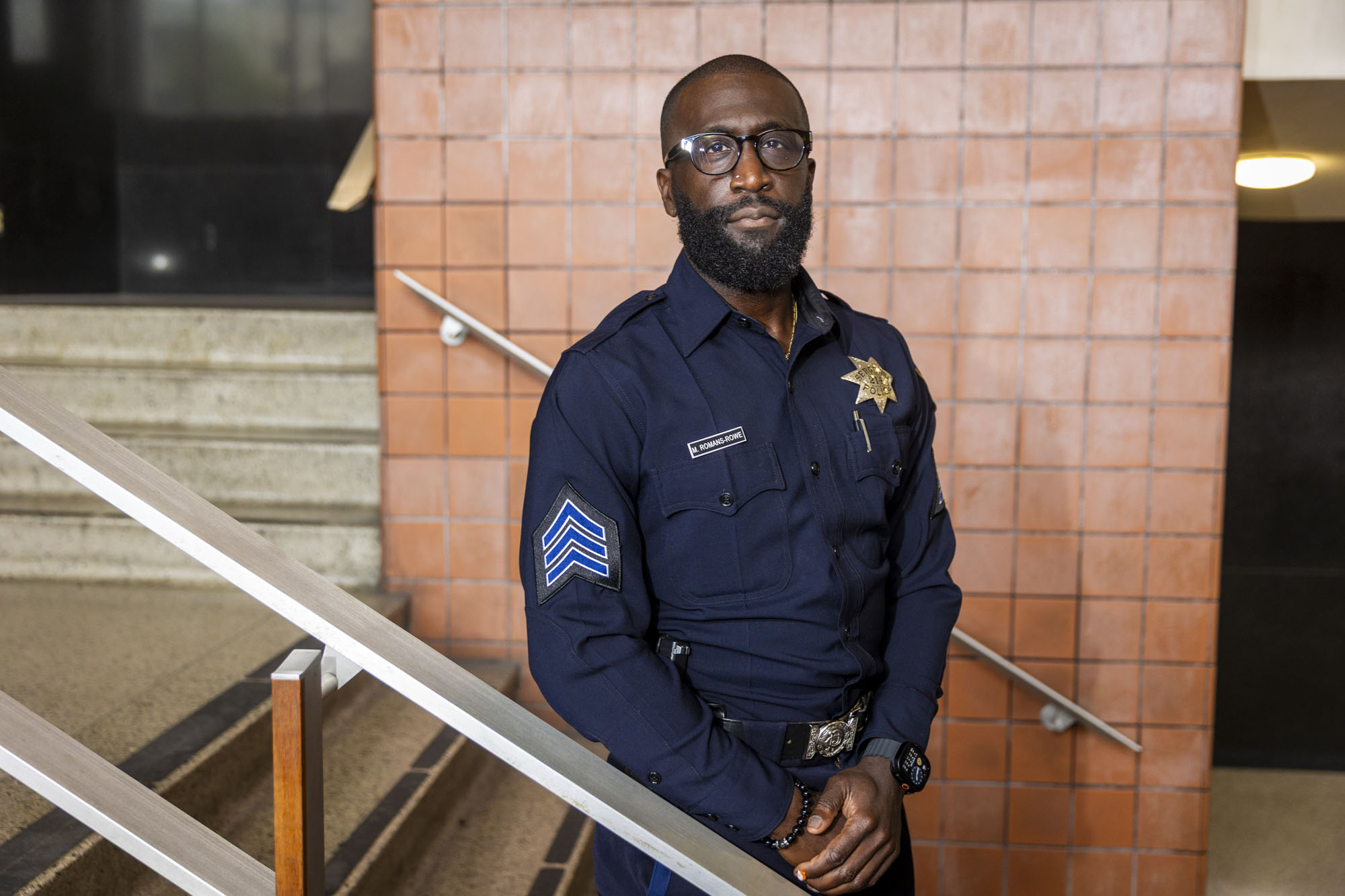 Michael J. Romans-Rowe, a police officer, poses for a portrait at the Oakland Police Department on Sept. 30, 2025. (Tâm Vũ/KQED)
Meanwhile, the department is facing a worsening staffing crisis.
As of Nov. 21, OPD had 625 officers. With 102 on some form of leave — military, medical or administrative — that means 523 officers are actively working. Meanwhile, five to six officers on average leave OPD each month, according to the department.
An independent firm recommended in April that Oakland have 877 police officers.
“It is likely that OPD’s percentage of female officers has remained relatively unchanged [due] to factors such as natural attrition, the budgeted reduction in overall sworn staffing levels, and the recent hiring freeze,” Romans-Rowe said.
Oakland isn’t alone. A 2019 study found 63% of surveyed police departments reported receiving fewer applications for sworn positions than in prior years. San Francisco’s police and sheriff’s departments are down 500 and 161 officers, respectively. The Alameda County Sheriff’s Office has nearly 200 vacancies, and Santa Clara County’s sheriff’s office is short 138 officers.
“In those first couple of years after the police murder of George Floyd, the profession was in crisis in a lot of ways. In some ways, I think, it continues to be,” said Maureen McGough, founder of the 30×30 initiative. “30×30 offers a promising and somewhat different path towards a partial solution for some of those problems.”
 The recruitment training unit can be found at the Oakland Police Department on Sept. 30, 2025. (Tâm Vũ/KQED)
For decades, McGough said, police departments tended to focus their recruiting on candidates with military backgrounds or criminal justice degrees.
“Those are important populations. But there are other populations that are service-oriented with empathy and a desire to serve their community and great interpersonal skills — things that we know make good officers,” McGough said.
Still, experts like Mary Dodge, professor of criminal justice at the University of Colorado, Denver, say that despite efforts to change the status quo, many agencies have struggled to boost the number of women in their ranks.
“I’m not at all surprised by the 15% number,” Dodge said about Oakland’s level of female staffing.
“Despite all the research we have and everything that says that women make good officers — they can do the job as well as men — nothing changes,” she said. “You really have to, at some level, attribute that to this hyper-masculine environment that they’re entering, even in 2025.”
‘You belong in business suits and heels’
When Margaret Dixon was a young mother in 1980, she saw an advertisement featuring a female police officer.
“I’ll never forget,” she recalled. “It said, ‘Woman. Wife. Cop.’”
“I fit all those categories,” Dixon said. “I was a woman, I was a wife. I was athletic. So I was like, ‘Wow, let me just try this.’ And I’m glad I did. It’s the best decision I could have made.”
 Margaret Dixon, a retired Oakland police officer who works with students at Merritt College, poses for a portrait at Merritt College in Oakland on Nov. 3, 2025. (Tâm Vũ/KQED)
Dixon enrolled in Oakland’s police academy and worked for the department for 25 years.
On a recent fall afternoon, she walked through a Merritt College classroom where she now advises the school’s Administration of Justice program, mentoring young women interested in careers in policing, corrections, and other justice-related fields.
“That’s why I’m so positive about really trying to get other women to do it, because I think if they get into it and see what they can bring to the job, they’ll be happy that they did,” she said.
An Oakland Office of the Inspector General report tracking OPD police academies and field training found the percentage of female recruits remained unchanged between 2019 and 2022.
Dixon believes there needs to be more female police officers so women see the job as something they can do.
“There are girls, young ladies, that want to do the work, but they don’t feel welcome because all they see is men,” Dixon said. “Women have to tell other women that — you can do this job.”
 Veronica (who did not share her last name for privacy reasons), a student at Merritt College who is studying to apply to the Oakland Police Academy, sits on a bench at Merritt College in Oakland on Nov. 3, 2025. (Tâm Vũ/KQED)
One of Dixon’s students, Veronica, recently took the Berkeley Police Department’s physical agility test but didn’t pass. KQED is not publishing her last name so she can speak candidly about the hiring process without harming her job prospects.
“The image of law enforcement doesn’t look like me. It doesn’t look like a single mom,” Veronica said. “It looks like a huge, masculine man.”
Veronica had always wanted to be a homicide detective, but when she started pursuing the career, she felt discouraged.
“I even have male family members who have told me, like, you won’t be able to do it,” she said.
Lack of support from her community has made breaking into such a male-dominated field harder, she said. It has felt like she’s doing it on her own.
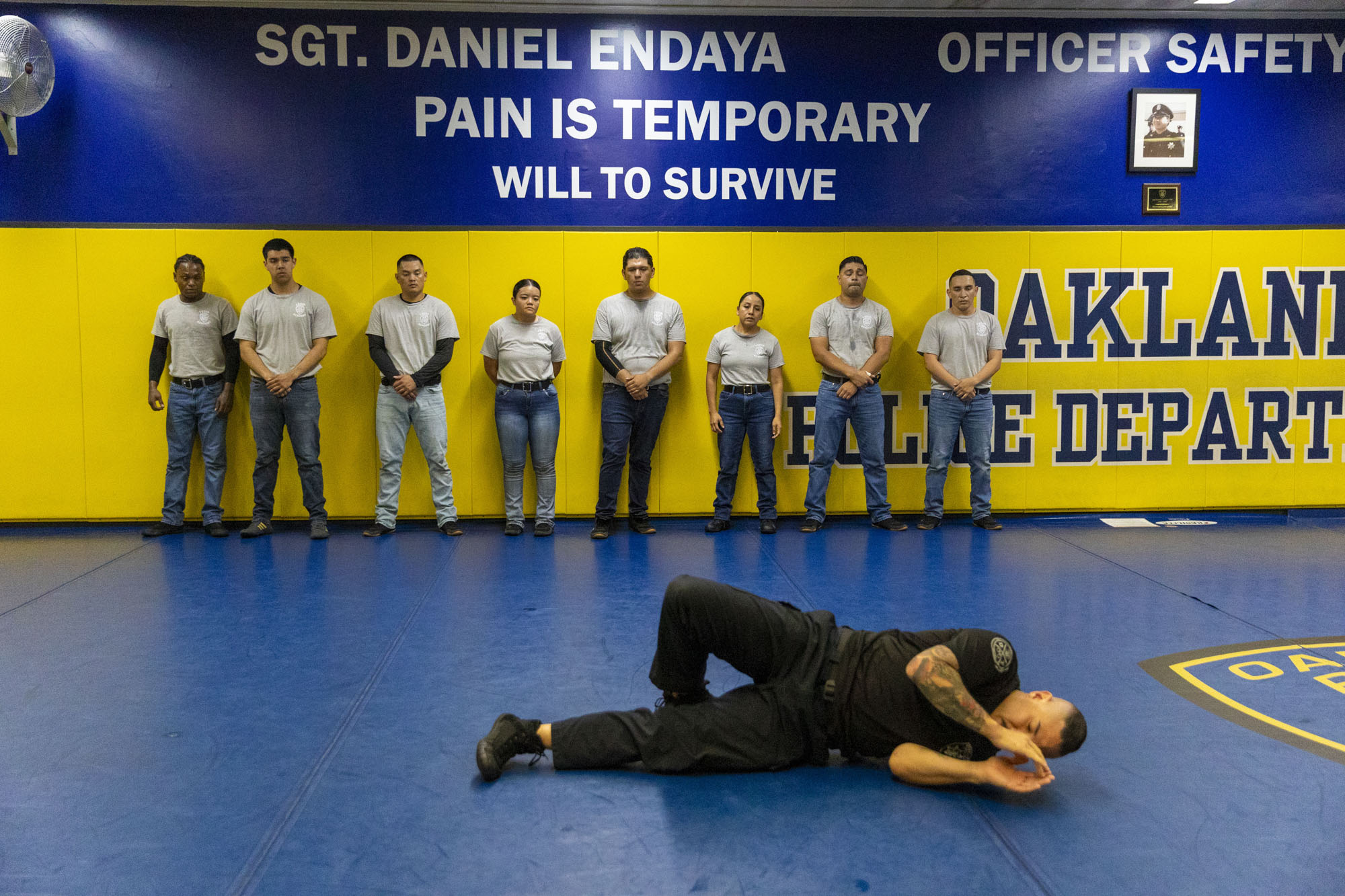 An instructor demonstrates a drill during a class for the police academy at the Oakland Police Department on Sept. 30, 2025. (Tâm Vũ/KQED)
“You go to a lot of these events and a lot of these training exercises, you look around and it’s like you’re one of maybe two [women], and it’s scary. It’s really intimidating,” Veronica said. “And you’re looking at them like, you know, maybe they were right. Maybe I don’t belong here. Maybe I should go get that desk job they told me to get. Oh, ‘You belong in business suits and heels.’ And it’s like, that’s not what I want to do.”
As she prepares physically and mentally to retake the test and apply to other academies, support from people like Dixon has helped, Veronica said.
“I want to see women because it makes us feel more able. Like I’m capable of the job. I see you’re here.
That means I can do it,” she said. “You have to stay encouraged.”
OPD Deputy Chief of Police Lisa Ausmus said she thinks the department has evolved since she first joined in 2000.
“We’ve just learned as a department to be better, to recognize people,” Ausmus said. “I see women in leadership roles now. I’m one of three deputy chiefs.”
Ausmus said other women have had success at OPD, and are part of the DEA task force, SWAT teams and investigations.
“The officers here – man, woman, color, not color, it doesn’t matter. All they want to know is, Are you going to do your job?”
What women bring
Supporters of increasing the number of women in policing emphasize the different skills they bring to the job.
“There is a strong and growing body of scientific evidence that shows that there’s a unique value in how women police,” McGough said.
“They use less force and excessive force,” she said. “They get better outcomes for crime victims, especially gender-based violence. They’re named in community complaints and lawsuits proportionally less often. They’re perceived as more trustworthy by diverse communities and especially communities who are impacted most by police activities.”
 Students’ duty belts lay on the floor during a class for the police academy at the Oakland Police Department on Sept. 30, 2025. (Tâm Vũ/KQED)
Bill Terrill, professor in the School of Criminology and Criminal Justice at Arizona State University, said that while the majority of research tends to reflect those positive outcomes, data on the use of force and gender is somewhat more complicated.
One study that Terrill co-authored found women and men used physical force similarly, he said.
“When we looked at it,” Terrill said, “whether you’re male or female, if you’re faced with a physical threat, you’re going to use physical force. Gender doesn’t come into play.”
Some of 30×30’s recommended actions for police departments have to do with ensuring hiring assessments reflect the knowledge, skills, abilities and experiences required to be an effective officer.