
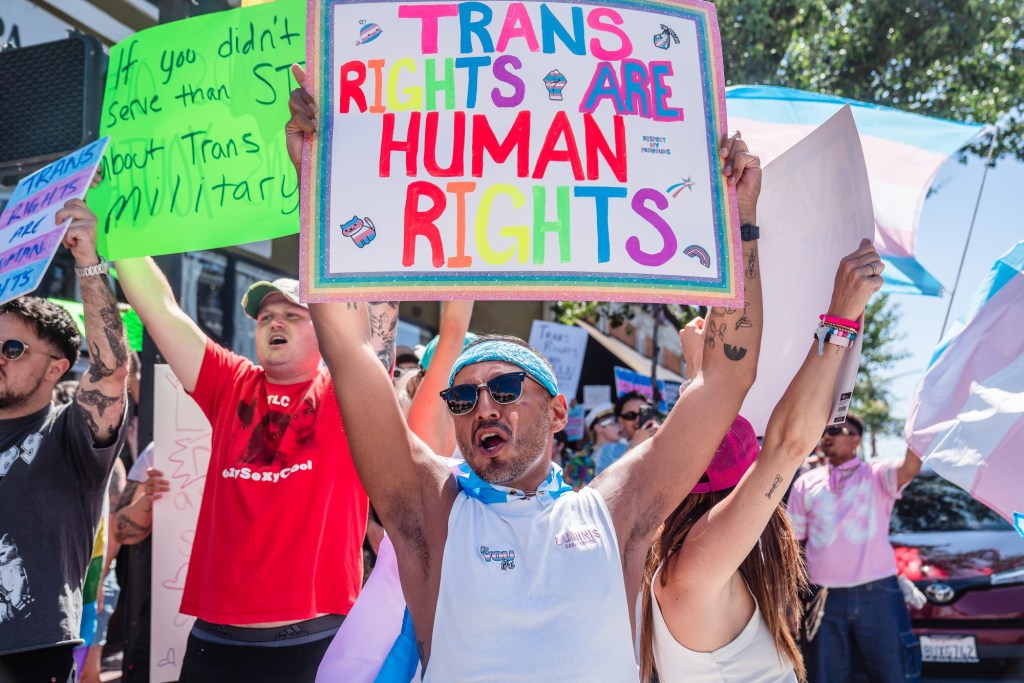
Across the country, transgender and nonbinary people are under attack. In 2025 alone, 88 federal and over 1,000 state anti-trans bills have been introduced that restrict access to health care, education, employment and basic human rights.
As a trans woman and a licensed marriage and family therapist, I know firsthand that the consequences of anti-trans violence and legislation are a direct threat to public health. When we are stigmatized or criminalized simply for being ourselves, the result is profound psychological harm. Constant exposure to rejection, discrimination and fear creates what researchers call minority stress — a chronic state of hypervigilance and trauma that fuels disproportionately high rates of anxiety, depression and suicidality in our communities, especially in Black and people of color communities. Nearly half of trans people in the U.S. report seriously considering suicide, and more than one in four have attempted it.
In my research, “Characterizing the Prevalence and Perpetrators of Documented Fatal Violence Against Black Transgender Women in the United States (2013–2021),” I found that anti-Blackness, misogyny and transphobia intersect to make Black trans women particularly vulnerable to fatal violence. These same forces also shape how society views intimacy with trans women of color, especially when Black and Brown cisgender heterosexual men are involved. The stigma, fear and shame surrounding these relationships perpetuate isolation and violence, reinforcing the false idea that loving a trans woman is somehow abnormal. Nothing could be further from the truth.
It is deeply wrong and profoundly unfair that so many trans people are being told, explicitly or implicitly, that who they are is unacceptable. Imagine being taught from a young age that the most honest parts of yourself must be hidden, debated or erased. What would it feel like if someone told you that your truth, your body or the way you love was wrong? No one should have to justify their existence to deserve dignity or safety.
Trans people are not asking for special treatment, we are asking for the basic freedom to live as ourselves without fear or shame, just like anyone else. When we teach young people that authenticity is something to be punished rather than celebrated, we fail them all. Our collective humanity depends on creating a world where everyone can exist fully and freely simply being themselves.
It is heartbreaking to see my trans clients struggle with carrying the weight of being told that their truth is wrong or a mistake. The pain of that message doesn’t just wound the individual; it echoes through families, schools, the justice system, and our entire communities.
Trans people are often characterized as “resilient,” and while resilience is powerful, it shouldn’t be a requirement for existence. We deserve more than simply surviving; we deserve to live freely and to live without fear that our honesty and authenticity will be punished. As a therapist, I’ve seen how healing begins the moment someone feels seen and accepted for who they are. That’s the kind of world I want for all of us.
I am a proud board member of the Institute for Public Strategies, a public health organization that values equity and authenticity and is standing in solidarity with the transgender, nonbinary and gender non-conforming communities. They are standing up for our community. We all deserve equal human rights and dignity and should not be threatened by politically misguided policies spreading hate that marginalizes our very existence.
To my fellow trans and nonbinary community members, you need to hear, loudly and clearly, that you are valued. And it has never been more critical for organizations like the Institute for Public Strategies to speak out. Silence is complicity. At a time when our very existence is debated in legislative and media environments, those of us who work in public health have a professional and ethical obligation to speak out. Those of us who have power and privilege have a moral duty to use that to defend, protect and support the LGBTQ+ community, specifically the trans/nonbinary community that is under attack. Our lives depend on it.
Halliwell is director of behavioral health services at the San Diego LGBT Community Center and a board member at the Institute for Public Strategies. She lives in San Diego.