
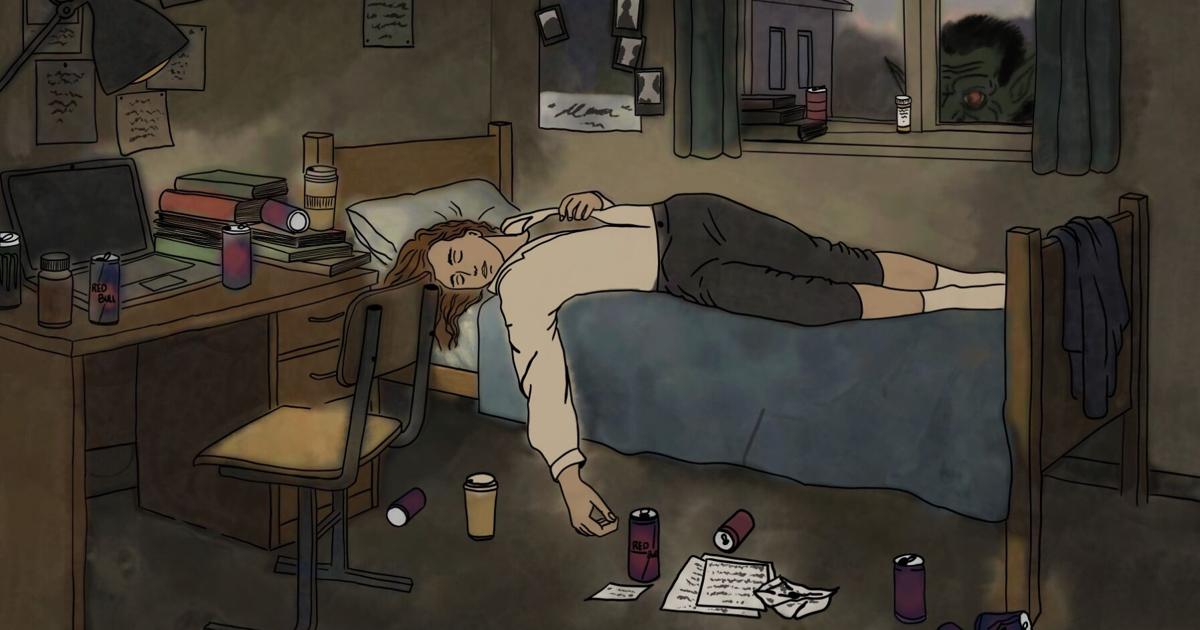
Ten little girls of various heights and ages ominously trailed my path as I stumbled down a monstrous hill, gasping for air and clawing at my chest, as if I could somehow break skin and reach into my lungs. I had narrowly escaped my death in a home invasion with three armed men, knocking them unconscious with a baseball bat found in my closet. I reached the bottom of the hill at the same second that I felt a hand wrap around my ankle. The girls had caught up to me, and there would be no escape from their suffocating stampede –– at least, until I opened my eyes.
With each year that passed, I waited for these dreams to cease. Though they grew more sporadic, their diminished frequency did nothing to lessen their intensity, yet it never occurred to me to stop and listen. Instead, I sought out a preemptive safeguard by blocking out the chance for these dreams to initially transpire — I cut out sleep, replacing it with an earlier start and a later end to each day.
UC Berkeley only reinforced this dirty habit of mine. Every task and event on my schedule perpetuates the cycle by giving me more of a reason to keep myself awake. The “we’ll sleep when we’re dead” mindset instills itself in our brains long before we realize the true importance of quality sleep.
College encourages these maximalist lifestyles as we struggle to balance social lives with work, work with academics, academics with family and so on. All too often, we make sacrifices to keep from drowning in our personal and professional agendas, and all too often, our primary sacrifice becomes our sleep. In doing so, we lose out on the ability to not only prioritize our health, but also to explore our subconscious.
According to researchers Shelley D. Hershner and Ronald D. Chervin from Nature and Science of Sleep, sleep deprivation and irregular sleep schedules are highly prevalent among college students, as 70% do not get a sufficient amount of sleep. However, the lack of sleep is not the only issue. Healthy habits for sleep influence quality, and poor quality sleep is highly ineffective.
At UC Berkeley, it is not uncommon for us to host study sessions in the library that extend far beyond midnight, peer at glaring screens under fluorescent overhead lighting and sip away at cans of artificial energy. This, followed by greasy late-night food runs on Durant Avenue that we fail to fully digest before throwing ourselves into bed for a few hours with the help of a melatonin gummy –– only to repeat the same cycle again the next day –– cannot be our working standard.
It does not come as a surprise that the American Academy of Sleep Medicine tells us that college students who are more likely to pull all-nighters or catch up on their sleep over the weekends will have a lower GPA or poorer academic performance. Each time we reset our sleep schedule by performing this type of inconsistency, our internal body clock is forced to reset and readjust, which throws our circadian rhythm out of balance. We lose out on memory retention, focus and the energy that is vital to human connection.
We are giving up our full potential by settling for mediocre academic performance and erratic relationships in our life, but our reliance on drugs like caffeine or melatonin, overuse of technology and inadequate sleep schedules prompt yet another heavy loss.
Without proper sleep, we miss out on an opportunity to engage with our subconscious. While there are several different theories about the significance of dreams and varying levels of their validity, I argue that dreams hold critical influence over our emotional regulation, unconscious desires and fears.
Many of us have indulged in a myriad of trends to manipulate or analyze our sleep, including dream journals, manifestation and lucid dreaming. With all of these methods, there is one underlying common goal: we are simply trying to reveal and gain a profound understanding of our yearnings and deep-rooted anxieties.
Sometimes we may wake, restless and tangled in our sheets, and all we remember are visions of metallic extraterrestrial aliens or interactions between people in our lives that would never meet in reality. Maybe the little girls of various heights and ages who ominously trailed my path down the hill were just various renditions of my past self, versions of my childhood helping me by haunting me. Maybe I felt oddly soothed by their overtaking because facing my past would be the only way to free myself after having to practice self-defense in my own home –– a sanctuary that should have been marked by safety and security.
Surrendering our sleep to the glorification of greater vices calls for a slippery exchange of priorities. Soon, we stumble into an inherent contradiction: losing sleep so we don’t miss out on perfecting our grades or spending time with our friends, even when rest is the very thing essential to our recovery and recuperation. We must stop falling for this counterintuitive process.
Ultimately, we can only settle what we choose to confront. We must begin dreaming again. We can do this by prioritizing a steady sleep schedule that promotes healthy habits, and when we do dream again, we can grasp that chance to analyze, interpret and challenge. With our eyes closed and our breathing steady, our subconscious will betray its truest form.