
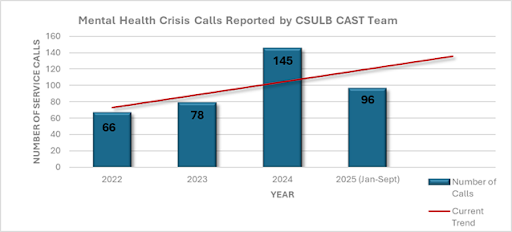
The above graph shows the number mental health crisis calls reported by CSULB Campus Assessment and Stabilization Team. Aiden Redsteer | Long Beach Current
Despite the number of involuntary psychiatric hospitalizations decreasing in Los Angeles, Long Beach State has seen an increase in mental health crisis calls on campus.
“They continue to go up,” University Police Chief John Brockie said. “We’ve seen that trend from 2017.”
With 96 calls already logged through September, this year is projected to reach a similar number as 2024, suggesting a continued pattern of increased mental health crisis events on campus.
The increasing number of mental health crisis events on campus was one of the issues that led to the creation of the CSULB Campus Assessment and Stabilization Team.
CAST is composed of social workers Graciela Lopez and Donna De Loera and law enforcement, who work directly with campus police officers to respond to mental health crisis calls on campus.
CAST is similar to the psychiatric evaluation teams that work with Long Beach and Los Angeles police departments.
The team is dispatched once university police have identified a mental health crisis. When responding to calls, CAST will attempt to de-escalate situations and assess the need for mental health stabilization at a psychiatric hospital.
CAST has been tracking an increasing number of mental health crisis calls on campus since its creation in 2022.
The rise of CSULB mental health crisis calls is incongruent with the pattern of 5150 calls in L.A. County.
5150 is a police term for an adult who has been assessed by a police department mental health professional and is found to be a danger to themselves or others.
The adult is then involuntarily placed in a mental health hospital or psychiatric ward for at least 72 hours.
Data from the California Department of Health Care Services show that the number of 5150 holds for adults declined over seven years, with the most recent data from the 2021-2022 fiscal year.
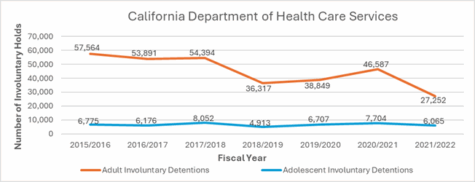
The above graph shows the number of involuntary holds reported by the California Department of Health Care Services. Aiden Redsteer | Long Beach Current
The idea is that these individuals will be stabilized and then referred out for continued care, following their stay in the psychiatric facility. Patients can be referred to mental health outpatient level of care or, if the case is severe enough, a longer-term inpatient setting.
While CSULB’s mental health crisis calls are on the rise, LA County’s number of involuntary holds, or 5150 calls, is decreasing.
It is unclear whether LA County’s mental health crisis calls are rising or declining, as LA County does not track the number of calls.
It is also unclear how many CSULB mental health calls lead to a psychiatric hospitalization or involuntary holds, as the police department is not tracking this information.
This means that even though the mental health crisis calls on campus are on the rise, actual hospitalizations of CSULB students and staff may not be increasing.
A meta-analysis compiled by Cureus, published in 2023, shows that individuals who have been hospitalized in psychiatric facilities have an increased chance of readmission to a similar facility within 30 days of the initial hold.
Patients who struggle with schizophrenia, personality disorders, bipolar disorders, depression and substance use have the greatest chance of a 30-day readmission.
Thoughts of suicide, self-harm behaviors and homicidal thoughts are a common pattern in these patients.
Since the criteria for a 5150 hold are a person who is a danger to themselves or others, these patients are close to meeting the required risk factors needed for an involuntary hold, even after being stabilized in a hospital for 72 hours.
Brockie explained that CAST, unlike its L.A. or Long Beach counterparts, maintains contact with students following times of mental health crisis.
Students have the opportunity to meet with Lopez and De Loera following these events. However, this team is a reaction to the existing times of crisis and not a preventative solution for mental health needs on campus.
Students looking to initiate a CAST mental health call can call 911 or the university police non-emergency line at (562) 985-4101.
Students who are unsure what resources they need can use HelpCompass to find the right ones.