
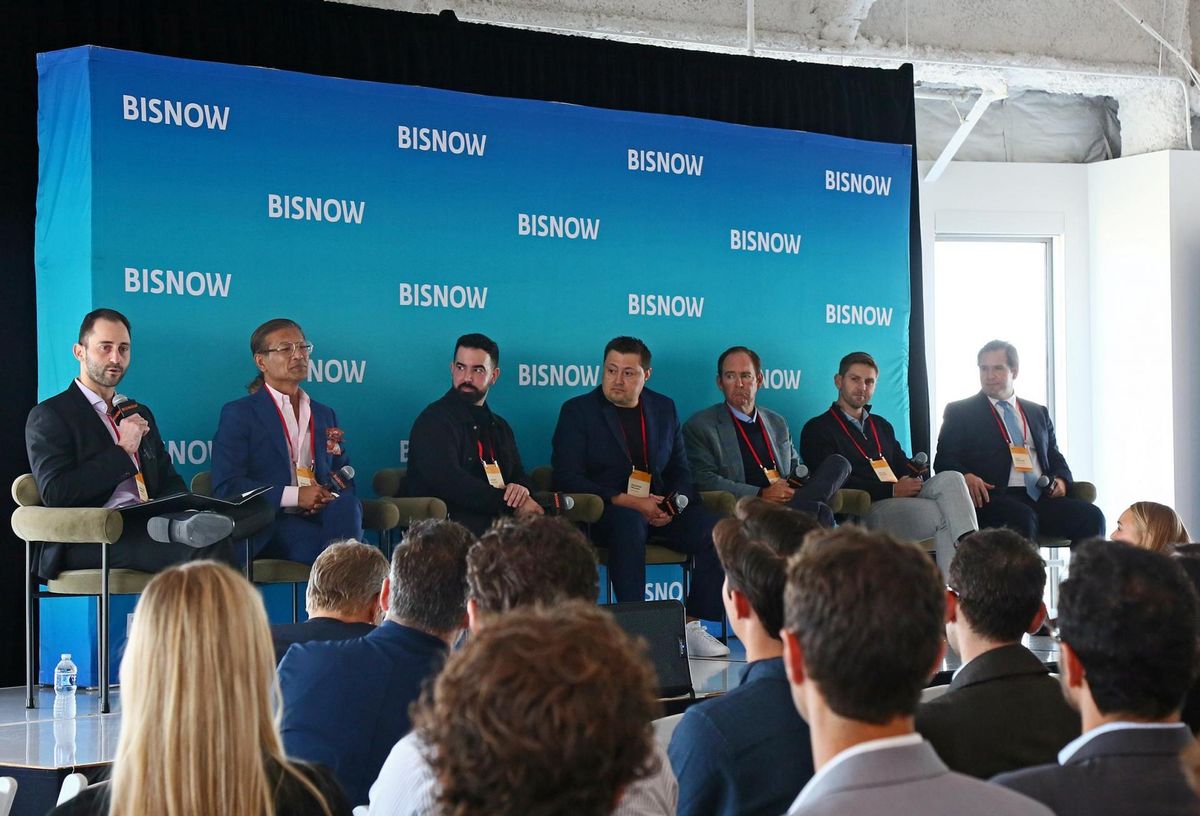
As the return-to-office movement picks up steam, owners are busy trying to make their properties as attractive as possible for tenants. That means introducing pricey new amenities to buildings, but with the cost of debt elevated, owners are shying away from borrowing to fund those improvements.

Photo by Joe Woolhead, courtesy of Silverstein Properties
Allen Matkins’ Jonathan Berger, Corgan’s Sean Kim Nickerson, ZGF’s Antony Tavlian, MAD Studio’s Eduardo Melgar, Lowe’s Marty Caverly, Silverstein Properties’ Harlan Strader and Hackman Capital’s Zach Sokoloff.
“You can’t do that anymore, or you can on a rare occasion,” Lowe Executive Vice President Marty Caverly said at Bisnow’s Los Angeles Creative Office and Workplace of the Future event on Nov. 19. “And until that comes back, the landlord is sort of stuck building out a nice space, but without going bankrupt doing it.”
Although the federal funds rate was cut again last month, it hasn’t been a cure-all for what ails office owners. Building values remain depressed, which makes it hard to borrow. The interest rate is still elevated above prepandemic levels and yields on the 10-year Treasury have remained above 4% for roughly a year.
The cost of doing tenant improvements has gone up, due to capital costs but also the price of labor and materials to get the job done. This has changed the way that some landlords rationalize decisions around forking over cash to build out space and lock in tenants.
Photo by Joe Woolhead, courtesy of Silverstein Properties
Colliers’ Adam Tischer, McCourt Partners’ Patrick Rhodes III, Harbor Associates’ Paul Miszkowicz, Uncommon Developers’ John Barganski and Kilroy Realty Corp. Andrew Schlegel.
Removing that access to capital adds a challenge when money is tight and the landlord is looking toward not only the current tenant but whoever might move in next.
The balancing act required of landlords means that sometimes, it is not possible to meet all of a tenant’s demands around outfitting their space, Caverly said at the event, held at the U.S. Bank Tower.
With tenants in a position of power, some owners noted that even among trophy buildings, occupiers are being very, very picky.
“All of our clients want the biggest and the best and the boldest and the newest and the most creative, but it really comes down to who’s going to ultimately pay for it, and that really determines the decision of what gets pushed forward,” Corgan Associate Principal Sean Kim Nickerson said.
Nationally, office owner concessions declined in 2025, a CBRE study found, pointing to a stabilization in the market, although concessions were still about 30% higher in 2024 than they were in 2019.
Bisnow/Stephanie Smith
DTLA Alliance’s Nick Griffin, Lincoln Property Co.’s Sam Pepper, Trammell Crow Co.’s Andrew Wallace and McCarthy Cook’s Dewain Campbell
For those who were at the opposite end of the spectrum — looking for buildings with low occupancy to improve and stabilize — there is dwindling belief in the ability of that path to profitability.
“We used to salivate for vacancy, where we could go in and reposition assets and lease it up,” Harbor Associates principal Paul Miszkowicz said.
Harbor bought 44 commercial projects in the last decade, nearly all of them in Southern California, paying roughly $1.8B.
“Now the market has a lot less conviction in those business plans, and they’ve seen less of those executing,” Miszkowicz said. “So you can buy vacancy for a lot cheaper now than you used to because people don’t believe in that lease-up business plan as much.”