
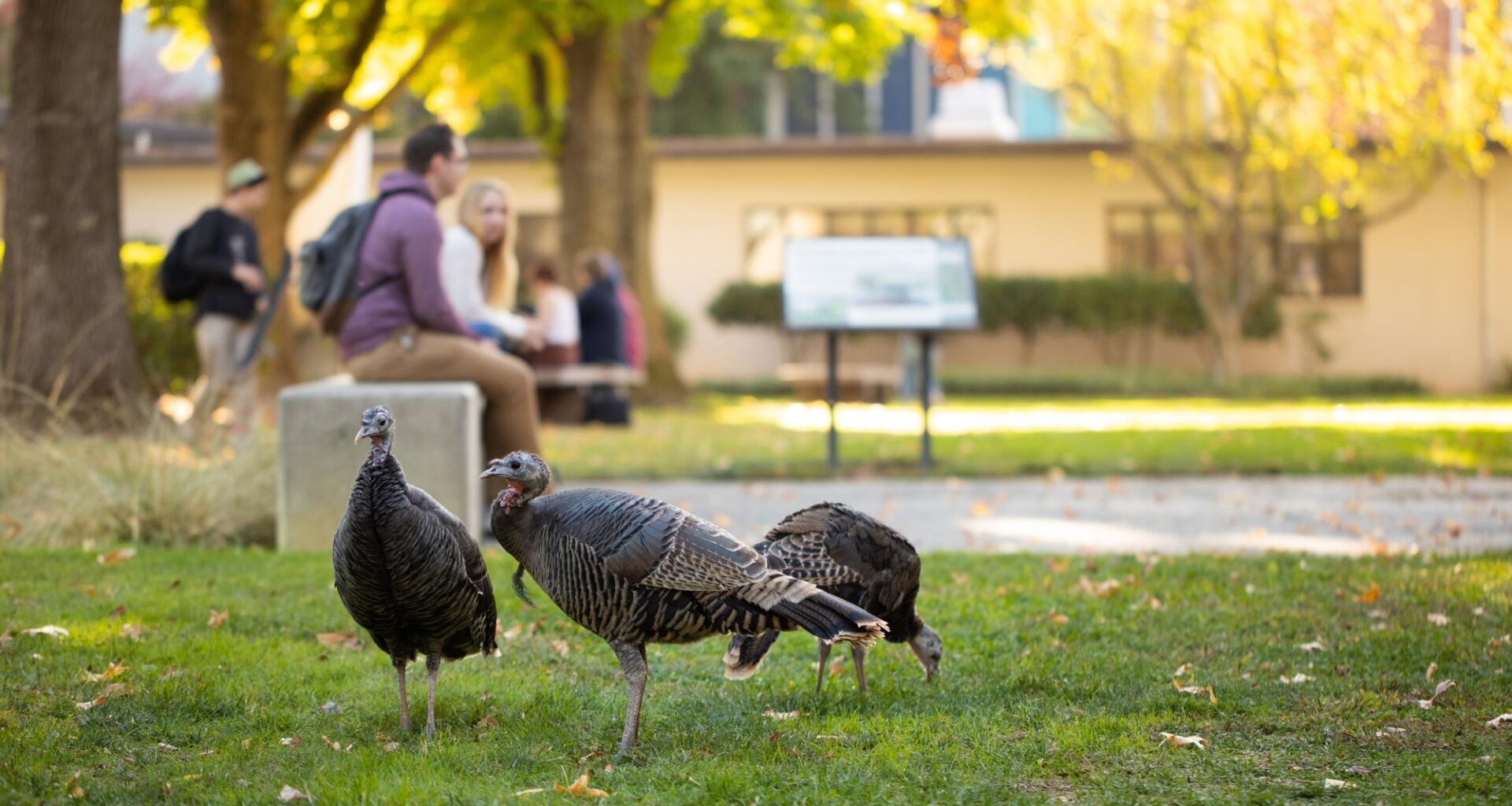
On any given morning at Sacramento State, you’re just as likely to run into a flock of wild turkeys as you are your fellow student. The birds strut across bike paths, fan their feathers near the library and occasionally hold up traffic as they waddle across campus crosswalks with the same confidence as tenured faculty.
For some students, it’s a charming quirk of campus life when a turkey blocks the path to class. Dailin Brown, a first-year political science major believes that they are a happy sighting and doesn’t believe they would have problems with others.
“They’re so chill. They don’t bother anyone,” Brown said. “It would be crazy for anyone to have issues without provoking the turkeys.”
Still, even if most of the birds keep their distance, their unpredictable nature can catch students off guard. The campus’ tree-lined walkways and shaded courtyards make perfect hideouts for turkeys to appear suddenly and sometimes startle students.
Jasmine Yang, a third-year accountancy major, said she still remembers one early morning encounter that left her wide-eyed.
“It really scared me,” Yang said. “It was still kind of dark, so I just speed walked the other way. They were just hanging out like they owned the place.”
Stories like Yang’s have become a rite of passage for many Hornets. While most encounters end in laughter or an impromptu photo session, they also raise a larger question: What happens if a turkey gets too close for comfort?
RELATED Honoring Native American history and how to support the community
Sacramento State’s 300-acre campus is more than just a collection of lecture halls, it’s a certified Garden for Wildlife, recognized by the National Wildlife Federation for its thriving ecosystem. From 100,000 honeybees buzzing at the Bioconversion and Agricultural Collaborative, the “BAC Yard,” to squirrels, hawks and even the occasional coyote, Sac State has long embraced its wild residents.
Ryan Todd, Sac State’s director of energy and sustainability, said in a university statement that the certification reflects the school’s philosophy of coexistence.
“It means that our campus caters to animals and fosters successful wildlife,” Todd said. “We’re in a park, so it’s not surprising that we met all of the criteria.”
Wayne Linklater, professor of environmental studies and zoology said that Sac State’s park-like setting is exactly what attracts the turkeys. The birds, accustomed to both human activity and discarded snacks, have made the campus their home base.
“They’re omnivorous animals that eat a wide range of foods, ” Linklater said. “And let’s be honest, there’s nothing like a half-eaten burger for a turkey.”
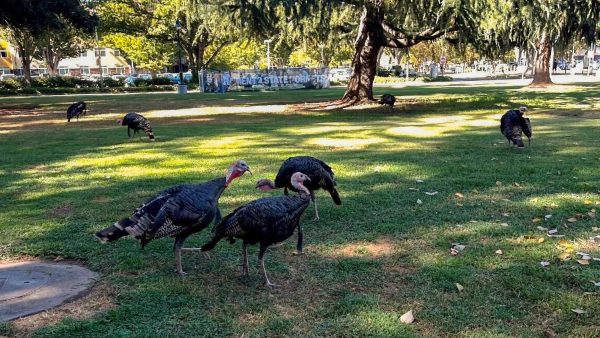 Wild turkeys foraging in the grass at the Main Quad Wednesday, Sept. 11, 2024. Turkey sightings are common in grass-filled areas on campus. (Delaney Joyce)
Linklater explained that the turkeys’ comfort around humans isn’t necessarily a problem, it’s a reflection of a healthy environment. When wildlife can thrive alongside people, he said it’s a good sign that the campus ecosystem is balanced and vibrant.
“If other species can occupy the spaces we live, work and play in, then it’s a good sign that these are healthy places for us to be,” Linklater said.
But a healthy ecosystem doesn’t come without responsibilities. As the turkey population grows, the university also has to consider the safety of students and staff and the legal implications of any close encounters.
According to Gary Rosenblum, Sac State’s associate vice president and chief risk officer, the school doesn’t have a formal “do not touch the turkeys” policy. However, he said safety reminders are occasionally sent out when wildlife sightings increase.
“We’re covered for that sort of thing, from tree branches to turkeys,” Rosenblum said. “If an employee interacts with wildlife and is injured while working, we even have a workers’ compensation system that would handle that.”
Rosenblum noted that wildlife-related incidents are extremely rare. In his eight years on campus, he said he hasn’t seen a single report of a student or staff member being injured by wildlife. The university’s approach is simple: observe, don’t interfere.
“Wildlife is protected by state law,” he said. “We encourage people not to feed them or try to take selfies with coyotes. If a turkey looks threatening, yell, clap, wave your arms and back away.”
Only in special cases, like rattlesnakes near high-traffic areas, will the university step in. Even then, Rosenblum said staff are trained to relocate, not harm, the animals.
For many, the question isn’t whether turkeys should be removed but how people can better coexist with them. Linklater said the situation at Sac State is a textbook example of what wildlife scientists call human-wildlife conflict, or rather, human-human conflict about wildlife.
“It’s not so much a conflict between people and turkeys as it is a conflict between humans about wildlife,” Linklater said. “Some people want the turkeys there, and some people don’t.”
According to Linklater, that distinction is key to understanding coexistence. Instead of trying to change the turkeys’ behavior, Linklater said he believes the solution lies in educating the campus community about the benefits of sharing space with wildlife.
“We can reduce conflict by teaching people to see wildlife as part of the campus experience,” Linklater said. “When I see turkeys, redwoods, squirrels, blossoms and falling leaves, I feel good. It helps me cope with demanding workdays.”
For some students, the turkeys have become as iconic as the campus’ towering trees. Joseph Donati, a Sac State alumnus who graduated in 2019, said he remembers being delayed by a flock crossing the road on his first day.
“I thought it was neat, a good omen,” Donati said. “I don’t view them as a safety concern. They add to the natural beauty just like the trees.”
Whether a source of stress or delight, the turkeys remain a symbol of Sac State’s living landscape. They act as a reminder that the university’s commitment to nature sometimes comes with feathers, footprints and the occasional standoff.
“When I see turkeys on campus, I feel good. It tells me I’m in a healthy place,” Linklater said.