
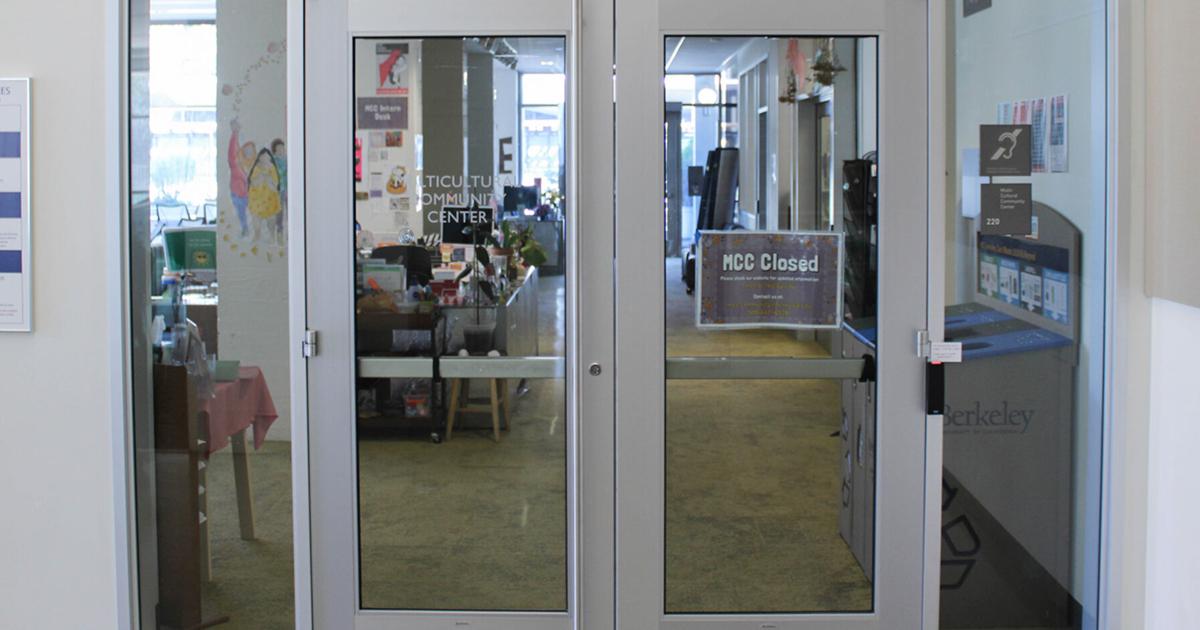
UC Berkeley has indefinitely closed the Multicultural Community Center, a space known to students as the MCC that offers cross-cultural community building, due to “criticism received from a number of campus stakeholders.”
The MCC, located in the MLK Jr. Student Union building, has been closed since the beginning of summer, and campus administrators have offered no solid return date. Interns at the center — who were initially not informed of the indefinite closure — were told by professional staff that the space would remain closed during conversations with the chancellor’s office regarding its current operating procedures.
While administrators offered little explanation, student groups have decried the move as the center is a “student-won, student-led space” and is “rooted” in UC Berkeley’s history of activism and protest and hosts community programming and events, according to its website.
“We had no idea,” said senior and MCC intern Mila Gonzales. “No one who is new this year to the intern cohort had any idea this would happen. It sounds like there were suspicions that something like this might happen. I don’t know that anyone thought it would be quite so severe.”
While campus spokesperson Dan Mogulof denied claims that the closure is related to recent federal crackdowns on UC Berkeley and the UC system concerning allegations of antisemitism, interns who previously worked in the space remain skeptical.
The center had been used in the past as a meeting and organizing space for pro-Palestinian groups during the 2024 Free Palestine Encampments. Students had also faced pressure from administrators to remove signs from windows in support of progressive causes, to which they complied.
The explicit concerns mentioned by administrators related to the closing of the MCC pertained to art and signage on their windows and walls. If any posters on the wall related to student activism, international relations or ethnic studies, administrators required them to be relatively uncontroversial, according to a campus junior and MCC intern who wished to remain anonymous in fear of retribution.
The professional staff and interns complied with the chancellor’s office’s request to remove the art and posters; however, the junior intern believes this is the result of a Department of Justice investigation into UC Berkeley launched earlier this year.
“We’re caught up in this antisemitism debate that’s going across all university campuses,” the junior intern said. “Because of the signage that was on our walls — even though we were open to let anyone put stuff on our walls — they (decided to) not have the space basically be open for any group, and label the campus as having transgender wellness initiatives, DEI-related initiatives and support for things that could be conflated with antisemitism.”
Mogulof noted that the space has been temporarily closed to allow for “review and reformulation of the MCC’s policies and practices.” He said the space is responding to criticism received from campus stakeholders and is not related to any “external action or inquiry.”
The interns have not received written explanations for the closure, so they do not know what they can and cannot do. So while the MCC, in name, has still been operational and the interns can work in the space, Gonzales noted they’ve had to do more tabling to offer food pantry items, printing services and hygiene products, since the space is not currently open to the public.
“The space inside the MCC is not open to the public, and that has been very upsetting for us as interns,” Gonzales said. “For me, I remember when we were told that it would not be opening right away, it was really devastating. Honestly, there was a lot of shock and dismay about this news.”
The MCC has been under scrutiny for alleged antisemitism. Interns mentioned that there were multiple instances of students coming into the space to confront interns regarding perceptions of antisemitism. Another MCC intern who is a campus senior — who wishes to remain anonymous for personal security reasons — alleged that some students would enter the space and make personal insults about people’s appearance, taunting and intimidating them.
In one instance, the third-year MCC intern recalled a day from last academic year when UC Berkeley School of Law professor Steven Davidoff Solomon brought his class to the space for reasons she could not determine. During this trip, some interns reported witnessing some students in Solomon’s class harassing professional staff.
Solomon has been an outspoken critic of campus administration’s response to alleged antisemitism. In February, Solomon authored an op-ed for the Wall Street Journal titled “Mr. Trump, Investigate My Campus,” after which a joint Department of Education and Department of Justice Taskforce to Combat Anti-Semitism announced an investigation into campus. Solomon is now on the payroll of the federal task force as an adviser on legal issues.
“The worst part of that experience was not even the fact that there was just this display of harassment, but how uncomfortable the students who he brought into the space were,” the junior intern said. “A lot of them were recording, and some of the students were visibly uncomfortable with the fact that their professor brought them into the space to talk to students their own age and harass us in this way.”
As a result, the interns filed a report to the campus Office for the Prevention of Harassment and Discrimination, or OPHD. However, the senior intern believed campus could not act on these reports since they were unable to provide the names of the students who were allegedly verbally harassing them.
The Daily Californian reached out to Solomon multiple times for comment and did not receive a response.
Even though the space has been closed, the interns and staff have been finding ways to host events and gatherings at various other community spaces on campus. They have hosted and encouraged students to attend events at Educational Justice & Community Engagement and the Fannie Lou Hamer Black Resource Center. The junior intern noted that if the space was not open, they still wanted to be able to help other centers.
Mogulof noted that the space does not have a specific reopening date; however, they are targeting the beginning of spring for reopening. Interns, on the other hand, do not know if it will open by next semester but are scheduling just in case.
“There’s nothing finalized, and mostly we’ve been doing phone campaigns and stuff like that,” Gonzales said. “One of the biggest things that people can do as students is to ask, ‘Why isn’t the MCC open? Will they reopen soon?’ Direct that to the administration because the more people who are requesting that we open, the more they will feel a need to see to it.”