
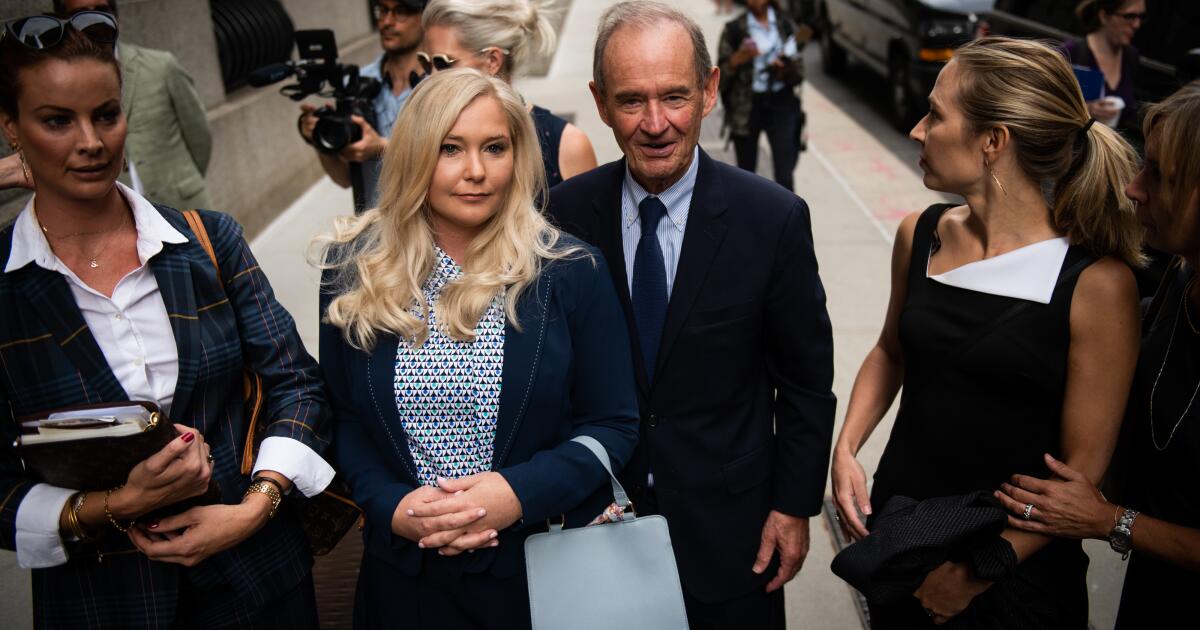
Jeffrey Epstein called her “Number One,” and her story of a childhood stolen away — first by relatives and then by the infamous sexual predator — has become the best selling nonfiction book in America for much of the last month.
Virginia Roberts Giuffre did not live to see the impact of her memoir. The most famous victim of the alleged sex trafficker committed suicide in April at age 41. But “Nobody’s Girl: A Memoir of Surviving Abuse and Fighting for Justice” has created a tempest because of what it reveals about the casual cruelty of the people who manipulated and abused young women, and those who covered up for them.
Giuffre’s book would not have been the same but for her collaboration with a brilliant and compassionate Californian, Amy Wallace, the book’s co-author and a veteran journalist who helped lay bare a story that many powerful people would prefer remain untold. “Nobody’s Girl” details how Giuffre went from an innocent early childhood in Florida to being sexually molested by her father (which he vehemently denies) and then into the ghastly orbit of Epstein and Ghislaine Maxwell.
I talked to Wallace, a former L.A. Times reporter, about a book that has sold roughly half a million copies around the world. The interview has been condensed here for clarity and space.
There are myriad themes in this book. Talk about some of them.
First, sexual abuse of children is not a thing of the past. What this book (and readers’ response to it) has taught me is that sexual abuse of children is very common, though reporting it is not. Second, the depravity of Epstein and Maxwell is sickening, yes. But the way Epstein leveraged that depravity to gain power and cozy up to “upstanding” people (mostly men) in our society sheds light on something deeply amiss in the culture.
As the brilliant writer Anand Giridharadas noted over the weekend, the scandal has resonated with a broad swath of people precisely because it pulls back the curtain on “a highly private merito-aristocracy at the intersection of government and business, lobbying, philanthropy, startups, academia, science, high finance and media that all too often takes care of its own more than the common good.” These elites get away with things that non-elites never do.
Virginia had her choice of many authors. How did you build trust with her?
In our first conversation, she was so used to being asked to serve up the very worst things that had ever happened to her that she began to launch right in. I stopped her and said she didn’t have to do that with me. I said: “If we decide to work together, we will get to know one another before we talk about how terribly you were abused.” I think that set us off on the right foot.
How extensive were your conversations?
We spoke regularly for nearly four years. Sometimes that was in person. I was with her in Paris and in New York when she had to be there advocating for victims, and I went to Australia and lived with her family, in their guest room, twice, for about a month in total. And I did a huge amount of reporting and interviewing around her, as well.
When Virginia talked about the release of the book, what did she think it would be like?
She was excited because she hoped it would help other victims of sexual abuse, both male and female, feel less alone, less ashamed. She knew firsthand how worthless and ashamed those experiences could make a person feel, and it was her primary goal to let those people know: I see you, I AM you, and I struggle too. She writes in the last line of her book that if it helps just one person, it will have been worth the effort.
I’ve heard from hundreds of people who say it has helped them. So she has succeeded on that front. And then there’s the way the book has connected with the zeitgeist. Virginia very much wanted [the Epstein] files to be made public because she wanted all of the men she’d been trafficked by to be held accountable.
Today’s top stories 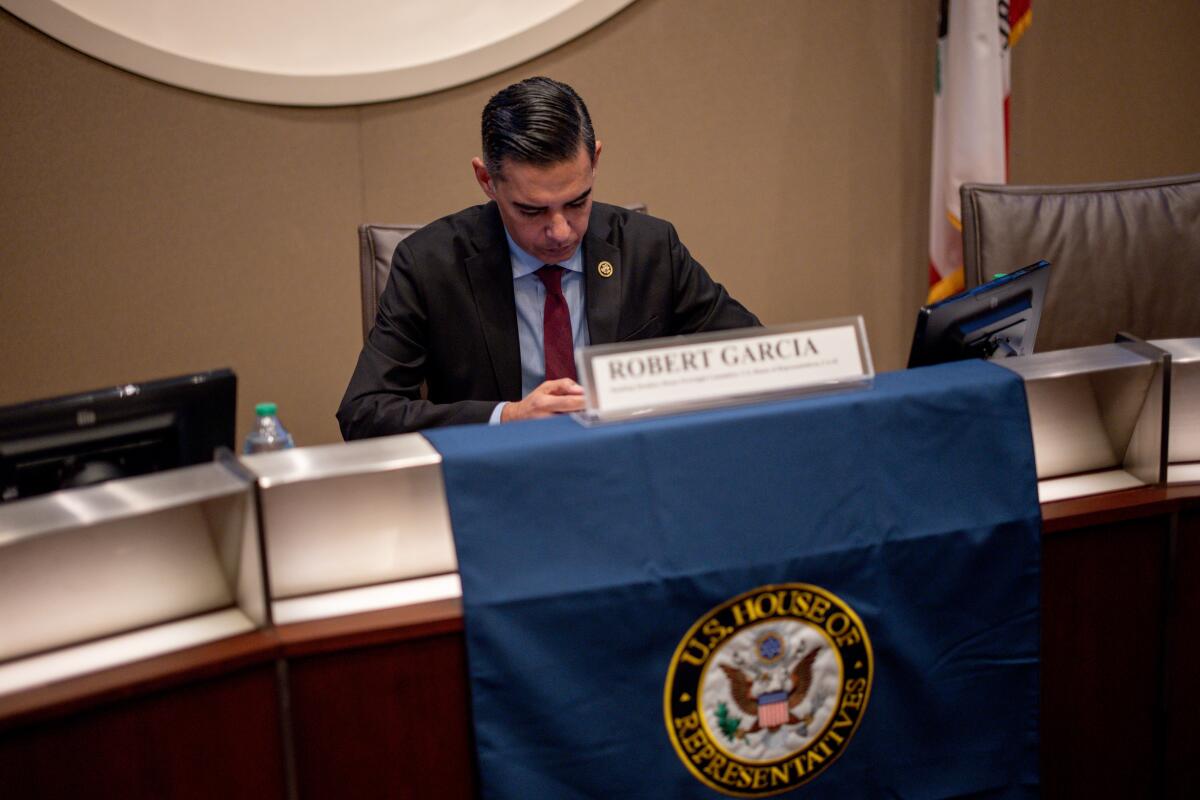
U.S. Rep. Robert Garcia (D-Long Beach) called for an investigation into arrests of U.S. citizens by ICE officers and a wider probe into immigration raids.
(Eric Thayer/Los Angeles Times)
L.A. hosts first congressional hearing on the effect of immigration raidsA congressional oversight hearing took place Monday, exploring how Trump’s immigration crackdown has harmed L.A. residents, including U.S. citizens who say they were wrongfully detained by ICE agents.More than a dozen elected officials, experts and community members spoke on the impact of the crackdown.Last month Mayor Karen Bass and the top Democrat on the House Oversight and Government Reform Committee, Rep. Robert Garcia (D-Long Beach), announced that Congress was opening “a broad investigation” into arrests of U.S. citizens by ICE officers, as well as a separate probe into immigration raids overall.California braces for an early, sharper flu seasonCalifornia could see an early start to the annual flu season, as a combination of low vaccination rates and late mutations to the virus may leave the state particularly exposed to transmission, health experts say.Typically, flu picks up right after Christmas and into the New Year, but Dr. Elizabeth Hudson, regional physician chief of infectious diseases at Kaiser Permanente Southern California, said she expects increases in viral activity perhaps over the next two to three weeks.An unproven air taxi company is spending $126 million to take over an L.A. airportArcher Aviation is buying control of the Hawthorne Airport for $126 million to build a hub for electric air taxis and test advanced aviation technology.Industry insiders say L.A.’s urban sprawl and congested freeways make it a prime test market for air taxis.Critics have questioned whether air taxis will ease congestion or merely shift demand, citing safety and noise concerns as the technology seeks Federal Aviation Administration approval.A giant landlord settled a lawsuit with California for colluding on rents in L.A. and elsewhereGreystar, a real estate company that manages 333 apartment complexes in Southern California, will cease using RealPage’s algorithmic pricing software as part of a settlement with California.The company and others will pay $7 million across nine states and help prosecute software company RealPage and landlords accused of conspiring to artificially inflate rents.The settlement represents a major victory for renters and signals mounting legal trouble for RealPage as antitrust lawsuits spread nationwide.
What else is going onCommentary and opinionsThis morning’s must readsOther must readsFor your downtime 
Magic of Lights in Indio is a drive-through experience that sparkles.
(Family Entertainment Live)
Going outStaying inAnd finally … your photo of the day 
Tyler, the Creator performs during Camp Flog Gnaw music festival at Dodgers Stadium on Saturday.
(Ronaldo Bolanos/Los Angeles Times)
Today’s great photo is from Times photographer Ronaldo Bolanos of Tyler, the Creator performing at his flagship festival, Camp Flog Gnaw, at Dodger Stadium on Saturday.
For the record
Correction: Saturday’s newsletter referred to Jared Sidney Thomas incorrectly as Jared Sidney Torrance.
Have a great day, from the Essential California team
Jim Rainey, staff reporter
Hugo Martín, assistant editor
Kevinisha Walker, multiplatform editor
June Hsu, editorial fellow
Andrew Campa, weekend reporter
Karim Doumar, head of newsletters
How can we make this newsletter more useful? Send comments to essentialcalifornia@latimes.com. Check our top stories, topics and the latest articles on latimes.com.