
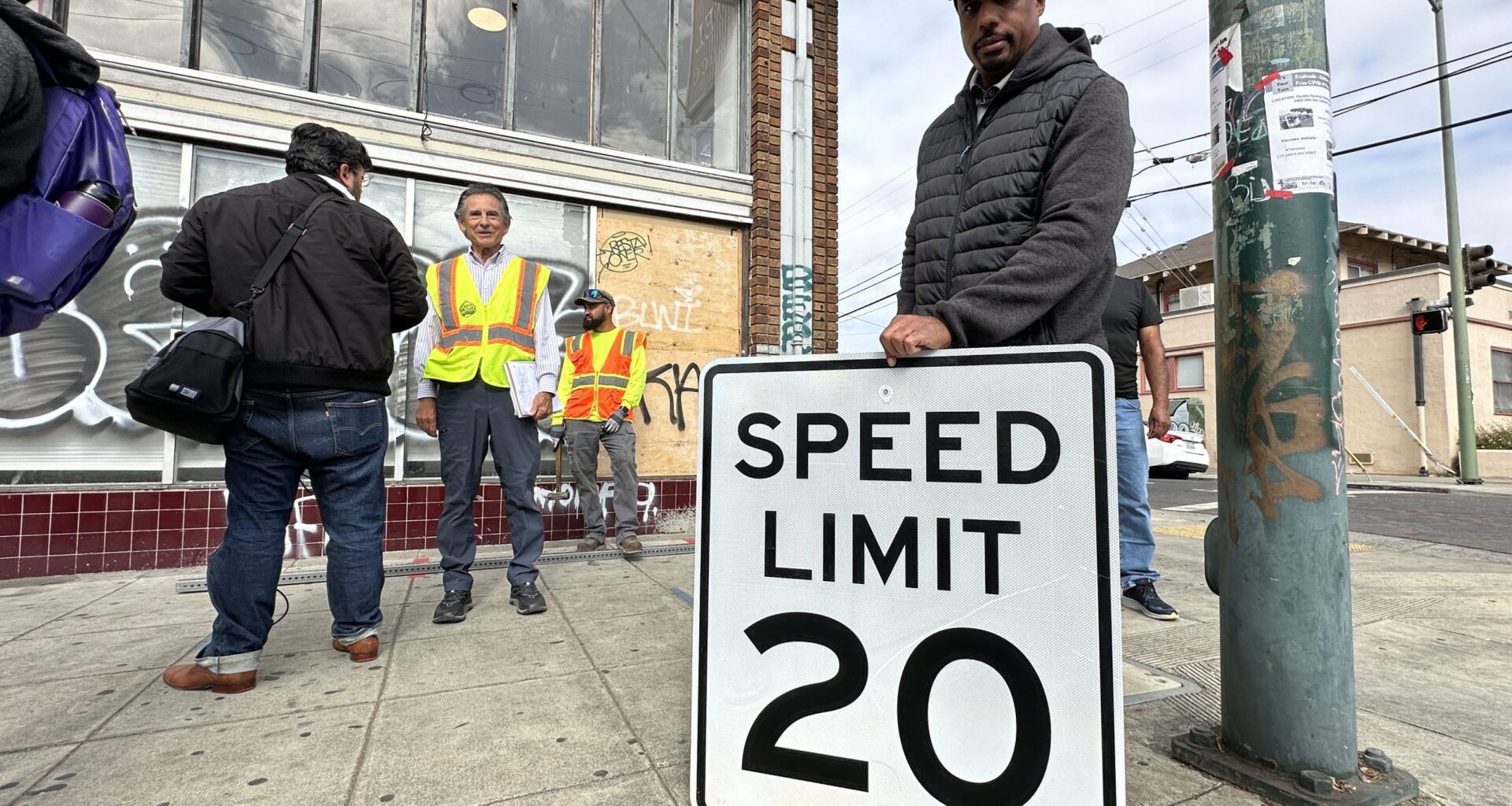
Two of the most-traveled roads in Oakland are in line for speed limit reductions to minimize the likelihood of collisions and to stay up to date with state and city regulations.
Over the years, some Oakland roads have used different speed limits on different sections; Broadway, for example, has a 25-mile-per-hour speed limit between 27th Street and Piedmont Avenue, and a 20-mile-per-hour speed limit between 27th Street and Water Avenue. The change will set the Broadway speed limit at 20 miles per hour all the way from downtown to the beginning of the Piedmont Avenue neighborhood.
International Boulevard will be reduced to 25 miles per hour on every block between 1st and 42nd avenues.
According to a report submitted by Oakland transportation director Josh Rowan to Jestin Johnson, the city administrator, on November 4, the city needs to adjust the speed limit chapter of its municipal code covering the Broadway and International Boulevard arterial streets.
“These changes support the citywide priority of Vibrant and Sustainable Infrastructure by eliminating confusion between Oakland’s Municipal Code and the roadway network, ensuring our speed limits comply with state law, and slowing vehicle speeds, each of which support a safer transportation system for all,” Rowan wrote.
Rowan said in the report that his staff conducted speed surveys that showed it would be practical and beneficial to make the changes.
In the past, the city had no authority to adjust speed limits, and was required to rely on a state-approved, federal formula that set speed limits based on average driver speeds, rather than what is safe. Then in 2021, the California State Assembly passed a bill, AB 43, which allowed local governments to reduce the speed limit by 5 miles per hour on roads in “business activity districts.” Starting in late 2023, Oakland reduced speed limits on parts of San Pablo Avenue, MacArthur Boulevard, 11th Street, 12th Street, and Fruitvale Avenue.
According to the city’s speed limit project page, 32 business districts in Oakland have seen speed reductions in the last two years.
The city has not yet made public any analysis of how, if at all, those speed changes have led to fewer collisions, especially on the most dangerous roads, such as Fruitvale Avenue in East Oakland.
In his report, Rowan also recommended a bit of housekeeping for the city’s municipal code, which is littered with typographical mistakes and misspellings of roads.
In the current municipal code, Foothill Boulevard is listed as intersecting with 57th Street, even though it actually intersects with 57th Avenue. The code update will also make the endpoints of some streets more accurate and change the classification of others, including relabeling some arterial streets as local streets. OakDOT noted in its report that 8th Street in West Oakland, for example, has a 30-mile-per-hour speed limit that reflects its former purpose as an arterial into downtown. But it became a local residential street after the creation of the I-980 highway decades ago. Relabeling it will allow for a 25-mile-per-hour speed limit.
The ordinance introduced to make these changes to the city code is with the Oakland Redevelopment Successor Agency and the City Council and will be read at their next joint meeting on Dec. 2 at City Hall.
“*” indicates required fields