
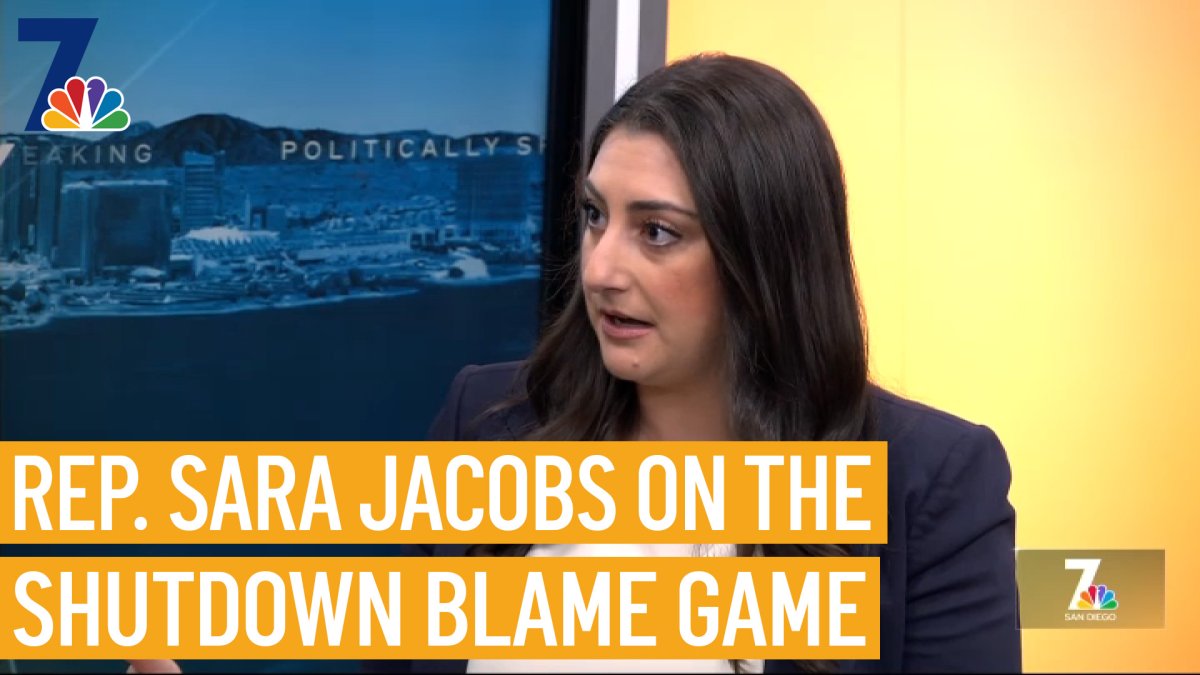
It’s week three of the government shutdown, and the stalemate persists with no end in sight.
Frustration is mounting for San Diegans who aren’t sure when their next paycheck is coming, but Democrats are holding their ground on the issue of health care.
On this week’s Politically Speaking, Rep. Sara Jacobs discusses all things government shutdown and why she believes the House has been out of session for nearly a month.
Below is the transcript to the full interview:
Safchik: How does this end?
Jacobs: Look, we’ve been very clear about what our demands are. If Republicans want our votes, we want to reverse their cuts to Medicaid. We want to extend the premium tax credits that so many people rely on to be able to afford their health care premiums. And we want some concrete guarantees that whatever deal we make will actually be implemented by the White House. We have sent them a proposal, as the start of negotiations. Literally, their response, the literal White House response was to go F ourselves. There’s been one single White House meeting between Leader Schumer, Leader Jeffries, and the president. And since then, the only thing we’ve heard from Republicans is AI meme videos.
Safchik: The White House said verbatim, ‘Go F yourself?’
Jacobs: Yes.
Safchik: What was your response to that?
Jacobs: I mean, to me, it just shows how unserious they are about actually coming to the table and getting to a negotiation.
Safchik: And for people at home, when we say ‘the White House,’ what do we mean by that?
Jacobs: It was a White House spokesperson.
Safchik: To Congress members?
Jacobs: It was their official – yes. They put it out to the press that that was their response to the, to the proposal.
Safchik: During your tenure in Congress, have you ever seen anything like that?
Jacobs: Absolutely not. This is crazy. And like, basically the president has not met or talked with any Democratic leaders since the shutdown began. The only way he’s been communicating is these AI meme videos. And like, I worked in international conflict resolution before I was in Congress. You do not get to a negotiation, you do not get to a resolution through AI meme videos.
Safchik: So let me ask you, do you think your messaging on the issue of health care, on that being the sticking point, is resonating with the American public?
Jacobs: Absolutely. I’ve been here, in San Diego, where, as you know, we have about 50,000 federal workers, many of whom are furloughed or working without pay. And the vast majority of what I’m hearing from them is that while they are suffering and they are hurting, they want us to keep fighting. They want us to stand up because they understand that while we’re in a shutdown now, Donald Trump has functionally been shutting the government down since the day he was inaugurated. And these illegal firings that they’re doing, trying to withhold back pay illegally, he could be doing all of those things. He could be breaking the law. Even without the shutdown, as we’ve seen him do for the entirety of his presidency. And so the vast majority of what I’ve heard from my constituents here in San Diego is to keep fighting, to keep making sure that Americans have access to health care.
Safchik: Some of your colleagues are back in D.C. Obviously, we’re very grateful to have you here in studio. But why are you still in San Diego?
Jacobs: I decided to stay in San Diego this week to make sure that I’m here talking to my constituents, hearing their stories, hearing their voices, so I can bring those back to Washington, D.C., bring those back to my colleagues. A lot of what I’ve found is that the best way to get my colleagues to change their mind is to be able to share with them real human stories about what’s happening. And so I’ve been here meeting with military families, with union leaders, superintendents, health care providers, with, you know, all sorts of people to be able to gather those stories and hear directly from the people most impacted by the fight that’s happening right now.
Safchik: On that note, child care is one of your signature issues. I spoke yesterday to military families who are now having to pay out of pocket for child care, and they say they are draining their savings accounts, doing that because they still have to report for duty. What do you say to them?
Jacobs: I have heard the same stories, and I know how difficult this is for our entire federal workforce. I’m glad that our service members were able to get paid this pay period. But I know that that doesn’t get rid of all of the stress and anxiety that they are feeling right now.
Safchik: They’re not sure if their next paycheck –
Jacobs: They’re not sure if their next paycheck is coming. They didn’t know they were getting this paycheck. So that was weeks of uncertainty. Obviously, the other federal workers and contractors that we have here in San Diego have not gotten their paychecks. And I understand how difficult that is, which is why I’m working every day to try and get the government reopened and protect people’s health care and why I’ve been doing everything I can to get my Republican colleagues to come to the table and actually negotiate with us.
Safchik: What can you do tangibly, from your perch, to ease the burden on constituents who are not getting paid?
Jacobs: Yeah. We’ve been working with local nonprofits to make sure that they are increasing their service delivery, to be able to accommodate the needs of the federal workforce. So I’ve worked with the food bank, Feeding San Diego, Jewish Family Services, others, to make sure that we are, you know, getting the information out to the federal workforce of how they can get the support that they need, and then making sure that our local nonprofit partners are able to provide those supports.
Safchik: You have been very vocal throughout this shutdown, conveying your message about why the government is in this position at this point. Is that really the extent of what you can do to bring this to a conclusion?
Jacobs: Right now, what we need is my Republican colleagues to come to the table and negotiate with us, and the best way to get them to do that is for them to hear from their constituents about what they’re facing right now and why they want them to address this health care issue, why they want them to work with us to reopen the government. And I found the more that I can talk about this, the more that I can make sure people understand what’s happening, the more that the people who live in those Republican districts have the information and tools they need to be able to call their representatives.
Safchik: Are you having conversation with your Republican colleagues, including San Diego’s Darrell Issa?
Jacobs: I have not talked to Darrell. I have talked to other of my Republican colleagues. I think a good number of them actually understand that we need to do something on health care. But, you know, at this point, it’s a question of Donald Trump deciding he’s ready to make a deal.
Safchik: Does this shutdown further erode public trust in the government?
Jacobs: Absolutely. Look, I was talking to a military spouse just the other day who was telling me that, like, she is struggling. Her husband is serving our country, and yet, all she sees is Democrats and Republicans fighting with each other, and no one looking out for them. And I totally understand that. Like, I understand that that’s how people feel. Not to mention the fact that Speaker Johnson hasn’t even called us back into session since Sept. 19. So the House has not been in session since Sept. 19 while the government has been in shutdown.
Safchik: What do you attribute that to?
Jacobs: Yes, I would say, and, you know, a lot of what we’ve heard is that he’s not calling us back into session because he knows he would have to swear in Adelita Grijalva, the representative who was elected in a special election in Arizona. And she would be the 218th signature needed to force a vote on releasing the Epstein files. And so Speaker Johnson is literally protecting pedophiles and child abusers instead of looking out for the American people. That’s what’s happening right now. That’s why he won’t even call the House into session.
Safchik: It just feels like this moment of absolute intransigence. Does this just go on forever?
Jacobs: Look, I think that this will come down to when President Trump decides he needs to make a deal. And I think the deal is very clear. We’ve been very clear about what we’re asking for. We’re asking for, you know, reversing the cuts to Medicaid. We’re asking for ACA premium tax credit subsidy extension. We’re asking for some guarantees that whatever deal we make is going to be implemented. And, you know, that was our starting position. We’re open to negotiating, but that requires them actually coming to the table.
Safchik: What compromises are Democrats willing to make?
Jacobs: Look, we’re not going to negotiate against ourselves, and we’re not going to negotiate in the press. But I think we are all very clear that we need to reopen the government, and we need to protect people’s health care.
Safchik: I do want to ask, Rep. Issa’s spokesperson told me Democrats are ‘demanding billions and trillions of new spending specifically for illegal immigrants.’ Is that true?
Jacobs: That is ridiculous and a lie. It is already federal law that no, no federal funding for health care can go to undocumented people. So Medicaid, federal Medicaid, dollars, Medicare, Social Security, none of that can go to undocumented immigrants. What we’re talking about is Americans’ health care. And I can tell you, in my district, a 60-year-old couple who makes about $82,000 a year, American citizens, they’re going to see their premiums go up by $15,000 if we don’t extend these premium tax credit subsidies. That’s what we’re talking about. Americans’ health care. And you know that Republicans are losing the argument when they try and make this about immigration. This is not about immigration. This is about Americans and the health care that they deserve.
Safchik: Sen. Schumer came under fire last week for saying the shutdown has political benefits for Democrats. How do you square Sen. Schumer’s point with the real world consequences of this shutdown on your constituents?
Jacobs: Look, I don’t take the shutdown lightly. It impacts our community here in San Diego so much. And I’m hearing from constituents every single day about the impact that this is having on them. No one takes this lightly, but we are not in normal times, and we can’t act like we are. And the fact of the matter is, 20 million people are going to lose their health care if we don’t get these tax credits extended. Already 15 million people have been kicked off of their health care because of the cuts to Medicaid. And that’s what we’re fighting for.
Safchik: Can the government reopen while this blame game is being played out?
Jacobs: We are ready and willing to open the government. We want to reopen the government and protect people’s health care. Democrats have been in Washington, D.C., every day of this shutdown to make sure that we have someone there if there’s a Republican who wants to come to the table. But so far, we haven’t had a single Republican leader take us up on that offer.
Safchik: Are you going to take your paycheck on Nov. 1?
Jacobs: I have already donated more than the amount of my paycheck to children’s causes in San Diego, and I’ll continue to do so. So, sure. But it will be donated.
Safchik: Do you support Rep. Peters’ No Budget, No Pay bill?
Jacobs: Yes.
Safchik: And do you support the Pay Our Troops Act?
Jacobs: Yes, I’m a co-sponsor.
Safchik: Where do you see us come Nov. 1?
Jacobs: I’m hopeful that by Nov. 1, as my colleagues have seen all of their constituents receive notice of what their higher premiums are going to be this year, that they will see the urgency of coming to the table and coming to a deal to extend these tax credits and reopen the government because open enrollment is already happening. We can’t actually wait until the end of the year because by then people will have already made decisions about their health care and whether or not they feel like they can afford it, or whether they’re going to forego health care and then end up in the ER instead of the preventative care that’s just going to raise costs for everyone. And so we need to make sure that we are addressing this now as people are making those health care decisions about their insurance. And I’m hopeful that by Nov. 1, as everyone has then received their notifications, that my colleagues will see that it’s their constituents who are being hurt and will be ready to come to the table and make a deal.
Safchik: Arguably, San Diego is hit harder than any other city in California because of the military presence here and civilian workers who are associated with the military as a San Diego representative. Do you feel that pressure, that burden?
Jacobs: Absolutely. It’s part of why I’m here this week in San Diego instead of in Washington, D.C., because I want to make sure that our federal workforce here, our service members, our defense contractors, our contract, our government contractors, all know that we are here. I’m here listening and fighting to try and get the government reopened.
Safchik: We know that this is hurting people’s pocketbooks. Does it also put you behind on other legislation that you’ve been working on to lower the cost of living?
Jacobs: Oh, absolutely. Because Speaker Johnson has refused to reopen the House of Representatives, we’re behind on all sorts of things. We are in the middle of negotiating the National Defense Authorization Act. It was passed through the House floor, and now we need to get to the final version with the Senate that is being delayed because of this. Other legislation that we had wanted to introduce around housing, and other things we are unable to do because the speaker has refused to open the House of Representatives. There are lots of things that we could be doing to actually address people’s cost of living, but instead we are having this fight because Republicans refuse to do anything to protect people’s health care, regardless of party.
Safchik: Why should people have any faith in their federal government after this?
Jacobs: I mean, it’s a fair question, and one of my real passions, one of my kind of guiding north stars, is how do we rebuild trust and faith in government and in institutions? And how do we show that we’re actually working for people? It’s why I try and be as transparent as possible about everything that I do. We go above and beyond the ethics requirements in terms of, you know, my own actions. And, it’s why I think we need to do a better job of making sure that we are having real conversations with our constituents, not only the ones who agree with us, but everyone. And that’s what I’m doing here in San Diego this week.