
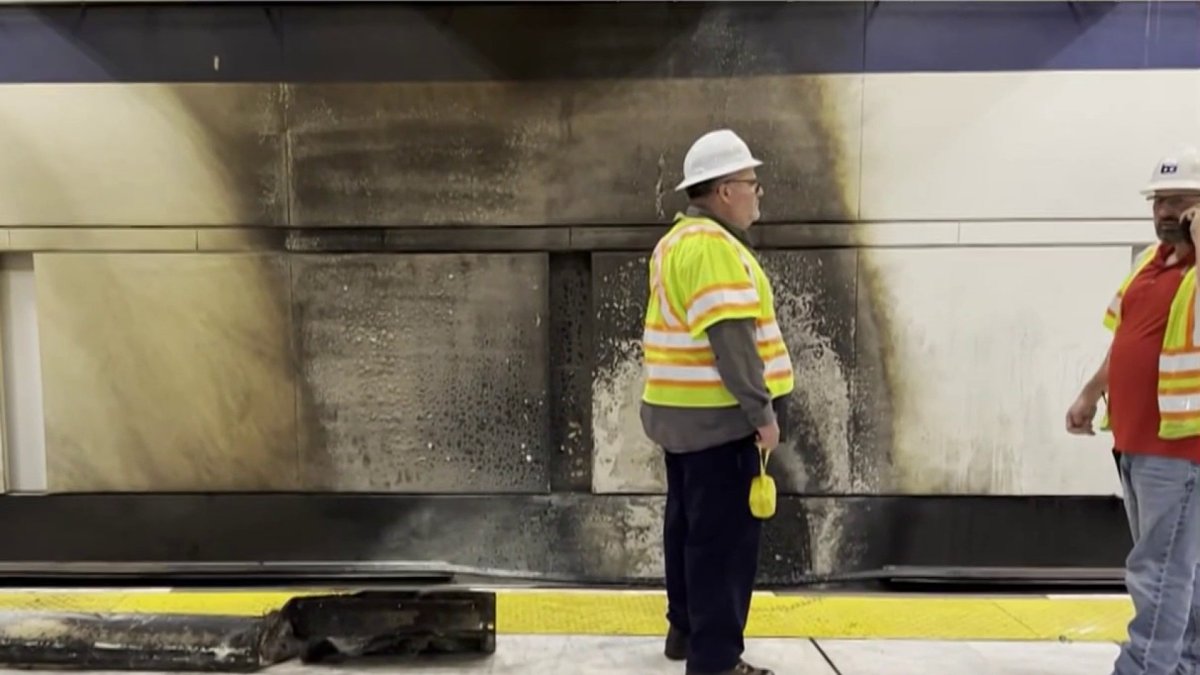
BART dispatch recordings capture how a train operator maintained his calm immediately after Tuesday’s small explosion and stubborn fire on the subway tracks. The fire filled his train with smoke, forcing passengers to flee to safety at Civic Center station.
At 11:30 a.m., the operator of train 375 reported to controllers that he had just seen an explosion of an insulator – a ceramic device that prevents voltage from the third rail from flowing into the ground. He told them it exploded “right in front of me.”
The train operator quickly describes to BART control the challenge he faces. The train is without power, stopped dead with the fire still burning in front of it. He announces a plan to sweep the train to assure everyone is out.
“It’s got a lot of smoke though and I’ve got everybody off-boarding at this time.”
“Copy that, great job,” a BART operation official responds.
Several moments later, with BART police now swarming the smoky platform, the operator reports back to BART controllers that he still sees flames coming from where the insulator exploded in the tunnel. “It’s still going at this time,” he says.
Even after seeing smoke had dissipated several minutes later, the operator reports back to BART control: “I can’t tell you if we still have fire on third rail yet.”
After the fire was finally put out, crews discover damage to that exploded insulator as well as the fiberglass board covering the third rail and the rail itself, according to the assessment by crews at the scene.
After the incident, a BART spokeswoman suggested an unspecified “foreign object” in the trackway may have hit the insulator, touching off the initial explosion.
The incident on Tuesday bore several similarities to several recent mishaps in the subway.
The first incident, on Aug. 29, also involved an insulator that exploded, filling the Transbay Tube with smoke. In that incident, the operator stopped the train at the East Bay side of the tunnel, allowing smoke to get sucked into her train through the ventilation system.
Eventually, the train made it out safely. BART has not said what caused the incident, but it did change its previous policy that kept operators from shutting off the train car ventilation unless their trains came under nuclear, chemical or biological attack. They are now told to deactivate the system as a precaution during fires.
But in October, the smoky incidents continued, including one on Oct. 7 at Embarcadero station. Like Tuesday’s incident, BART blamed unidentified trackway debris for that incident, but says it is still under investigation. Two more incidents involved insulator failures.
BART recently acknowledged to the investigative unit that crews had recovered broken metal paddles at the scene of all the incidents in October and August.
Those paddles, also known as collector shoes, serve as the vital link between the train car and the third rail. But when they come under stress, they are designed to break to protect from causing further damage. It is not clear whether those paddles might be hitting insulators, triggering explosions.
Separately, the NBC Bay Area Investigative Unit first reported that it has been five years since the agency cleaned caked-on iron deposits from the surface of ceramic insulators that line the subway.
Those insulators normally block energy from flowing from the third rail into the ground below. But when iron builds up, it creates an alternative path for that voltage to flow to the ground, sometimes triggering short-circuits and flash over fires.
BART has acknowledged to the investigative unit it stopped cleaning the insulators in 2020 – saying that using carbon dioxide crystals for cleaning can damage the ceramic surface. BART says it has since been inspecting and replacing at-risk insulators.