
By Jim Newton, CalMatters

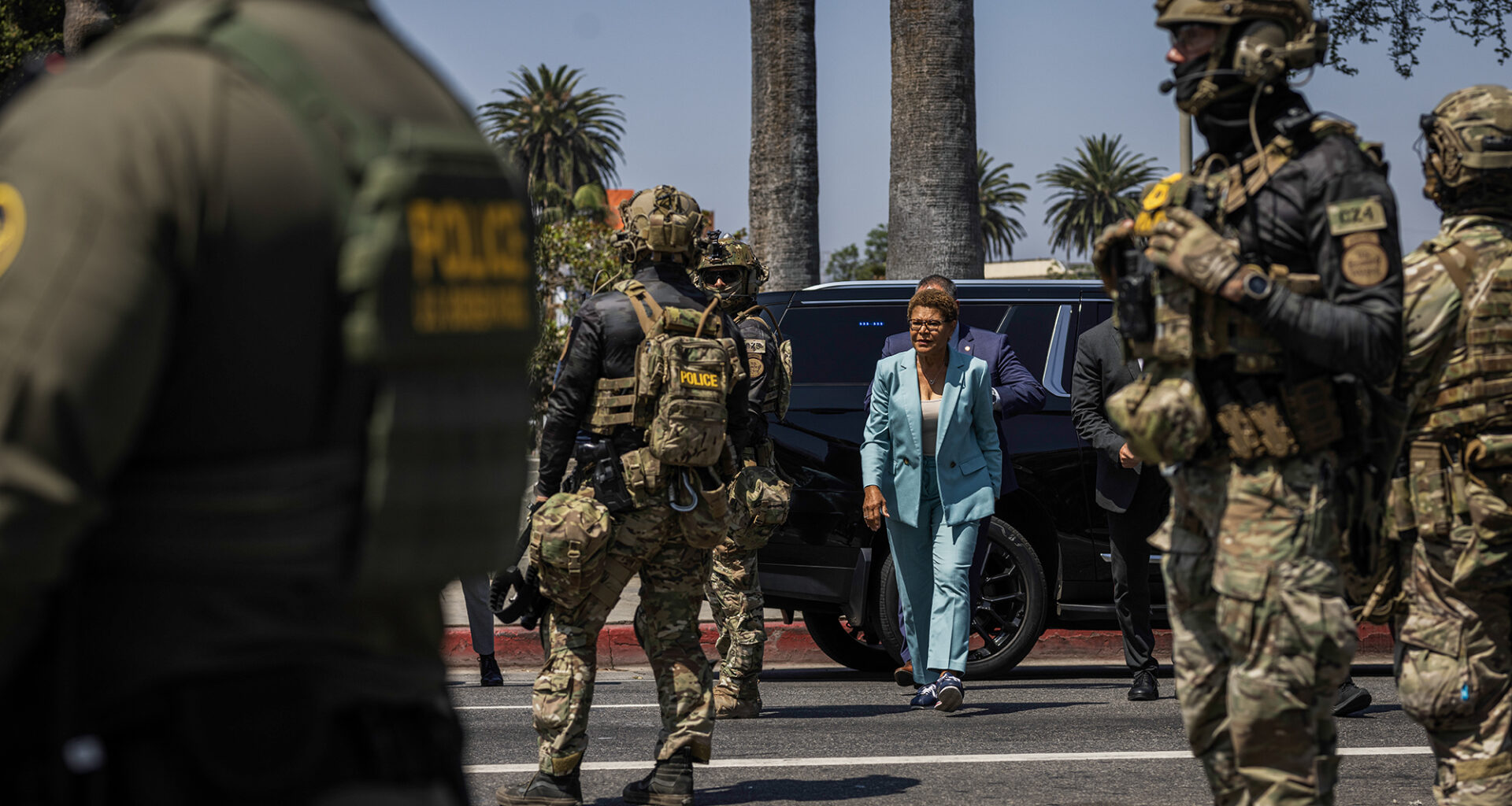
LA Mayor Karen Bass arrives as federal agents descend on MacArthur Park in Los Angeles on July 7, 2025. Photo by J.W. Hendricks for CalMatters
This commentary was originally published by CalMatters. Sign up for their newsletters.
A congressional hearing Monday in Los Angeles on the Trump Administration’s immigration raids offered a searing look at a program that has been equal parts stupid and cruel.
One witness after another faced the House Oversight and Reform Committee and described their experience at the hands of Immigration and Customs Enforcement, which descended on Los Angeles in June, stirring discontent with a theatrical assault on the city’s immigrant communities.
One man who has lived in Los Angeles for 23 years and is married with four children, dropped his younger kids at school on June 6 and headed to work, where ICE agents detained him. He ended up at an ICE facility in Adelanto, struggling with his health, waiting for days to see a nurse or doctor. Eventually he was released and is home in Los Angeles.
A young woman, not present for the hearing but represented by a friend, was up early one morning to sell tamales outside a local school. ICE agents tossed her to the ground, injuring her so seriously she had to be hospitalized. She’s an American citizen and was released but now is so scared of ICE, she refuses to leave her house. She has been inside for 158 days.
Yet another man, detained on June 10 by masked men who had no identification or warrant for his arrest, remained locked up by ICE until Sept. 16, when he was released on bail. He described his 98 days of detention: rotten food, orders to stay silent when officials visited, an atmosphere of danger.
His voice broke as he acknowledged he had been raped. The experience, he said, “reminded me of the violence that I lived through in my country, Honduras.”
Their stories were piercing, puncturing any glib stereotypes about immigrants, documented or undocumented. These were not dangerous criminals who need to be removed to protect this country. They are working men and women, laboring to support their families and loved ones.
President Donald Trump promised to go after the “worst of the worst,” but his agents ended up harassing and devastating these decent people. And their detentions benefited no one.
Moreover, there are costs to others around them. Witnesses from local organizations made clear in their testimony that school attendance is down, church pews are half-empty, summer youth programs struggled to stay afloat and businesses are suffering for want of employees and customers.
 Federal agents descend on MacArthur Park in Los Angeles on July 7, 2025. Photo by J.W. Hendricks for CalMatters
Some people are afraid to venture out because they lack proper documentation. Others are afraid because they simply “look illegal.”
That apparently was the case for Andrea Velez. The daughter of Mexican immigrants, Velez was born in the United States and is, therefore, an American citizen.
On June 2, her mom dropped her off at work in the fashion district. But before Velez could get inside, she was rushed by ICE officers, who took her into custody. She was not carrying any proof of American citizenship — few people do — and ICE was not interested in her driver’s license. She was handcuffed and detained.
Denied food, she was told she could only have water if she purchased a cup. She was rebuffed in her requests to contact family or a lawyer. Velez was held two days, until June 4.
To be clear, Velez had committed no crime and is a native-born American citizen. Her only offenses were to come to work and to be Latino.
She asked the officers who arrested her for their names but was denied that, too. “They told me I didn’t need to know their names,” she said in response to questioning by Congress members who participated in the hearing.
One member questioned her more deeply, wondering if she had done anything to warrant such treatment. Velez said she had not been carrying any weapons and had neither attacked nor threatened any officer. She is 4 feet, 11 inches tall.
The treatment described by witnesses at the hearing should shock the conscience, but some consciences appear too hardened to be moved.
As Mayor Karen Bass and Rep. Robert Garcia, who presided over the session, noted, the cruelty of these policies is not a defect — it is the point.
“It was over the top from Day 1,” Bass told me after the hearing, “the way they dramatized it by pulling up on the street and jumping out with rifles at a woman selling fruit. There’s no way in the world you can tell me they thought she was a criminal … It was designed to terrorize. It was to go in and inflict maximum damage.”
These wanton attacks on the fabric of Los Angeles life have had at least one positive effect: In a city that has sometimes seen Black and brown residents turn against each other, this episode has been unifying, something many speakers remarked on, and that was reinforced by the proceeding itself: Garcia, a native of Peru and naturalized American citizen, sat next to Bass, the first Black woman to serve as Los Angeles’s mayor.
Support for immigrants came from a broad range of speakers: from Rep. Maxine Waters to immigrant groups, from union leadership to prominent Japanese-Americans. including some who drew parallels to the 1942 internments that were carried out under the same legal authority Trump is using now for his anti-immigrant actions.
Monday’s hearing was packed, and speakers were often interrupted by cheers and applause. As witnesses concluded their sometimes-harrowing stories, others stepped forward to hug and comfort them. A session called to collect evidence became an opportunity to demonstrate solidarity.
One of the day’s loudest expressions of support came for Waters, when she used her time to denounce Trump, whom she called a “low-down, no-good, filthy president.” The audience — white, Black, Asian, Latino, old and young — cheered loudly for that. Give him his due: Trump has brought Los Angeles together.
This article was originally published on CalMatters and was republished under the Creative Commons Attribution-NonCommercial-NoDerivatives license.