
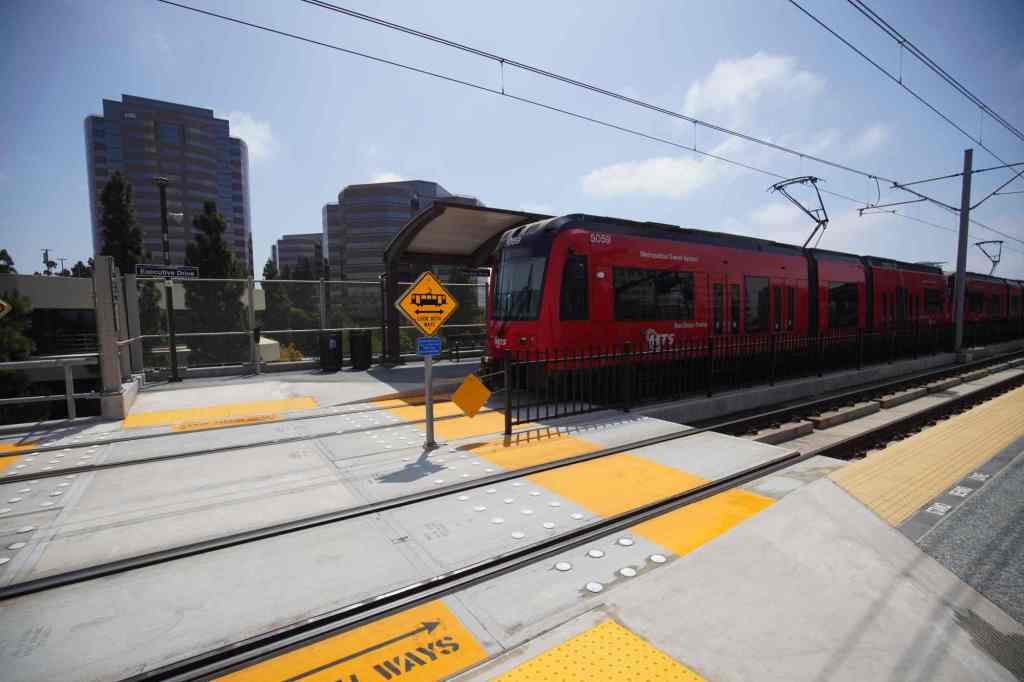
California Senate Bill 79, signed into law in October, is intended to allow increased construction of multifamily housing near public transit such as rail stations and bus lines. According to new estimates from UC San Diego’s Center for Housing Policy and Design, some locations in and around La Jolla could be affected when the law takes effect in July.
The Center for Housing Policy and Design says it aims to “close the housing research and policy gap” in the San Diego/Tijuana region. It was formed to tackle what it describes as a regional housing problem.
The center’s estimates, published Nov. 14, indicate that 83 “major transit stations” in the San Diego region could meet the bill’s requirements for developing midrise housing nearby. The release comes with the caveat that how many developments are created ultimately will be in the hands of the San Diego Association of Governments.
“Major transit stations” are defined as those that serve at least 48 trains or buses per day, according to the center. In San Diego, that means “virtually all trolley and Sprinter stations,” it said.
Housing up to eight stories tall can be built directly next to stops on those lines under the new law. It also allows projects within a quarter-mile of such transit stops to be six stories tall and projects between a quarter-mile and a half-mile away to be five stories.
Late amendments to the legislation exempted stops on commuter rail lines such as Coaster and Amtrak. Another ensured that rapid bus lines are included only if they have a dedicated line and service every 15 minutes.
The center mentioned six transit stations in and around La Jolla, a majority of which are around the UC San Diego campus: Nobel Drive, VA Medical Center, UCSD Central Campus, UCSD Health, Executive Drive and UTC.
The location closest to the heart of La Jolla is the Nobel Drive station next to La Jolla Village Square. The closest spot south of La Jolla is the Balboa Avenue Transit Center between Interstate 5 and Morena Boulevard.
See the full map at unquote.ucsd.edu/chpd/sb79-map.
How much of an impact the law will have depends on how much development has already taken place near transit stops.
But notably, the law overrides local zoning — including zoning that calls for commercial development or less-intense residential development like single-family homes.
SB 79, formally called the Abundant and Affordable Homes Near Transit Act, was introduced by state Sen. Scott Wiener (D-San Francisco). It drew strong reactions on both sides of the housing-density fight, with supporters hailing it as a breakthrough and opponents warning it could destroy neighborhoods.
Among the local opponents were the La Jolla Shores Association, which wrote a letter against the bill; state Sen. Catherine Blakespear (D-Encinitas), whose 38th District includes La Jolla and who voted against the bill; and Neighbors for a Better San Diego.
On the other side, Ryan Stock of Respect Bird Rock advocated at a La Jolla Town Council meeting in August for what he described as “middle-density housing,” citing high demand.
Geoff Hueter, a leader of Neighbors for a Better San Diego, speaks against SB 79 at the La Jolla Town Council’s Aug. 14 meeting. (Noah Lyons)
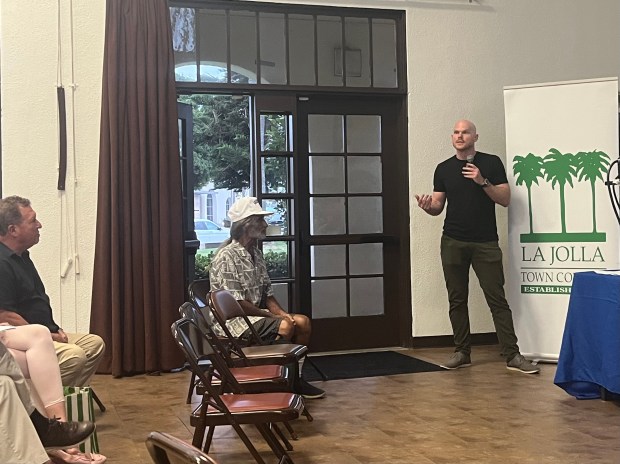
Ryan Stock voices support for SB 79 and “middle-density housing” while speaking at the La Jolla Town Council meeting Aug. 14. (Noah Lyons)
Show Caption
1 of 2
Geoff Hueter, a leader of Neighbors for a Better San Diego, speaks against SB 79 at the La Jolla Town Council’s Aug. 14 meeting. (Noah Lyons)
San Diego Mayor Todd Gloria also praised the legislation, saying it would ensure cities “do their part to address California’s housing crisis.”
He said changes in San Diego will be small relative to other cities with less development at transit stops and less aggressive zoning near them.
— San Diego Union-Tribune staff writer David Garrick contributed to this report. ♦