
I’d like to say that there was a blinding light — a culinary epiphany! — that struck at some point in the second half of the 20th century, when eaters around the world suddenly discovered the joys of consuming fish raw … or, at most, quasi-cooked in citrus or some other acidic liquid.
The rise — explosion, really — of poke, crudo, ceviche, sushi and sashimi on our menus seems to have happened all at once. And, indeed, here in the US of A, it very well may have. But not out there in what passes for the real world.
Cooks around the globe have been fermenting seafood for thousands of years; there are records dating back to the 8th century of a preserved fish dish in Japan called namasu, which was apparently eaten even earlier in Southeast Asia.
And ceviche goes back far further, to Peru in 3500 B.C., when there’s evidence that anchovies were “cooked” with chili and salt by the Caral people of the Andes, and the Moche of the coast, who did their preserving with passionfruit.
The Incas liked to use a fermented beverage called chicha. The dozens of ceviche houses that line the coastline in Lima are serving a dish with roots rising from an historical fog heavier than the one that spills off the Pacific. Ceviche goes back to before the beginning.
And it has a cult following that can be more than a little manic. The portions of ceviche, served at Lima Cebicheria Peruana, just down the street from the legendary Jongewaard’s Bake n’ Broil in Bixby Knolls, are considerable — more than enough that most folks leaving are carrying a container for lunch the next day. Or, in my case, a somewhat eccentric breakfast. But it’s the sort of dish that also inspires competitions to create the largest ceviche.
For many years, the record was held by a group of chefs in Lima, who ceviched more than six tons of seafood — which was then served to locals who hungrily waited while a giant tank was filled, and then emptied into portions.
The record now belongs to a group of professors and students at the Universidad Tecnológica de Manzanillo. They doubled the record holder, filling a swimming pool with more than 12 tons of tuna, onions, chiles, cilantro, tomatoes and lime juice.
College kids used to stuff themselves into phone booths and VW Bugs. I guess ceviche is at least edible.
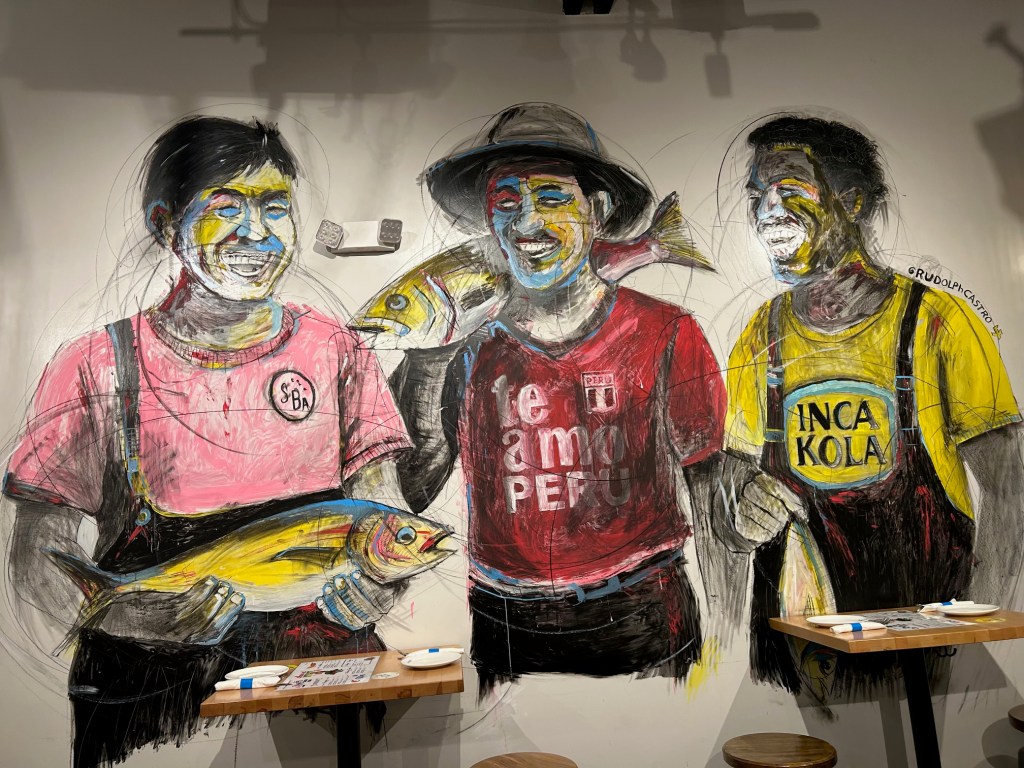
Lima Cebicheria Peruana, in the Bixby Knolls neighborhood of Long Beach, serves ceviche and more ceviche, along with other iconic Peruvian dishes. (Photo by Merrill Shindler)
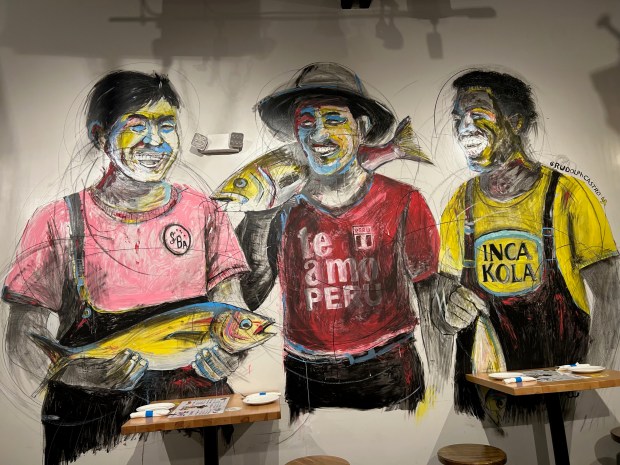
Artwork fills one of the walls at Lima Cebicheria Peruana, in the Bixby Knolls neighborhood of Long Beach. (Photo by Merrill Shindler)
Show Caption
1 of 2
Lima Cebicheria Peruana, in the Bixby Knolls neighborhood of Long Beach, serves ceviche and more ceviche, along with other iconic Peruvian dishes. (Photo by Merrill Shindler)
As big as the portions are at Lima Cebicheria Peruana (3851 Atlantic Ave., Long Beach; 562-247-1418), the menu is decidedly small, focused on doing a handful of dishes very well. The first section on the menu is headed “Piqueos,” which literally means “pecking.” It refers to appetizers … snacks. Which these dishes definitely are not.
The choritos a la chalaca is a big tray, covered with ice, on top of which half a dozen very large mussels rest, each topped with chopped red onions, cilantro, the jumbo kernel Peruvian corn called choclo, the toasted corn nuts called cancha, and the marinade called leche de tigre (“tiger’s milk”). It’s a very substantial portion, enough for two.
More Merrill: Kevin Bludso’s BBQ is a must-try for every barbecue fan
There’s more: the mashed potato and seafood dish called causa “Lima” especial. The fish and seafood pater known as jalea mixto. The marinated octopus creation called pulpo a la parrilla.
Move to the main dishes — Platos de Fondo — and there’s stir-fried beef tenderloin (lomo saltado), seafood and rice (arroz con mariscos), and Chinese fried rice done Peruvian style (chaufa de mariscos). It’s a remarkable transliteration of a dish we know so well, and don’t really know at all.
And then, there are the four ceviches — made with either the fish of the day alone, or mixed with shrimp, mussels, octopus and more. The ceviche comes El Pescador (Clasico) style, flavored with leche de tigre, cancha, choclo and some especially soothing slices of sweet potato.
El Chalaco ups the ante with some seriously spicy rocoto peppers mixed with the leche. The pepper in the La Sirena is aji amarillo, which is a tad milder. And finally, the Leche de Tigre comes with a topping of crispy calamari. Which sounds wrong — and tastes amazing. The soft fish with crunchy calamari is a joy, not just in terms of taste, but obviously in terms of texture.
You can wash it down with the sweet purple corn drink called chicha morada. Or with the hot roasted barley and herb drink called emoliente. Myself, I prefer Inca Kola. Did the Incas drink kola? Maybe. There’s Mexican Coke, too. Apparently the Incas weren’t part of the Pepsi Generation.
Merrill Shindler is a Los Angeles-based freelance dining critic. Email mreats@aol.com.
Lima Cebicheria Peruana
Rating: 3 stars
Address: 3851 Atlantic Ave., Long Beach (Bixby Knolls)
Phone: 562-247-1418; www.instagram.com/limacebicheriaperuana/?hl=en
Cuisine: Ceviche and more ceviche, along with other iconic Peruvian dishes like causa, choritos, jalea, arroz chaufa and lomo saltado.
Hours: Lunch, Saturday and Sunday; dinner, Tuesday through Sunday
Details: Peruvian soft drinks; reservations usually not needed
Menu: A creation of the lively team at the nearby Sushi Nikkei, churning out some of the best ceviche in SoCal in an oversized space with a very cheerful staff. The menu is short. But the food is just right.
How much: 4 Appetizers ($18-$32), 4 Ceviches ($28-$30), 3 Main Dishes ($28-$30), 1 Dessert ($8)
Credit cards: MC, V
What the stars mean: 4 (World class! Worth a trip from anywhere!), 3 (Most excellent, even exceptional. Worth a trip from anywhere in Southern California.), 2 (A good place to go for a meal. Worth a trip from anywhere in the neighborhood.) 1 (If you’re hungry, and it’s nearby, but don’t get stuck in traffic going.) 0 (Honestly, not worth writing about.)