
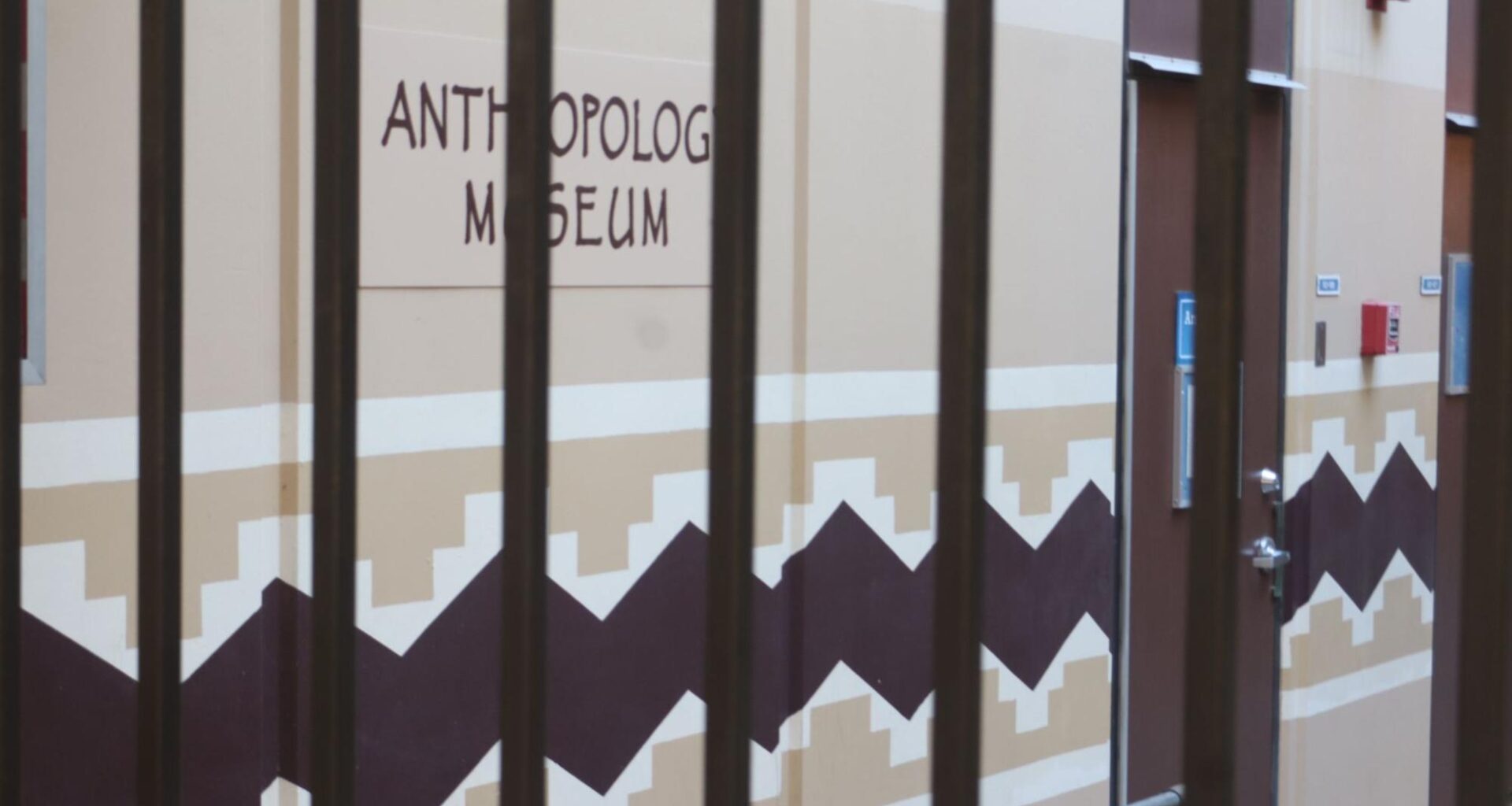
The Fresno City College Anthropology Museum has been closed to all students and faculty since early 2024 due to the California Native American Graves Protection and Repatriation Act (CalNAGPRA).
The museum opened in 1975 and is home to Indigenous artifacts that require proper identification under CalNAGPRA. FCC has been working with the Native American Heritage Commission (NAHC) to ensure that all artifacts are in compliance with state and federal law, according to Kherstin Khan, the interim dean of social sciences at FCC.
On Dec. 31, 2020, the NAHC sent a notice to all agencies and state-funded museums to complete an inventory of any California Native American human remains and funerary objects they were in possession of or had control over.
The notice called for a “detailed assessment of all artifacts in the museum’s possession” by Jan. 1, 2022, which would then be used for consultations with representatives of Native American tribes and groups in Fresno County.
Khan said the assessment process was completed under the department’s previous dean, Cherylyn Crill-Hornsby.
Khan said there are still a few items in FCC’s possession that need to be consulted about with Native American tribes.
“That was a huge part of what the previous dean worked on, we have loads of Excel files and software that helped us to essentially itemize what we have and where it came from, so if it was a previous faculty member who brought in that piece, we would say, ‘Okay, there’s all of these potential native tribes that we would want to consult with to see if that piece belongs to them,’” Khan said.
The NAHC provided a tribal consultation list of the area for this purpose. Khan said that there are two major things currently being worked on in order to re-open the museum, including revisions of inventory and repatriations that will return artifacts to their respective tribes.
“We’re working to make sure that our inventory is accurate with the Native American Heritage Commission and we are still working with Cold Springs Rancheria to ensure that we have appropriately repatriated the items that they have,” Khan said.
The Indigenous Tribes with items found in the museum include the Cold Springs Rancheria, in Sycamore Valley and the North Fork Rancheria, in Madera County. These are homes to the Mono people and the Yokut and Miwok linguistic groups.
Erik Escovedo, an American Indian studies instructor at FCC, said that the Anthropology Museum is something that the district needs to prioritize.
“I would like to see it open, I’d like to see the district put effort into it because those artifacts deserve to be honored in a respectful and responsible manner, in the hands of the right people,” Escovedo said.
Khan said there’s no confirmed date for the museum’s re-opening and that it all depends on how the process continues to move forward.
“It would be ideal to have it open within a year, it would be fabulous to see it open in the fall of 2026, but that requires consistent effort and a lot of work. I know that the faculty and staff here are committed to doing that work, but it’s a lengthy process,” Khan said.
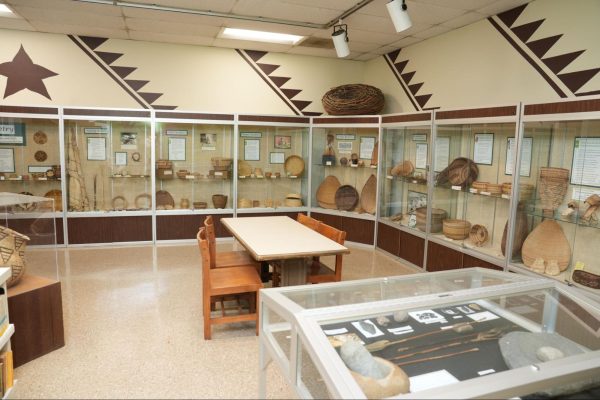 Photo of the Anthropology Museum’s interior on Nov. 24. Courtesy of the FCC Public Information Office.
FCC has been completing inventories of human remains and associated funerary objects since 2018, according to the Federal Register National Park Service with the help of a NAGPRA Consultation/Documentation grant of $83,814 awarded to the State Center Community College District (SCCCD) in 2016.
Before its closure, the exhibit focussed on Native American basketry techniques and materials, specifically, Western Mono baskets.
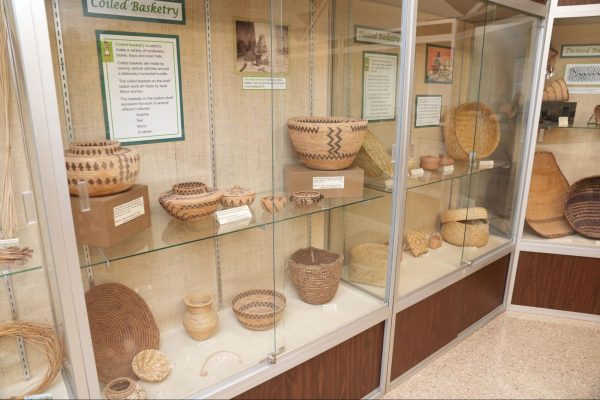 Photo of the Anthropology Museum’s Coiled Basketry exhibit on Nov. 24. Courtesy of the FCC Public Information Office.
The museum previously offered opportunities for students to lead tours and activities within the museum, called docents. Khan said those opportunities would certainly make a comeback in the future.
“We used to have a training program for student docents. We would need to reinstate that. We want to make sure that process is transparent for our tribal partners, and that they agree with it, and that it aligns with their expectations of the museum as well,” Khan said.
Miguel Barrita, Associated Student Government (ASG) president and anthropology major, said ASG has begun collaborating with campus staff in support of the museum’s re-opening.
“We do have quite a few students that are interested in history and anthropology. Here on campus, we find people to be super enthusiastic. So our relationship towards the museum is basically trying to figure out, you know, why is it not available for students? For those types of students that want to be able to have access to those artifacts or access to more education,” Barrita said.
Like many others, Barrita, who has been at FCC for four semesters, has also been unable to visit the Anthropology Museum due to its closed doors.
“I have talked to people that have been here before, and they say that It had a lot of histories and ties to cultural groups here in Fresno and the Central Valley, specifically Californian history. We are a campus that prides itself in really getting everybody to know who’s here, who’s been here before, who’s gonna be here after. And that museum was just a big part of it,” Barrita said.
For now, nobody is allowed inside the museum without proper guidance, including Khan.
“There’s a lot of rules about going into the museum because some of the artifacts require certain people be present when you are around them. And because I am brand new, I want to make sure that I’m honoring that, so I’ve not stepped foot in the museum until I am told that I have the appropriate people with me to do that,” Khan said.
In addition to inventory and student docent processes, the heating, ventilation and air conditioning systems in the museum have been overhauled to ensure that the climate is appropriately controlled. Khan said the lighting in the building will also need to be updated.
Khan said that the department is still putting its best foot forward for the Anthropology Museum despite its staffing issues and course removals in the recent past.
In 2024, all but one archaeology course was removed from the anthropology department, leading to the elimination of the Archaeological Technician Certificate of Achievement at FCC.
“Know that we understand the importance and the significance, we just want to make sure that we do it right,” Khan said.
In a situation like this, Khan said that people’s voices are what really matter.
“There are artifacts in that museum that belong to the tribes of current students, current faculty, current staff and seeing those in an important space is imperative, I think that it’s vital to seeing your culture and honoring it,” Khan said.