
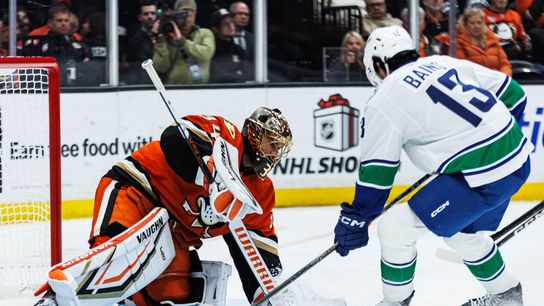
ANAHEIM, Calif. – The Anaheim Ducks’ bad habit of letting the opponent ahead off the opening puck drop has become more than a problem, as the Ducks dropped an extremely winnable game they were forced to come back in on Wednesday.
The Ducks held nearly every statistical and analytic edge, but loose net front coverage and unfortunate bounces put the visiting Vancouver Canucks ahead in the first period, 2-0, and broke the late tie in a 5-4 Ducks defeat at Honda Center.
Jackson LaCombe, Leo Carlsson and Mason McTavish scored in the second period to level the game, 3-3, but the Canucks got the go-ahead deflection in the third period. After allowing an empty-netter off an untimely spill by Carlsson, Cutter Gauthier scored with six seconds remaining, but it was far too late.
“Things went wrong with it,” Joel Quenneville said. “You don’t expect to win the back to back games down two-nothing before you touch the puck, and I thought we were–we had some good stretches there, but I thought we were inconsistent with our possession game tonight. Lost a lot of pucks. Didn’t influence enough pucks… You gotta make them earn it.”
Petr Mrázek made 23 saves, while his Vancouver counterpart Nikita Tolopilo stopped 37 of the Ducks’ 41 shots.
The Ducks went 1-for-6 on the power play with eight shots, including LaCombe’s goal nine seconds into the second period. LaCombe has scored in back-to-back games and three goals in the last five games, his first three goals of the season.
Anaheim (14-8-1, 29 points) will look for a response in the first Freeway Face-Off of the season, as the Ducks host the rival Los Angeles Kings (11-6-6, 28 points) in the Black Friday matinee.
What Time Does the Game Start?
Four games into the season on Oct. 18, the Ducks had allowed the first goal in each of the first four games of the season. Asked then about what to do about the slow starts, Mason McTavish quipped, “I guess just score the first one… warm-up better. I don’t know. I’m not sure.”
Four games in, it was worth just a quip.
However, now that the season is 23 games in and Wednesday marked the 15th time overall and third straight game Anaheim has given up the first goal, it’s more than officially developed into a problem.
“We’ll look at addressing whatever we think that could be the reason, but I think we’re prepared,” Quenneville said. “I think they’re excited to get started. Building’s loud. A lot of enthusiasm. I mean, it’s what we’re looking for. I mean, so now we just got to… Hey, it’s tough league when you’re digging into that kind of a hole.”
The Ducks are now 6-8-1 when allowing the first goal, and conversely, a perfect 8-0-0 when Anaheim scores first.
“I think today did a good job. I thought we came out hot and made a lot of chances,” LaCombe said. “I think just a few bounces didn’t go our way, and that’s how it goes sometimes. I don’t think we did anything wrong at the start. It just happens.”
Despite saying and possibly doing the right things, the Ducks have managed to start behind in nearly two-third of their games.
Anaheim did have a relentless surge at the end of the first period and held a healthy advantage on the expected goals charts throughout most of the game. Vancouver did tighten in up late, but the Canucks also did have a very slight advantage of their own when they scored the game’s first two goals.
Unlucky Bounces and Net Front Defense
Three of Vancouver’s goals, including the first two, can be tied to the Ducks’ defense directly in front of the net.
Yes, two goals can be chalked up to some degree of puck luck, but there are still defensive notes to be had in each situation.
“In our D zone, we can just tighten things up and be more connected, I think,” LaCombe said. “I thought we did a great job, but I think we should just be better.”
The Canucks’ first goal came off a wide shot left that rebounded off the endboards to the right side of the net. With the Ducks defensive structure, the zone was shifted to the left side of the zone, and when the puck bounced over to the right side, the Ducks were caught with a wide-open Canuck for the goal.
Vancouver’s next goal was on the power play, but the shot fluttered around an unbothered Canuck screen in front. Anaheim’s penalty kill structure keeps players from engaging with the screening player and instead being free to defend. However, it leads to tough chances like that.
The Canucks’ go-ahead goal in the third period pointed out a few flaws. First, LaCombe went out to block the point shot, but in doing so, that left Max Sasson in front uncovered. When LaCombe didn’t get a piece of the shot, Sasson got a stick on the shot, and the deflected puck pinballed off Drew Helleson, who was tied up with his own Canuck, and into the net.