
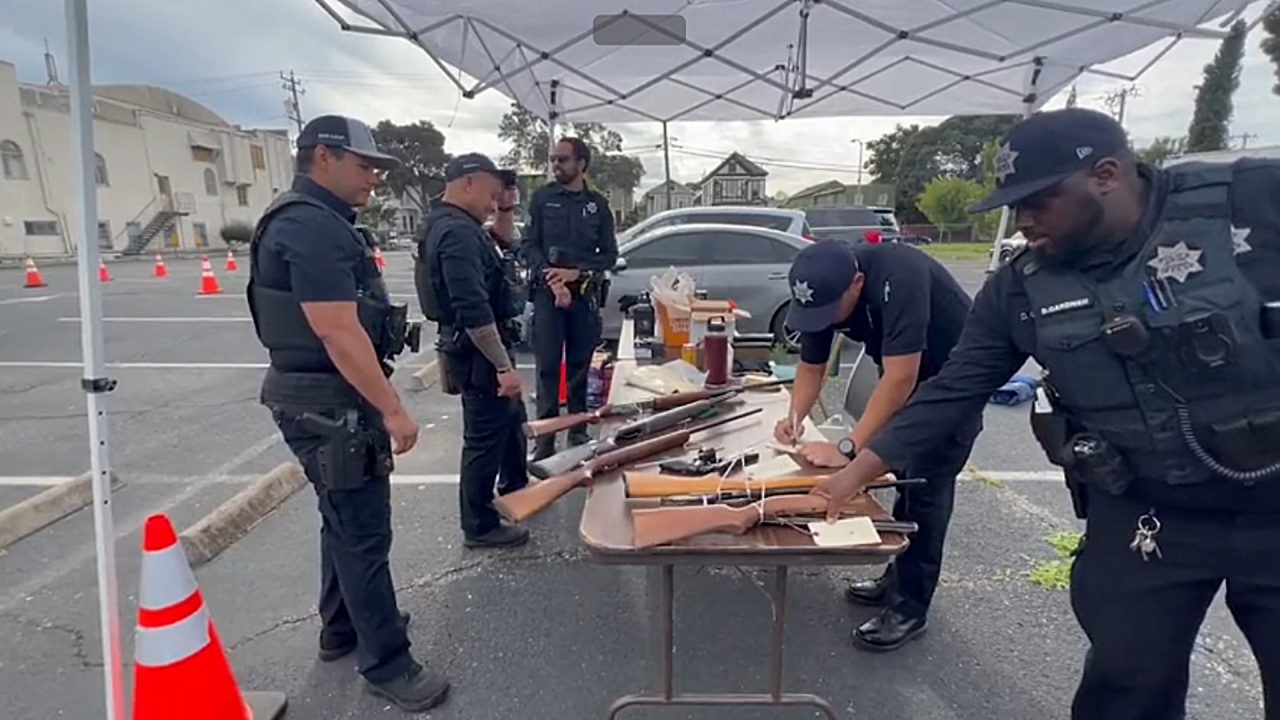
The sky was cloudy and gray, but smiles were evident on the faces of over two dozen volunteers who stood in the wide expanse of a parking lot at Mount Zion Baptist Church in Oakland, California. Officers from the Oakland Police Department, dressed in casual attire instead of standard uniforms, stood on one side of a double row of orange traffic cones, while volunteers from St. Paul’s Episcopal Church of Oakland and other faith-based anti-gun violence organizations stood on the other side of the cones.
Hope was evident when Guns to Gardens amassed 25 guns in less than 90 minutes on November 15. But for the volunteers from St. Paul’s, the collaborative gun buyback stood for something bigger and even more meaningful.
As the second-oldest Episcopal parish in Oakland, St. Paul’s was established in 1871 and celebrated its sesquicentennial anniversary nearly half a decade ago. Located near the heart of downtown Oakland, adjacent to Lake Merritt, the parish sees itself as both a community and a people of worship—as seekers of the faith who invite “the curious and the serious” to ask big questions and wrestle with convictions on their respective journeys.
For many who call St. Paul’s and Oakland home, however, significant wrestling centers on the grief and heartache that often accompany gun violence.
Oakland, which is home to 438,072 people, began to see an increase in crime in the late 1960s. High gun violence peaked in the late 20th century, before a significant decline in the 2010s. Because the decline still represented a loss of life, for Episcopalians who do not believe in standing idly but in doing something about what they believe in, the decline wasn’t enough.
When three children were killed by guns in Oakland in 2011, Paula Hawthorn, 82—the event organizer and a St. Paul’s parishioners—received clear direction from above to do something and use the talents at her disposal. Hawthorn, a retired computer scientist, started researching different programs in the fight against gun violence. She found Oakland Ceasefire Strategy, a partnership-based, intelligence-led, and data-driven violence reduction strategy; she joined the Brady Campaign, an American nonprofit organization that advocates for gun control and against gun violence.
Then, nearly a decade later, Hawthorn felt her attention peak while listening to The Way to Love podcast. In the episode, former Presiding Bishop Michael Curry interviews retired Episcopal Suffragan bishop Jim Curry of Connecticut, who brings a portable forger around to different communities in the Nutmeg State to forge surrendered guns into garden tools. As the cofounder of Swords to Plowshares Northeast, a nonprofit rooted in the transformation of guns into garden tools and based on the vision of Isaiah 2:4 (“they shall beat their swords into plowshares and their spears into pruning hooks; nation shall not lift up sword against nation; neither shall they learn war anymore”) Jim Curry sought to convert weapons of death into tools of life.
That was all Hawthorn needed to hear to bring Guns to Gardens to Oakland. Over the next 18 months, Hawthorn worked to raise funds, find a local blacksmith, and further establish relationships with the Oakland Police Department, whose presence is required by state law at any gun-buyback events.
St. Paul’s Episcopal Church adopted the innovative gun buyback program as one of its justice ministries, out of a devotion to get “guns out of homes because they pose such serious risks to children and other members of our community.”
For the Rev. Dr. Mauricio J. Wilson, rector of St. Paul’s, the rationale behind Guns to Gardens is clear: The City of Oakland has too many unnecessary sources of death.
“If we, as a people who believe in life, can do something to remove some of those sources of death, we need to do something,” Wilson said. “We continue to do it because people still continue to die of guns in our city. And until nobody dies from gun violence or guns at all, we will continue doing it.”
The November event was Oakland’s fifth Guns to Gardens event in less than four years and came two days after back-to-back shootings at Skyline High School and Laney College in Oakland. The shooting at Laney College led to the death of John Beam, a legendary, larger-than-life football coach.
That day, 57 guns and a switchblade were surrendered and over $4,500 in Target gift cards were handed out in return; since its inception, 352 guns and an array of shells, casings, and other ammunition have been collected and over $15,000 in Target, Walmart, and Chevron gift cards have been distributed.
Anyone who surrenders a gun, no questions asked, is offered a garden tool forged from previously surrendered guns—because as St. Paul’s sees it, there’s a double benefit in the possibility of participants taking a garden tool and using it to bring something to life.
“We remove sources of death and provide sources of life,” Wilson said.
They remain a hopeful Easter people.

Cara Meredith, a freelance writer and postulant for holy orders in the Diocese of California, lives in the San Francisco Bay Area.