

The president of the Academic Senate at Madera Community College (MCC) is speaking out about a costume mimicking his appearance worn at a private Halloween party attended by college administrators.
On Oct. 31, Cory Bukarth, MCC’s director of marketing and communications, dressed up as Academic Senate president and math professor Todd Kandarian. MCC President Angel Reyna was photographed smiling beside Bukarth in the costume.
Bukarth’s costume included glasses, a bald cap and stomach padding underneath his shirt. Kandarian was unaware the party was taking place, and after receiving word of Bukarth’s costume, described the incident as “plain and simple bullying.”
“It was bodyshaming. It was horrible behavior condoned by my president,” Kandarian said.
According to Kandarian, he and Bukarth were not close, and there was no communication that Bukarth was going to the party dressed up as Kandarian.
Kandarian said he was an “easy target” due to his position within the Academic Senate, which issued a vote of no-confidence against President Reyna in fall of 2024.
“I’m the guy who speaks up against my president, and so that makes it easy for me to be the butt of the joke,” Kandarian said.
In a statement, the State Center Community College District (SCCCD) said the incident is under active investigation, and because it involves personnel, the district can’t make further comments.
Kandarian said President Reyna and other administrators failed to uphold SCCCD Administrative Regulation (AR)-3150 and instead condoned Bukarth’s actions.
“That’s a failure to do the most basic job of an administrator, which is to provide a safe environment for faculty, staff and students,” Kandarian said. “[President Reyna] failed at that job. All the administrators in that way failed at that job.”
Alongside President Reyna and Bukarth, Kandarian said there were four other administration members at the party who failed to speak out against the costume.
“Every one of those administrators who saw him should have stopped him, especially my president, who was standing next to him taking pictures,” Kandarian said. “That’s not okay.”
Since the event, Kandarian said that meetings between himself and President Reyna have been cancelled. He also hasn’t heard word from Bukarth about the incident as of Nov. 26.
Former MCC Academic Senate president and math professor Lynette Cortes Howden supported Kandarian when he called out administration about the Halloween party. Cortes Howden said that the incident is part of a culmination of disagreements between faculty and administration at MCC over the past year.
“It’s gone beyond a professional disagreement and a professional discussion to now we’re being personally targeted,” Cortes Howden said.
Cortes Howden questioned the impact that these actions leave on faculty and staff at MCC.
“What kind of message does that send to our campus? Where not only do we see an example of bullying, but it’s bullying that’s accepted by our administration,” Cortes Howden said. “That does nothing for the way things are right now at Madera.”
Further Claims
The Halloween costume was one of a few alleged offenses from MCC administration, according to Cortes Howden. Both Kandarian and Cortes Howden said that former Academic Senate member, Erin Heasley, was denied tenure in the spring of 2025. This decision was made in the months after the fall of 2024 vote of no-confidence.
Kandarian and Cortes Howden said that Heasley’s tenure had been approved by a majority vote between three people, but was ultimately rejected after MCC Vice President of Learning and Student Success Marie Harris voted no. This decision was later overturned by the Board of Trustees and Heasley was granted tenure.
Despite being approved, Kandarian and Cortes Howden claimed that President Reyna waited three weeks to give Heasley the news.
According to President Reyna, California laws surrounding employee privacy prevent administration from making statements regarding Heasley’s tenure.
Participatory Governance Handbook
In another incident, a Participatory Governance Handbook was worked on by three MCC constituent groups (Academic Senate, Associated Student Government and the California School Employees Association [CSEA]). It was unfinished by the end of the 2025 spring semester.
“Over the summer, [administration] convened a work group to work on this handbook, and when we came back, this document was drastically different from what we had worked on,” Kandarian said.
Kandarian claimed that President Reyna sent the edited version of the Participatory Governance Handbook to MCC’s College Council agenda for approval without constituent review. This version of the Participatory Governance Handbook added administration as a constituent body and removed the Academic Senate’s written process for electing a department chair, according to Kandarian.
However, in a statement President Reyna made to the Rampage, the work done on the Participatory Governance Handbook was made publicly available over the summer, which contained contributions from a workgroup formed between administration and constituent groups. President Reyna claimed employee groups moved the Participatory Governance Handbook forward for approval, not himself.
In the statement, President Reyna said that other constituent groups have expressed support for the current version of the Participatory Governance Handbook after a workshop for the handbook was held at the August 2025 opening day faculty meeting.
The Academic Senate requested to review the updated Participatory Governance Handbook, where it’s currently being edited.
Online Meetings
Shortly after the fall semester began, Kandarian said MCC’s Program Review Committee meeting was moved from an online call to in person without a vote of the Academic Senate committee. Kandarian, on behalf of the Academic Senate, called out the change as a violation of the Committee Operating Agreement (COA).
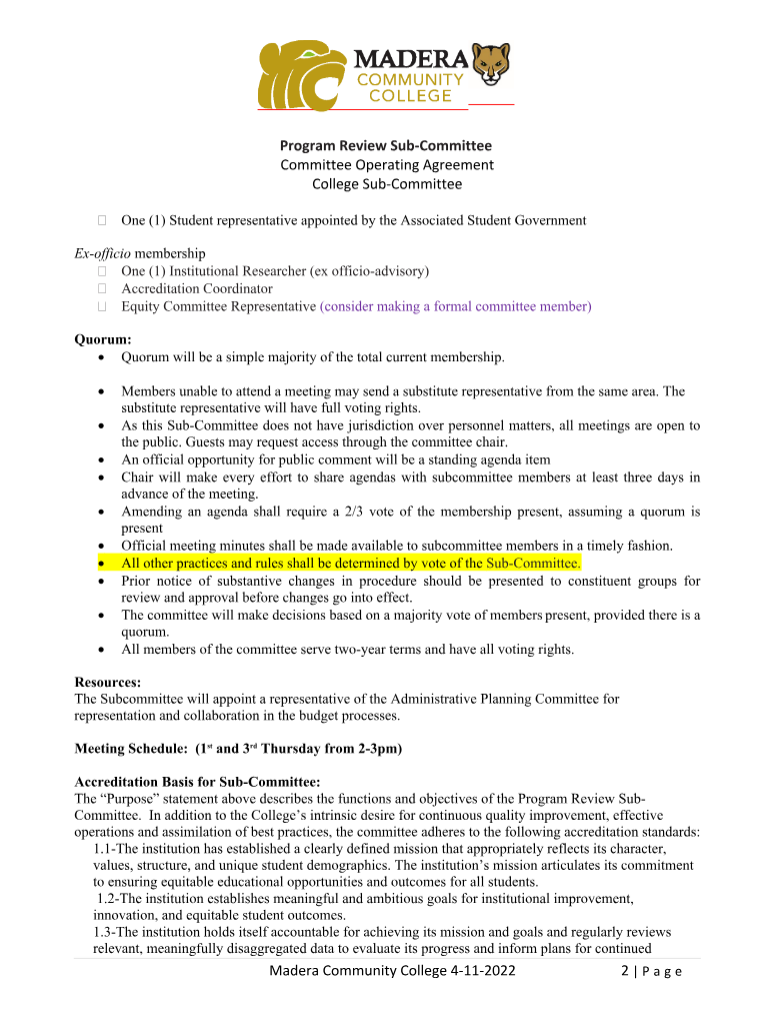 An edited version of page 2 of MCC’s Committee Operating Agreement highlights the sentence “All other practices and rules shall be determined by vote of the Sub-Committee.”
“There are more than a few senators asking, ‘What’s the point?’ Why waste our time and effort reviewing a COA that will just be ignored or overridden by President Reyna,” Kandarian said in a SCCCD Board of Trustees meeting on Oct. 7.
In an email exchange with Kandarian, President Reyna said the administration has the right to decide how meetings are held.
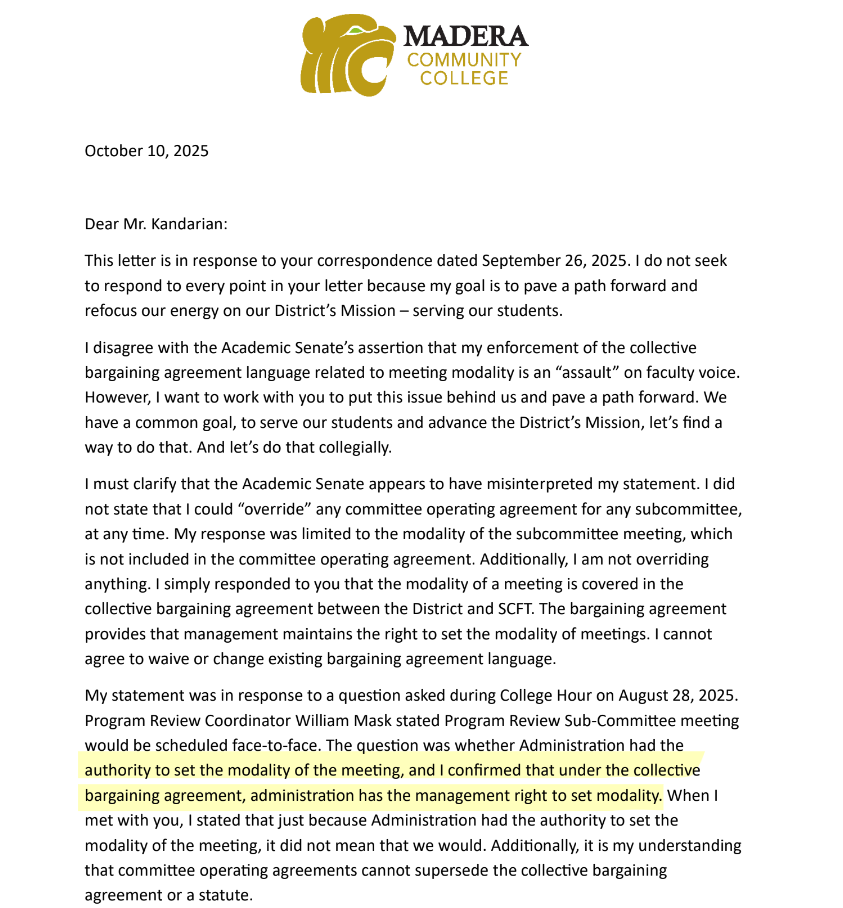
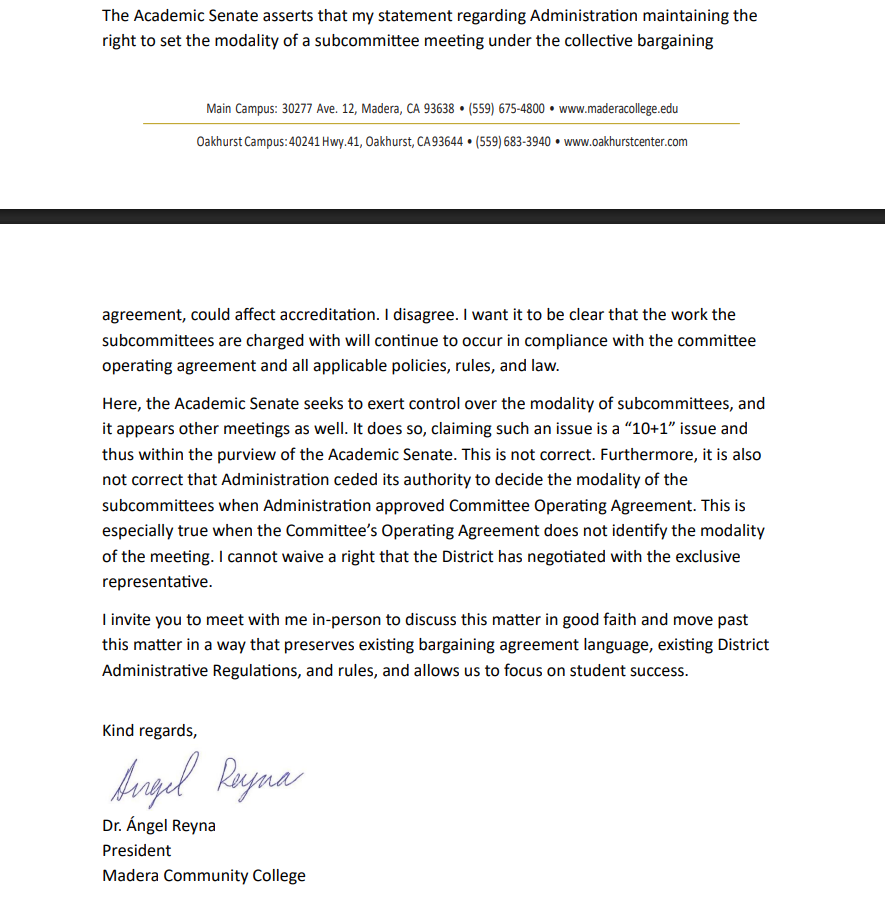 An email from President Reyna in response to Kandarian on the topic of COA from Oct. 10, 2025.
President Reyna cited MCC’s collective bargaining agreement, referencing the statement, “All faculty, both instructional and noninstructional, are responsible for attending assigned meetings, including all meetings called by administration, on any day and in the modality scheduled.”
Kandarian pointed out that the collective bargaining agreement statement implies that the administration doesn’t call every meeting, contradictory to President Reyna’s claim.
The Academic Senate and faculty rely on policies and regulations to voice their opinions, according to Kandarian.
“It’s literally the only power the faculty members have,” Kandarian said. “Our adherence to those rules is our only power and insisting that those rules are followed.”
President Reyna’s statement claimed that the faculty request to shift College Hour from in person to hybrid was accommodated. Kandarian said this accommodation was given after a “huge uproar.”
Mediation Attempts
There have been “multiple good-faith efforts” to strengthen the trust between the Academic Senate and administration, according to President Reyna. In fall of 2024, President Reyna said there was a mediation attempt including a mediator recommended by the State Center Federation of Teachers, SCCCD’s faculty union, that the Academic Senate declined. According to Kandarian, the mediator, Ashlee Hernandez, was chosen by Chancellor Carole Goldsmith, who was revealed to be Goldsmith’s goddaughter. Cortes Howden asked Hernandez about her relationship with Goldsmith, where Hernandez stated that she was not related.
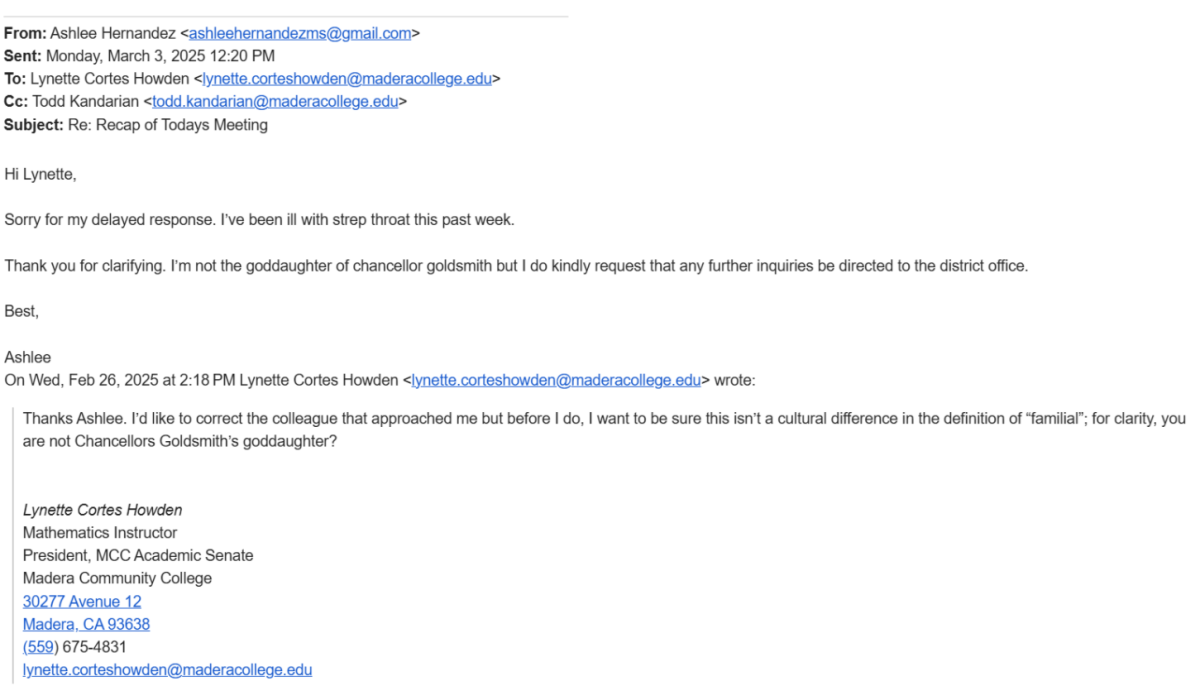 An email exchange between Lynette Cortes Howden and Ashlee Hernandez. Photo courtesy of Todd Kandarian.
Kandarian said the Academic Senate denied mediation because terms outlined by the SCFT crossed into working conditions, which is outside of the Academic Senate’s legal control. Both Kandarian and Cortes Howden stated that the Academic Senate didn’t intend to drop mediation entirely.
President Reyna claimed there were two other attempts at participatory governance that were declined by the Academic Senate.
Kandarian emphasized that all of these incidents have led to mistrust amongst MCC faculty and administration.
“All we want is the voice that we’re supposed to have,” Kandarian said.
After the Halloween incident, Kandarian said other faculty have come forward to voice their frustrations with MCC administration’s actions.
“It doesn’t feel good to drive up to the place that you work knowing that you could be the subject of a horrible bullying incident like this,” Cortes Howden said. “We preach to our students that we should have certain values and that we should have a certain decorum and a way of conducting ourselves. I think it sets a horrible example to our students that we don’t live up to it ourselves.”