
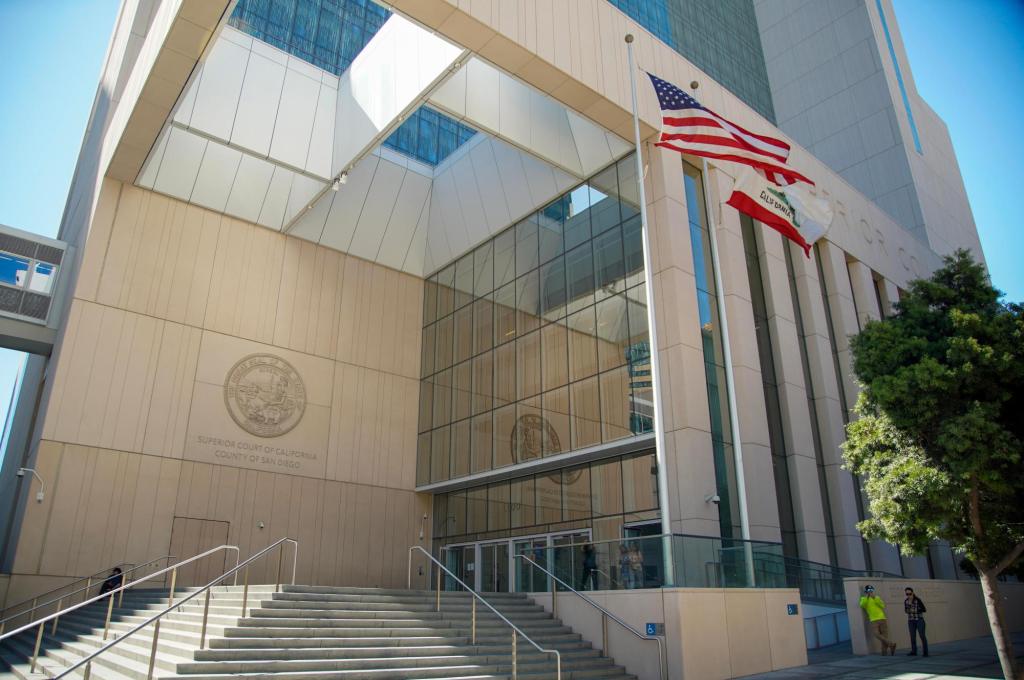
In early October, I was given a measure of control over $10.1 million.
If I, along with 11 strangers, believed a former executive at a mortgage company had been wronged by his bosses, we could order the firm to pay him that money. Or, if we thought the company had acted fairly, there was the option of sending the guy home with nothing.
I did not think I would be in this position when I arrived for jury duty Sept. 29 at the downtown San Diego courthouse. I told my editors at The San Diego Union-Tribune, where I’ve worked for the past three-plus years, that I’d only miss a day. I couldn’t imagine a judge and two lawyers agreeing to put a journalist on a jury. The reporter might write about what happened — especially if the experience led to epiphanies about American democracy.
More than 50 of us filed into Department 72, a 6th-floor courtroom overseen by Judge Marcella McLaughlin. The attorneys on the case stood as prospective jurors entered. It turns out lawyers always stand when you walk in.
We took turns publicly introducing ourselves. After I said I was a reporter, the judge asked what my beat was. “I cover homelessness,” I said. The room grunted in unison.
Before writing regularly about San Diego County’s most visible crisis, I would probably have said there was no way I could ever end up on the street. I’m now aware of 6,000 scenarios that might push me onto a sidewalk, and many of those were represented in that room. As the judge and two attorneys questioned us about our backgrounds, speaker after speaker brought up their precarious finances.
Several said they were federal workers worried about a government shutdown. One person said they’d recently been laid off from a retail gig and were looking, largely unsuccessfully, for temp jobs. Another said the income they’d lose from missing even a few days of work might prevent them from paying rent.
This perhaps explains why the room became politely hostile when the lawyers explained the case.
On one side was Darren Nolander, a former vice president with American Pacific Mortgage. Nolander had signed a contract that said he was “guaranteed” bonuses for two years and those payments, which were tied to his efforts to expand the company, could continue “in perpetuity.” After Nolander was laid off in 2023, and the paychecks stopped, he sued for $10.1 million, arguing that he didn’t need to be employed to keep receiving some of the money he helped bring in.
On the other side were representatives of American Pacific Mortgage, a company that deals with billions of dollars, who said Nolander was misrepresenting the agreement and had already been paid handsomely.
One prospective juror characterized this situation as a waste of our time. At least two people used the phrase “late-stage capitalism.” There were stories about corporate greed and foreclosed homes and occasional bafflement around that 10.1 million number.
Interviewing everyone took more than a day. The judge and attorneys dismissed several people. When the dust settled, I was Juror No. 11.
Sitting in a jury box makes you feel both powerful and lonely. The trial, which began immediately and lasted more than a week, featured pleading eye contact from witnesses and speeches from lawyers praising our wisdom. Yet you’re not allowed, at this point, to speak with fellow jurors about the case. Outside the courtroom, attorneys are discouraged from even making eye contact with you. Jurors may submit questions in writing, but they can be ignored without explanation.
As a result, the prospect of deliberations was initially a relief. A sheriff’s deputy walked us into a small, windowless conference room and shut the door. We promptly unloaded. Jurors who I’d never heard so much as sneeze rattled off thoughtful, well-reasoned arguments. When the deputy returned to offer us a break, we kicked him out.
I can think of few other spaces in adulthood like this. Since the country’s political debates have become so vicious — including those about, say, income inequality — I’m almost never discussing controversial topics with friends. Certainly not strangers. In the rare case where I am publicly unpacking a weighty issue, there’s no mandate to reach a resolution.
But here, in this conference room, next to a framed image of a departing space shuttle, we were stuck in place until we had a verdict.
Two camps emerged. Several of us saw the contract as intertwined with another, earlier agreement which clarified that bonuses were contingent on employment. Others felt the company was reneging on a clearly stated deal. We talked for more than five hours. When the deputy walked in to send us home, I don’t recall giving any resistance.
One of the people I disagreed sharply with was Juror No. 10. His name is Douglas Barrera, which I know because he emailed me long after deliberations had formally concluded to continue our debate. (He’s cool with being in this essay.) I like Barrera. If I dropped my wallet near him, I’m convinced he’d chase me down to return it. Nonetheless, after hearing the same witnesses, reading the same documents and looking through the same spreadsheets, the two of us came to vastly different conclusions.
Our impasse invites a broader question about the country as a whole. If two people can never fully understand each other, are they still able to make space for each other?
During the second day of deliberations, the room settled on a compromise. The mortgage company had botched “the implied covenant of good faith and fair dealing,” a large majority of us voted. (Since it was a civil trial, unanimity wasn’t needed.) We told the firm to hand over $184,000 in missed bonuses, plus $73,600 for taxes. In doing so, I’m pretty sure we made nobody in or out of the deliberation room completely happy.
I wonder if the decision will be appealed. Juries can certainly miss the mark. Journalists, too. In a story published earlier this year, I mangled the title of a job that had once been held by Santee’s new city manager. She emailed me to flag the error. I apologized and rewrote the sentence.
The pitch for relying on both jurors and journalists, I suppose, isn’t that we are infallible. The pitch is that we’re your neighbors.