
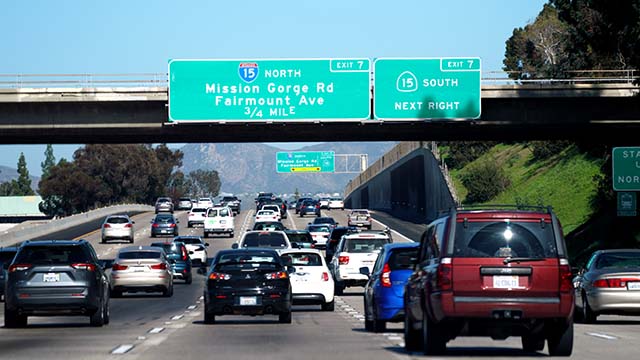
 Traffic on Interstate 8 in Mission Valley. (File photo by Chris Stone/Times of San Diego)
Paul Krueger correctly notes in his commentary last week that the new Home Depot in Mission Valley is a further commercial blot on an overdeveloped and traffic-choked landscape.

But his lament sadly is one that city planners voiced and lost seven decades ago when the die was cast turning the agricultural river plain into an urban mecca that overwhelmed businesses in downtown San Diego and in traditional neighborhoods like North Park and East San Diego.
The newest Home Depot — similar to the nearly three-dozen hostelries and hundreds of businesses throughout Mission Valley — all owe a debt of thanks to crucial city zoning changes pushed by developer Charles Brown in the 1950s.
Brown built the first hostelry in Mission Valley in 1953, the original Town and Country hotel, a single-story motor inn with 46 rooms. He received city approval under a conditional use permit and his commitment to preserve the rural character of the valley.
Both were deemed necessary by city planners wanting to avoid a slippery slope to dense urban development. They had hoped to transform Mission Valley into a recreational/active sports area, shaped around the San Diego River and conceptually similar to Mission Bay Park, then in its first stages of development.
But urban encroachment proceeded steadily little-by-little. In 1955 the Pacific Coast League Padres owner and influential financier C. Arnholt Smith gained a zoning permit to develop Westgate baseball park on portions of land used for thoroughbred farms (the location of today’s Fashion Valley mall).
Another approval in 1957 allowed for a major bowling center, Bowlero, to open on the south side of the U.S. Highway 80 freeway (now Interstate 8), the site where the Home Depot is under construction. (Bowlero was later converted into the valley’s first Scottish Rite Events Center.)
In 1959 Brown and other influential developers won permanent zoning changes from the city council which resulted in a bevy of hotels constructed on both sides of I-8, and what is now known as Hotel Circle. Other rezoning at the time also paved the way for the May Company department store chain to build Mission Valley Shopping Center, and the valley’s rural character was doomed as car dealers, supermarkets, ice rinks, restaurant chains, apartments and office buildings followed.
The canaries in the coal mine for Mission Valley were dairies. Dairies used to be as common a sight aside the river bottom as Navy ships in the bay. Kansas native Sereno Allen established the first commercial dairy in the late 1880s, below the southern cliffs halfway between today’s Interstate 5 and State Route 163, after failing to make a go at raising fruit trees.
Soon the Ferrari Dairy followed farther east, across the river from today’s Snapdragon Stadium. Italian immigrant Louis Ferrari found that milk and butter proved more profitable than chickens and corn, and his sons built the dairy into San Diego’s largest. The numbers steadily grew; the early 1950s marked the high-water mark of valley-based dairies, with some 20 neighboring the San Diego River. (Dairies countywide numbered more than 100.)
The number began a rapid decline with the encroaching development in the mid-1950s. The Allens moved to El Cajon Valley in 1957. Bond Dairy entered a real estate partnership with May Company and Mission Valley Center opened on its site in 1961. San Diego Stadium construction in 1965 forced the shutdown of the Guglielmetti Dairy.
The Ferrari Dairy was the last holdout in the valley. In 1954, when the old Mission Valley Road became the four-lane U.S. 80 Alvarado Freeway (U.S. 80 having been moved from El Cajon Boulevard), the expanded route bisected the dairy, so construction included a tunnel under the road to allow cows access to grazing pastures from the milking barns. But Ferrari closed in 1968 when the city refused to renew its permit, citing the distasteful smell in proximity to the new stadium as reason for the decision.
Gradually, urbanization also thwarted dairies in most other county locations suitable for milk production. Today, a single county dairy remains, located in the city’s San Pasqual Valley Agricultural Preserve.
Similarly, sand and gravel mining operations dotted Mission Valley for much of the 20th century. The deep sediment deposited by the San Diego River over eons provided the raw materials for major construction projects throughout the region. Mining adjacent to the river was a common sight at the base of the northern cliffs of Mission Valley between State Route 163 and Mission Gorge Road.
Mining began in 1913 and peaked in the second half of the century, as rapid post-World War II growth demanded the ingredients for concrete to build a sprawling freeway system, institutions such as UCSD, and San Diego Stadium. The stadium alone required 1,715 pieces of concrete cut into 2,345 shapes, with some weighing 40 tons.
Notable construction materials firms included H.G. Fenton, Daley Corporation, San Diego Consolidated Co., and R.E. Hazard. The Hazard Company’s construction signs in particular were a common sight along Interstates 5, 8, 15 and 805, using humor to try and placate drivers wrestling with the many temporary detours. Along Interstate 5 construction near downtown, a typical sign read, “You will be WAY OUT — way out of town, that is, when HAZARD is done.”
The valley’s urbanization forced the movement elsewhere of an industry that had contributed so much to development. Today, large residential projects such as Civita and Portofino have replaced former mining pits and only one small operation remains in the valley.
David Smollar is a former Los Angeles Times staff writer. He lives in Tierrasanta.
READ NEXT