
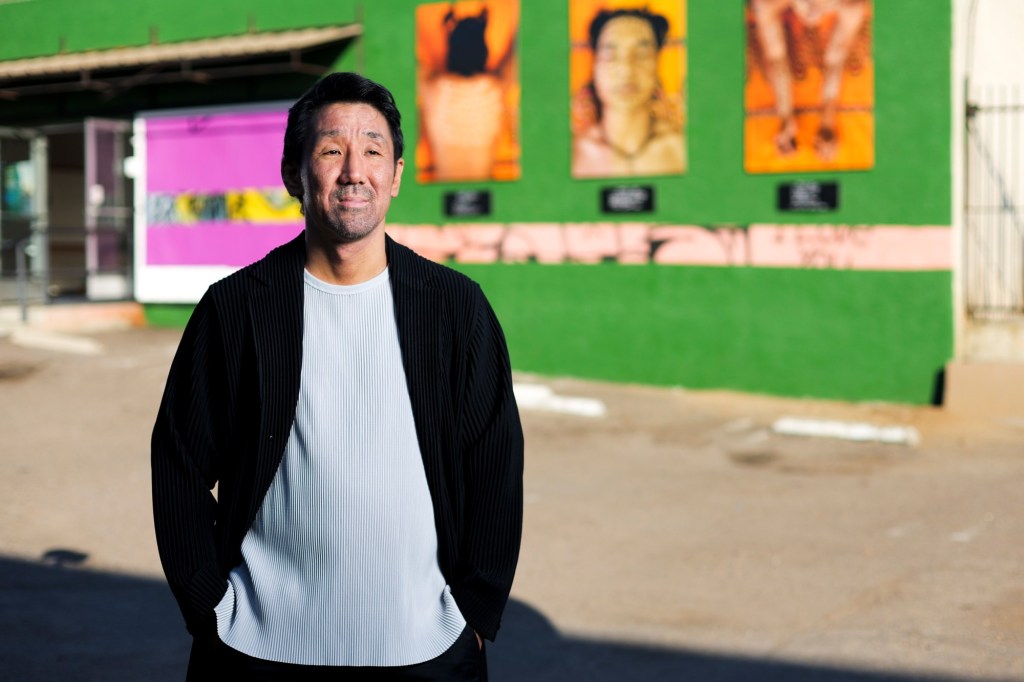
The AjA Project has been a mainstay in the San Diego arts community, using documentary art, specifically photography and public art projects, to help youth tell their stories. It has, since its inception, focused on refugee and immigrant communities, and used a participatory approach — building community through art, education and social-justice advocacy.
The City Heights-based organization recently celebrated its 25th anniversary with a gala where it showcased the impact of a quarter century’s worth of work. The “AjA” in its name is an acronym for “Autosuficiencia juntada con Apoyo,” which translates to “supporting self-sufficiency.”
Shinpei Takeda, co-founder and executive artistic director, took some time to talk about how The AjA Project has changed the lives of countless youth in the San Diego-Tijuana region and what he hopes the organization will do in the future.
Q: The AjA Project is celebrating a milestone anniversary this year: 25 years. Tell us about the significance of reaching this momentous milestone.
A: It is incredible that a community-based organization so unique like ours has been around for this long and still thriving in San Diego. It is also very personal for me because it has been a challenging few years since I put a hold on my life in Germany as an artist/filmmaker and had to reboot my transborder life between Tijuana and San Diego to return to the organization in late 2022 and bring the soul back to an organization that was in the midst of transitions and uncertainties.
 “Memoria Terra” (2024) is a public art project behind the City Heights LIbrary in which 2,000-word poems by five CIty Heights youth fill the pedestrian-only street. (Shinpei Takeda / The AJA Project)
Q: What kind of impact has The AjA Project had on the community at large as well as its constituents — the youth of San Diego?
A: We have primarily worked with refugee and immigrant youth and other underprivileged youth — teaching photography, storytelling and sharing them in exhibitions and public art projects, always bringing their lived experiences spoken by their voices in the center of the conversation.
In 25 years, we have had over 5,000 students, carried out over 250 workshops/exhibitions and reach over 1 million people. I believe we have brought visibility to San Diego’s refugee and immigrant populations and City Heights, a historically disinvested community that is now quickly changing. I also believe that through our exhibitions and public art projects, we have created meaningful dialogues creating a buffer and a space to understand our new neighbors who have so much to offer. I also know that many of our former students, participants and team members are now community leaders doing great work, and they are also a living testament to years of our work.
Q: Why is The AjA Project’s work more important than ever now, especially for San Diego’s youth?
A: First in the current political climate of anti-immigrant rhetoric and policies, it is important that we continue to bring out the stories of their lived experiences through the lens of refugee and immigrant youth. I really believe that this brings humanity to a society that is evermore divided.
Second, the role of photography has changed so much in the last 25 years. We started out with analog photography, developing rolls of TriX 400 film and hand-printing them with the youth. It was so important for the youth to learn to say that “this is my photo, and this is what I want to say with this image.”
Now, the camera is in everyone’s pocket in the form of a smartphone, and yet it has become a data collection tool. The same cameras are now used as surveillance cameras on our streets looking down on us, and somehow we have lost a sense that it is our tool to express ourselves. So I think it is again important, more than ever, for the youth to understand the process of image-making and storytelling. Also important is the education around how the surveillance cameras and the data are used against our civil liberties.
Q: When you helped start The AjA Project 25 years ago as co-founder, what did you envision for the organization, and has the vision been fulfilled as you embark on the next 25 years?
A: I started the organization with my co-founder, Warren Ogden, as an all-volunteer organization from the living room of a two-bedroom Ocean Beach apartment. I was 22 years old, having just graduated from college. I was working as a bike-cab taxi driver during the weekend to pay my rent, while working on AjA during the week. Back then, we were managing a project with Burmese refugees along the Thailand-Burma border and collaborating with a similar project working with internally displaced youth in Colombia. We had a lofty vision that our work could break the cycle of violence.
When I looked at the people at the 25th year celebration, the work we have done and the community that we have created, I believe that it is possible. Obviously, there’s still a lot of work to do, and this might take another 25 years.
Q: There have been, for sure, many memorable moments in the group’s 25-year existence. Can you share one story that truly encapsulates the impact The AjA Project has had on the community?
A: The stories are countless, and it is incredible how many people who have seen our exhibits or come up to me and tell me that they did their AjA Project in their teens.
One of my favorites is a public art project called “In+grain” in 2007 when we covered the Southeast San Diego area with 8-by-8-foot photo prints — some on fences, some standing on frames. One of the photos taken by our students was an assignment called “Old Home.” It was a photograph of a wall of his home on which his grandmother’s photo was hung. On the Day of the Dead, someone put candles and flowers in front of this photo. It was incredible to see what was personal to this student become a shared story that people could relate to. It was incredible for this student to witness that people do relate to his stories.
Q: Personally speaking, how has leading this organization affected you in a positive way?
A: After founding and leading the organization in the first six years, I was involved for another 13 years as a creative director. For me, it was always my community, and I have become friends with many who have come and gone. When you are a founder, the organization becomes like your child, so there is that type of unconditional love I have for the organization. In turn, this organization has always surprised me, inspired me and given me hope that it is possible to heal, to transform and to change in both a very personal way and also in a very big picture way.
Q: Running a nonprofit organization, especially these days, isn’t easy. What’s the most challenging part of your job as executive director?
A: When we started out, there were not as many nonprofits as today. Now there are many nonprofits, but there are also more resources. It has always been challenging to run a nonprofit. However, with the current political and economical uncertainties — something rivaling the Lehman shock of 2008 — and particularly with evermore increasing anti-immigrant rhetoric and policies, our work is more urgent than ever. Yet the funding cuts and scarcity of resources are very real. We need to be as creative as possible in navigating this complex situation, but as long as we don’t forget that origin of the organization — when we didn’t have anything but passion and soul — I think we will be fine.
Q: As you celebrate 25 years, what is your hope for the future of The AjA Project?
A: We are going to get more involved in different systematic change efforts that are being built from the ground up. This means we are going to be doing fellowships and different public art projects, educating ourselves about the surveillance issues and other civil liberties issues that are so much at stake at this moment in history.
We are going to continue what we have always done: creating a space for youth to “find,” “use,” “raise” and “channel” their voices through different media arts. We are also continuing to do bigger public art projects centering the voices of those who are unheard and putting these stories in the center of the conversation.
But as long as there are those who take away our voices, we will always be fighting so that we are the one to capture our images and tell our stories.
“Memoria Terra” is a current AjA Project exhibition that can be seen near Jeremy Henwood Park, 4455 Wightman St., behind the City Heights Library in San Diego.