
Looking for dental work? As in a job in the dental profession? Chances are a dentist near you is looking to hire a well-trained dental assistant.
A new pilot in San Diego is working to smooth out supply and demand by educating more of these technicians and making it easier for students to seek training by erasing barriers to access.
The pilot, run by the San Diego County Dental Society’s Academy of Learning and funded by the society and grants from the California Dental Association and San Diego County Supervisor Joel Anderson’s office, offers a low-cost dental assistant certificate program with a curriculum that is state credentialed and designed to meet the needs of San Diego’s dentists. It is a part-time, 15-week-long program, with in-person instruction on weekends and some online homework, allowing students to continue at their current jobs or stay enrolled in college while taking the course.
Assistants help care for patients, schedule appointments, take X-rays and support the dentist. They are different from hygienists, which examine patients and provide hygiene and other preventative dental and oral care.
Toward the beginning, students in the pilot learn about local anesthetics, handling instruments and positioning patients. Later they learn CPR, billing and working the front desk, and other clinical concepts and skills. At the end, they get job application help and salary negotiation tips, and they graduate with a dental assistant certificate, Basic Life Support certification and eight-hour infection control certification. Students can then take a state exam to get registered as dental assistants, which opens the door to higher pay.
“It was basically a direct response to what our members told us they needed,” said Joanne Young, a dentist in private practice who oversees instruction at the program.
The training gives students “lots of hands on, personal attention” and is taught by people who really want the students to succeed, she added.
“We believe it’s a win-win because this can also be a stepping-stone for someone that might have had a financial barrier or … knew nothing about dentistry,” she said. “But once they get this training, they can move up in the dental field.”
Demand for dental assistants was projected to grow 6% nationwide from 2024 to 2034, according to the Bureau of Labor Statistics. California’s long-term demand is far greater: There were about 56,900 dental assistants working in the state in 2022, and the projected employment for 2032 was 65,200, an increase of 8,300, or 14.6%, according to projectioncentral.org, a Utah state database. Pay was around $47,000 a year in 2024, and higher in California — around $53,500 — according to the BLS.
For the San Diego County Dental Society, the pilot is also about attracting and training new workers, especially people who want to pursue the field but can’t afford the schooling or traditional course scheduling.
“It is important to us not only to be an active part of the regional workforce development, but to diversify the field and ensure that people from all economic walks of life have opportunities to be part of the rewarding field of oral health,” Angela Landsberg, the executive director of the San Diego County Dental Society, said in a news release.
The total cost of the year-long pilot is $80,000 to $100,000, Landsberg estimated.
Different states have different requirements before a dental assistant can enter the workforce. Alaska and Utah, among others, do not require registration or a license. Vermont requires assistants to register with the Vermont Board of Dental Examiners. In California, dental assistant can do some tasks with training and without a license, while other tasks, such as applying sealants, require a license. Vocational schools, community colleges and technical schools can all offer such training. Training can also take place on the job.
Even at the full $2,500 for instruction, uniform and other costs, the San Diego County Dental Society’s program is more affordable than some others, though it is hard to draw direct comparisons.
Several programs in San Diego teach these skills. At San Diego Mesa College, a certificate in dental assisting, at 37 course units, costs around $1,700. At Pima Medical Institute, a certificate program lasts 9 to 10 months and costs close to $20,000 at its Chula Vista campus, including tuition, textbooks, lab supplies, uniforms and tax, with financial aid available for qualified students.
Programs at some institutions do not list pricing and encourage prospective students to reach out and ask before tuition is disclosed.
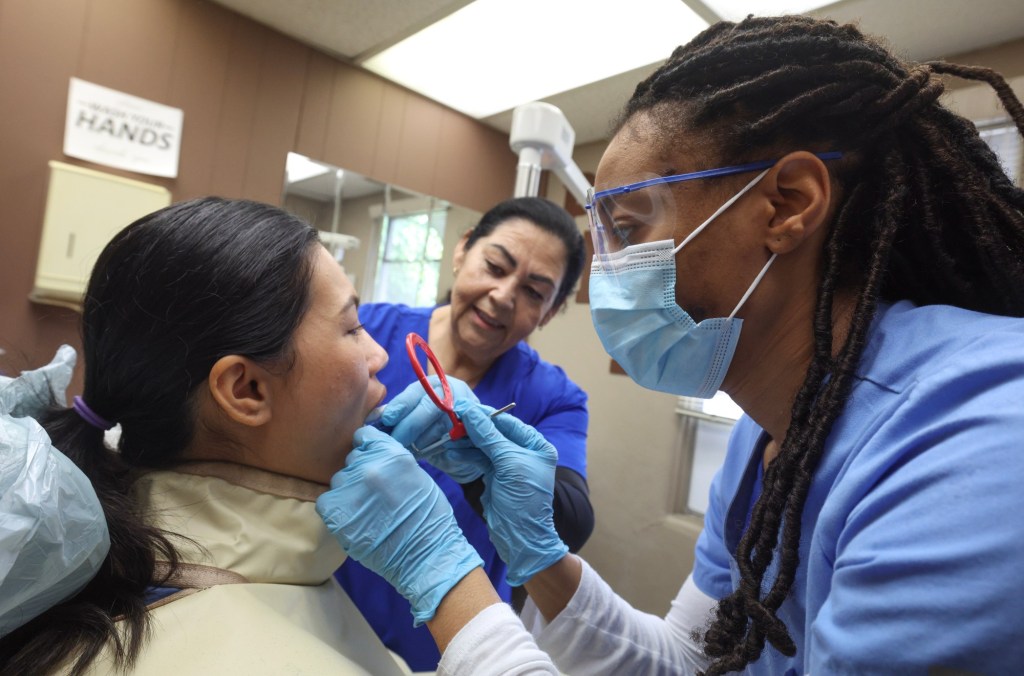
On a recent Sunday, students learned how to take X-rays and then practiced on one another at a dental office on Adams Avenue.
Phennapha “Pow” Rozelle, 33, recently moved to San Diego County from Portland. Her husband got a job here, and she decided to shift careers from restaurant work. Dentistry seemed like a good path, and this training program is giving her a chance to learn more.
“I’m like, OK, I’m here. New city. I want to try something else,” Rozelle said. Dental assisting “is a good start in the dental field.”
Rozelle said she is paying half of the tuition. She will shadow and observe dental professionals at a Solana Beach practice and will apply for jobs soon.
“The lower price that they have it at … is very important. It’s one of the factors that (made me) decide to do it,” she said of the program’s discounted tuition.
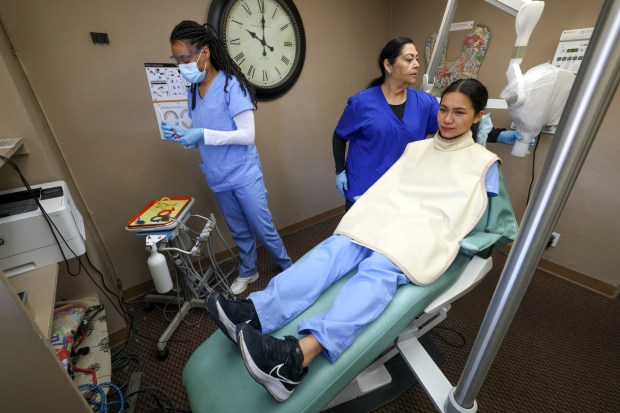 Dental student Erika Contreras, left, prepares to take oral x-rays of fellow dental student Phennapha Rozelle’s teeth while dental assistant Yolanda Zapata, who is helping train Contreras and Rozelle, observes. (Hayne Palmour IV / For The San Diego Union-Tribune)
Another student is Lindsey Matthews, who has been unhoused in recent years. That situation and a disability made it hard “to secure a long-term job despite having a substantial college education and professional experience.”
The program’s educators “recognize the effort and potential from current and prospective students. … They don’t make me feel like a product or a means to an end, and they’ve helped to solidify that I deserve fair treatment just like everybody else.”
Root canals were a revelation for Matthews, who has a full scholarship.
“I had thought the main method involved drilling into the root, but after learning more about the anatomy of teeth, I came to realize that this wouldn’t be possible. So I asked out of curiosity,” Matthews said, who added that dental anatomy, not root canals, is on the curriculum. “I wouldn’t recommend looking it up to anyone who is particularly squeamish, but I do think it’s very cool.”
The current cohort of 10 students will graduate in December. A second group, which starts in February, is seeking applicants now, go to sdcdsacademy.org/apply to apply.