
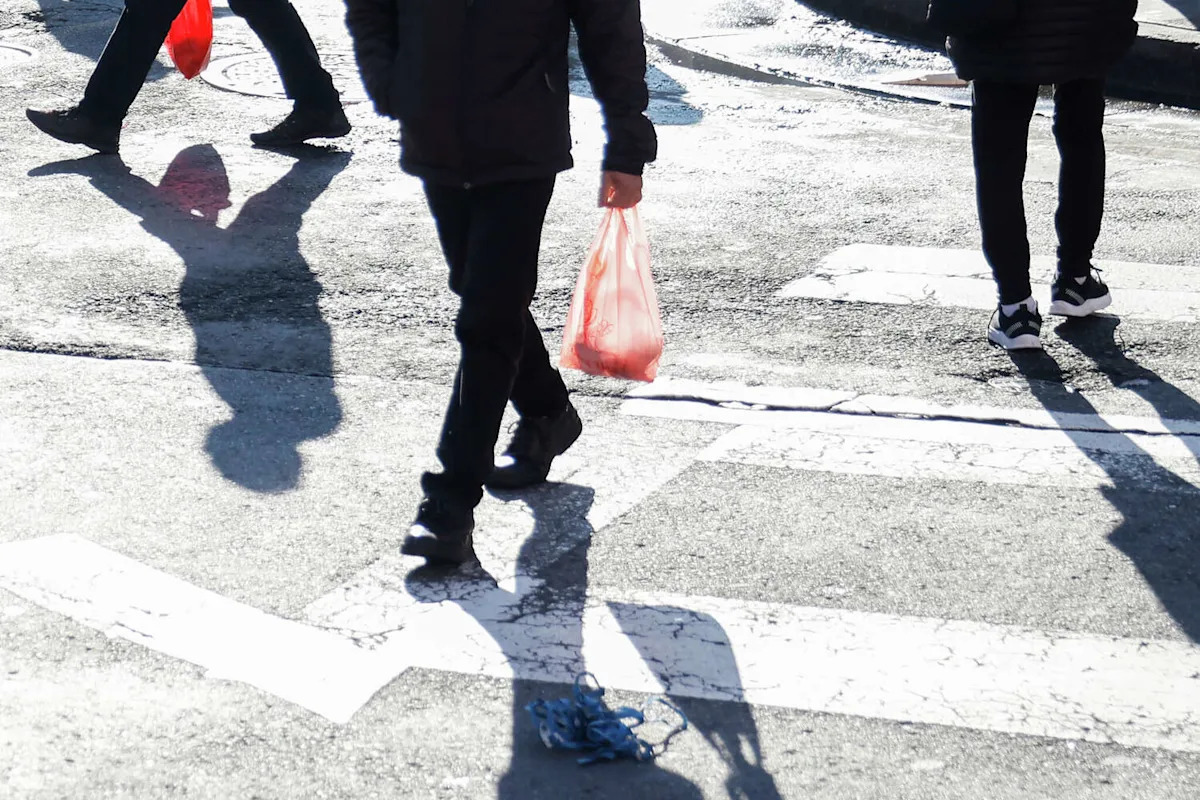
Plastic grocery bags will start vanishing from California grocery stores after Jan. 1, when restrictions are set to tighten as part of the state’s campaign to keep the bags from clogging waterways and landfills.
California technically banned plastic grocery bags more than a decade ago, in 2014. But at the urging of plastic and grocery lobbyists, that law left an exception for thicker plastic bags that can theoretically be reused 125 times. It didn’t take long for the bulkier bags – which use more plastic and are still often thrown away after a single use – to become standard at grocery store registers.
Gov. Gavin Newsom signed a law prohibiting the thicker bags last year. This time, lawmakers and environmental advocates are hopeful that the ban will stick.
“What people will experience on the first day of 2026 is not dissimilar from what people experienced when the law first went into effect, before the stores and the bag manufacturers began exploiting what became a loophole,” said Mark Murray, director of Californians Against Waste, which helped write the original law. “Instead of ‘paper or plastic’ the question is going to be, ‘Do you need to purchase a paper bag?'”
Paper bags will soon be the only option at grocery stores around the state. (By 2028, those bags will also be required to be made of at least 50% recycled paper.) Stores are required to charge customers at least 10 cents for the bags; they also cost more for grocers than their plastic counterparts.
Murray hopes that the change will encourage more people to make reusable bags their default or hand-carry their purchases. Some grocery stores, like Trader Joe’s, already sell canvas totes and insulated bags near the checkout counter.
It’s a win for environmentalists, who argue that the proliferation of thick plastic bags in the years since the ban has made the state’s plastic pollution worse. Murray said the heavy-duty bags “exploded” in California during the early months of the pandemic, when reusable bags were temporarily banned at some stores. In 2022, the tonnage of plastic grocery and merchandise bags discarded in California was 47% higher than the year the ban was passed, according to a CalPIRG report.
One reason for the jump is that very few of the theoretically reusable bags are actually brought back to grocery stores, said Judith Enck, a former Environmental Protection Agency regional administrator who’s now the president of advocacy group Beyond Plastics.
“There must be one person” who regularly reuses their bags, Enck said. But “most people” discard them after a single trip to the grocery store.
“People just throw it in the garbage or the plastic recycling bin, and most of that plastic doesn’t get recycled.”
Plastic bags are harder to recycle than they are to reuse. They often get tangled in the machinery at recycling plants, where their complex chemical makeup makes it difficult to process them into new materials. Four plastic bag producers said they would stop selling bags in California last month, after Attorney General Rob Bonta alleged that they printed a “chasing arrows” symbol on their products without evidence that they could be recycled in the state.
Many plastic bags still clog the recycling stream. They’re the most common contaminant at Recology Central, the Pier 96 facility that processes San Francisco’s recycling. Even after Jan. 1, the bags won’t disappear from the city entirely. While they’ll be banned at groceries, liquor stores and pharmacies, they will remain a legal option at many retailers and restaurants around the state.
“We’re supportive of the legislation in that it would keep the bags out of the recycling,” said Recology San Francisco General Manager Maurice Quillen. “There’s still a lot of bags out there in the public realm.”
This article originally published at New California law means a big change for grocery shoppers in 2026.