
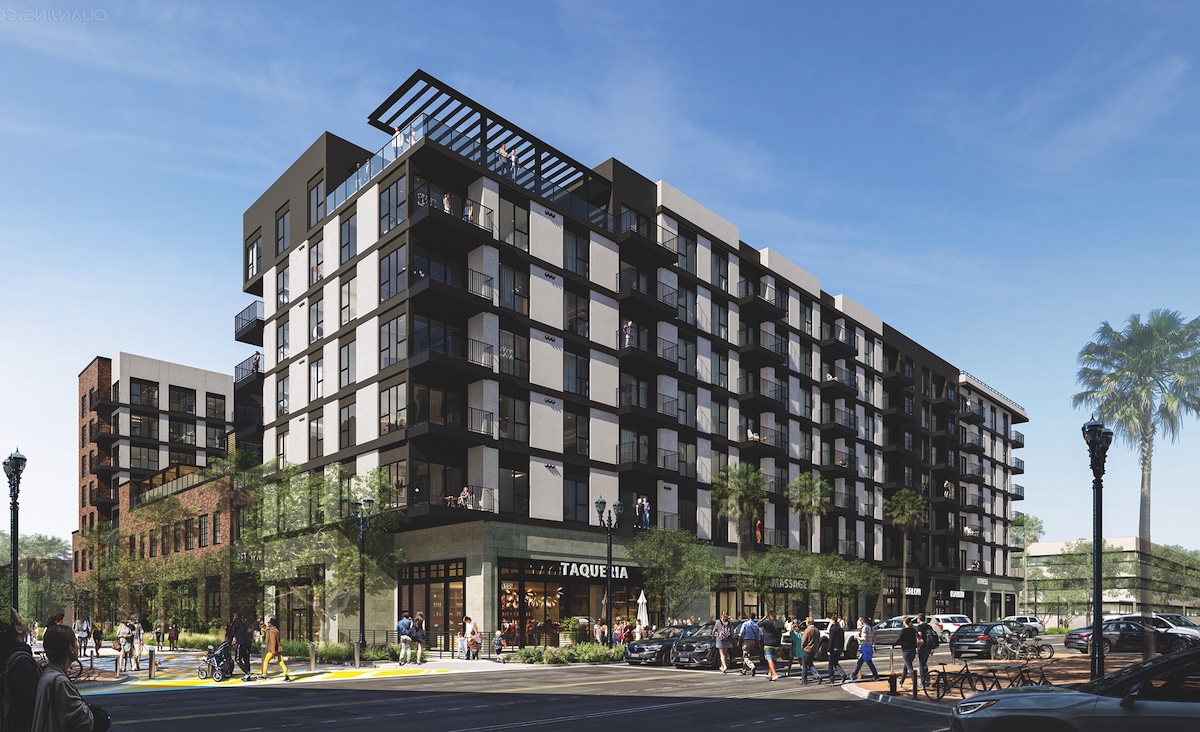
The first phase in the 14-acre redevelopment of former shopping center City Place Long Beach has broken ground following a $150 million close for construction financing.
Led by JPI, this initial phase dubbed Portico will be a 272-unit mixed development with more than 18,000 square feet of ground-floor retail. The larger redevelopment plan – a group venture from Turnbridge Equities, Waterford Property Company and Monument Square Investment Group – will deliver a total of 900 multifamily units with close to 40,000 square feet of commercial space.
Through a combination of investment from Tokyo Tatemono US Ltd. and BMO Bank, the $150 million financing is expected to cover the entirety of Portico’s development costs, said Tyler Mangiafico, vice president of development at JPI.
Largescale adaptive reuse developments have been gaining traction in Los Angeles, as multifamily occupancy remains high while office and certain areas of retail lag behind. In the third quarter, Colliers reported an 11% vacancy rate for large regional malls in Los Angeles County.
When JPI purchased a 1.6-acre portion of the shopping center last year, Mangiafico said the building that Portico will replace had been completely vacant and hadn’t received a payment from a tenant in more than a year.
“Especially in these urban infill areas, adaptive reuse is probably the biggest opportunity that I think we have at this point,” Mangiafico said of the local real estate landscape. “Whether it’s retail or office, there’s plenty of groups that are looking at trying to convert these buildings into multifamily.”
The trio leading the masterplan oversaw the technicalities regarding use conversion and then brought JPI in to work out the specifics of phase one of the redevelopment, Mangiafico said.
For the retail component of Portico, JPI expects to split the 18,841 square feet of space into eight to 10 parcels, though there’s room to make adjustments.
“The way we’ve designed it and the way we’re building it, we can be a little more flexible and upsize or downsize some of the spaces as needed to accommodate specific tenants,” Mangiafico said.
The team expects to lease to a mix of restaurants, cafés, a fitness component and potentially a service-related tenant such as a dog groomer. With an anticipated delivery of 2028 for the project, JPI said it’s too soon to lock in the exact tenants but that they’re working on strategy.
“We’re really trying to deliver an elevated product for residents,” Mangiafico said. “We’ve hired some consultants who are very well regarded to help us plan our retail spaces to maximize the benefit to the residents who live there, but also to all the residents
in the surrounding area that frequent the promenade.”
He sees value in mixed-use developments that play at “the appeal of having a live, work and play environment right in your own building” in downtown Long Beach, noting that these developments don’t always make sense in more suburban markets.
JPI looks forward to exploring similar types of projects both in the Long Beach area but also in other urban, infill areas.
“We’re really excited about further opportunities to help develop in communities that have underutilized existing space,” Mangiafico said.